Time

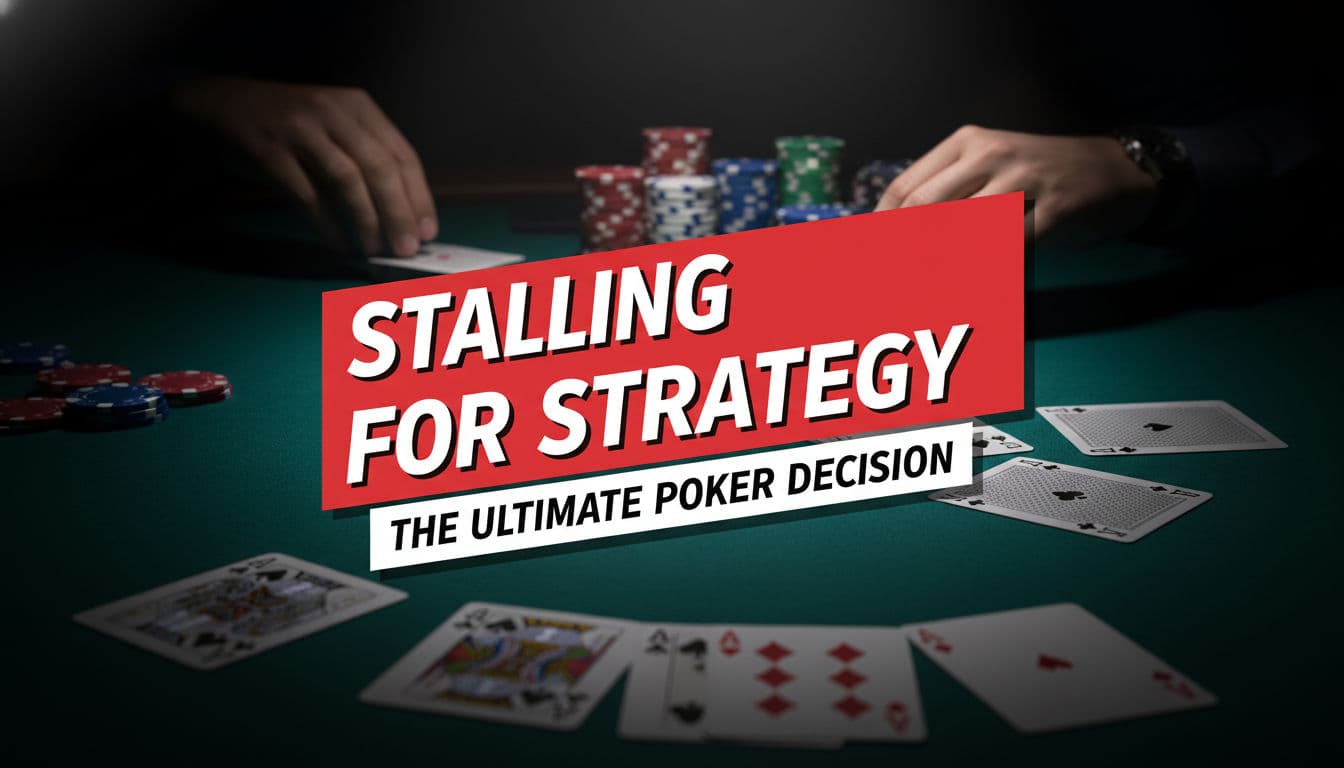
The term Time in poker, deceptively simple, carries a surprisingly rich tapestry of meanings and strategic implications that extend far beyond a mere temporal reference. For the uninitiated, it might seem straightforward, but within the intricate world of poker, Time can signify a critical pause in play, an alternative financial structure for a game, or even a deeply superstitious plea for luck. Understanding these distinct facets is crucial for any player looking to navigate the nuances of both live and online poker environments with expertise and confidence.
This comprehensive guide aims to demystify the various applications of Time in poker. We will dissect its role in decision-making, explore the mechanics of time games as an alternative to traditional rake, and shed light on the intriguing phenomenon of the One Time superstition. By delving into each interpretation, we provide an analytical framework to enhance your strategic acumen, ensuring you're not just playing the game, but mastering its hidden dimensions.
Understanding Time in Poker as a Deliberation Request
At its most fundamental level, Time in poker functions as a formal request for additional moments to contemplate a crucial decision. This action is not a sign of weakness but often an indication of a player facing a complex situation, a substantial pot, or needing to meticulously analyze opponent tells and pot odds. In high-stakes scenarios, where every chip represents a significant sum, a well-timed request for poker decision time can be the difference between a winning play and a costly blunder.
This necessity for reflection is so universal that it’s hard-coded into the world of online poker through the time bank feature, ensuring players have the same opportunity to pause and recalculate when the pressure peaks. It allows a player to step back from the immediate pressure, gather their thoughts, and make a more informed choice.
Live Poker Protocol for Requesting Time
In a live poker setting, the process is straightforward yet governed by unwritten etiquette. A player simply states Time aloud, ensuring the dealer and other players clearly hear the request. This is part of the standard live poker rules time procedures. Upon hearing this, the dealer will typically grant a reasonable extension, often a minute or two, allowing the player to deliberate without feeling rushed.
It's important for players to use this privilege judiciously; excessive or frivolous requests can disrupt the game's flow, frustrate opponents, and may even lead to warnings from the floor manager. Seasoned players often follow a specific poker etiquette decision process, using this delay not just for genuine thought, but sometimes as a strategic ploy - to feign strength or weakness, or to buy time for an opponent to inadvertently reveal a tell.
The Time Bank System in Online Poker
Online poker platforms have evolved a more structured approach to decision-making pauses through the online poker Time Bank system. Instead of verbal requests, players are allocated a finite pool of extra time, typically measured in seconds, that can be drawn upon when facing tough decisions. When a player's regular decision timer expires, their time bank automatically activates, giving them a few extra moments before their hand is folded by default.
This system provides a fair and standardized method for deliberation, preventing the game from stalling indefinitely while still offering players the necessary leeway for complex plays. Strategic management of one's time bank is critical, as it is a limited resource that, once depleted, leaves no further room for extended thought.
Time Game: An Alternative Rake Structure
Beyond its role in decision-making, Time also refers to an entirely different aspect of poker: a poker time game. This denotes a specific fee structure where players are charged a fixed amount based on the duration they play, rather than a percentage of each pot (known as the rake). This hourly rakeor half-hourly fee is collected by the house, irrespective of whether a player wins or loses hands during that period.
Advantages and Disadvantages of Time Games for Players
Time games offer a predictable cost structure, which can be advantageous for players who participate in many pots or those who prefer to play a tight, patient style. For a winning player who consistently takes down small pots, a time game can be more profitable than a raked game where a percentage is taken from every pot won.
Conversely, for players who sit out many orbits or have short, losing sessions, a time game can prove to be a more expensive proposition than a raked game where their losses might be less compounded by fixed fees. It shifts the financial dynamic, rewarding active play and discouraging excessive stalling.
When and Where are Time Games Prevalent?
Time games are less common in mainstream casinos but can frequently be found in high-stakes private cash games, exclusive clubs, or certain international poker rooms. They are particularly favored in environments where a traditional pot-rake system might be impractical or undesirable, such as home games with established players, or very high-limit games where a percentage rake would lead to exorbitant fees, potentially discouraging participation. This structure fosters a different kind of game flow, often encouraging more action as players feel the continuous burn of the hourly fee, incentivizing them to play hands.
The Superstitious Charm of One Time
Separate from the practical applications of Time as a decision-making tool or a game's fee structure, the phrase One Time poker meaningholds a distinct, often humorous, and purely superstitious place in poker lexicon. This phrase is typically uttered by a player who finds themselves in a dire situation - perhaps drawing to an improbable out on the river - and needs a specific card to appear 'just this one time' to win the hand. It's a plea to the poker gods, a hopeful incantation for a miraculous outcome.
While entirely devoid of strategic value, One Time reflects the psychological ebb and flow of poker, where luck, fate, and superstition often intertwine with skill. Players say it with varying degrees of seriousness, often eliciting chuckles from opponents or sometimes a sympathetic nod. It's a testament to the emotional rollercoaster of poker, where moments of despair can quickly turn into elation with a single card, provided the one time wish is granted.
Strategic Implications of Time Usage
The judicious use of Time particularly in its decision-request form, is itself a subtle poker strategy time tool. A player who consistently takes time on every decision might be perceived as a novice, or conversely, as someone trying to induce specific reactions. Taking a long time on a small bet can suggest weakness or uncertainty, while a swift call on a large bet might signal strength.
Masters of poker psychology understand that the duration of a decision can be as informative as the decision itself, providing a layer of meta-gameplay that influences opponents' perceptions and subsequent actions. Managing your pace of play, therefore, becomes another arrow in your strategic quiver.
| Pros | Cons |
|---|---|
Requesting 'time' allows players to thoroughly analyze complex scenarios, calculate odds, and consider opponent behavior, leading to more rational and potentially profitable decisions, especially in high-pressure situations. | Frequent or prolonged 'time' requests can disrupt the pace of the game, frustrate other players, and lead to a less enjoyable experience for the table, sometimes even drawing attention from floor staff in live games. |
In 'time games,' the cost is fixed per hour, which can be advantageous for players who play many hands or for extended periods, potentially costing less than a high-percentage rake in a very active game. | If a player only plays for a short duration or is very inactive, the fixed hourly fee of a 'time game' can become disproportionately expensive compared to a rake-based game where fees are only incurred on won pots. |
The continuous cost of a 'time game' often incentivizes players to engage more actively in hands, as sitting out or folding frequently still incurs the same hourly fee, potentially leading to more dynamic gameplay. | While 'time' can be used for genuine thought, it can also be exploited by players to feign weakness or strength, manipulate opponents, or even slow-roll, which can be considered poor etiquette. |
Related Poker Terms
6-Max
9-Max (Full Ring)
A-Game
ABC Poker
Angle Shooting
Bankroll
Bet Size
Bet Sizing
Blocker
Bluff
Bluff Catcher
Board
Bubble Factor
Button
Call
Check-Call
Check-fold
Check-Raise
Click-Back
Donkament
Double Barrel
First in
Gap Concept
GTO
Gutshot
Hit And Run
Hot Streak
HUD
Image
Insta-Call
Isolation
Kicker
Leak
Limp
Limp-Fold
Limp-Raise
Marked Cards
Middle Pair
Min-raise
Misdeal
Monotone
Monster
Muck
Multi-Way Pot
Neocheating
Nit
Nuts
One Chip Rule
One-Way Straight
Online Poker
Online Poker Strategies
Open Limp
Out Button
Out of Line
Over the top
Over-Limp
Overblind
Overcall
Overcard
Overpair
Pat
Peel
Peg
Play Behind
Played Card
Polarized
Pot Control
Potting Out
Preflop
Premium Hands
Pricking
Probe Bet
Prop
Push or Fold
Range
Royal Flush
Sit and Go (SNG)
Slow Play
Smooth Call
Snap Call
Snapped Off
Soft Play
Soft Seat
Solid
Splash Around
Steal
Suited
Suited Gappers
Tank
Toke
Total air
Trap
Two-Gapper
Under the Gun (UTG)
Underpair
Value
Value Bet
Villain
Weak Ace
Window Card