

Gap Concept

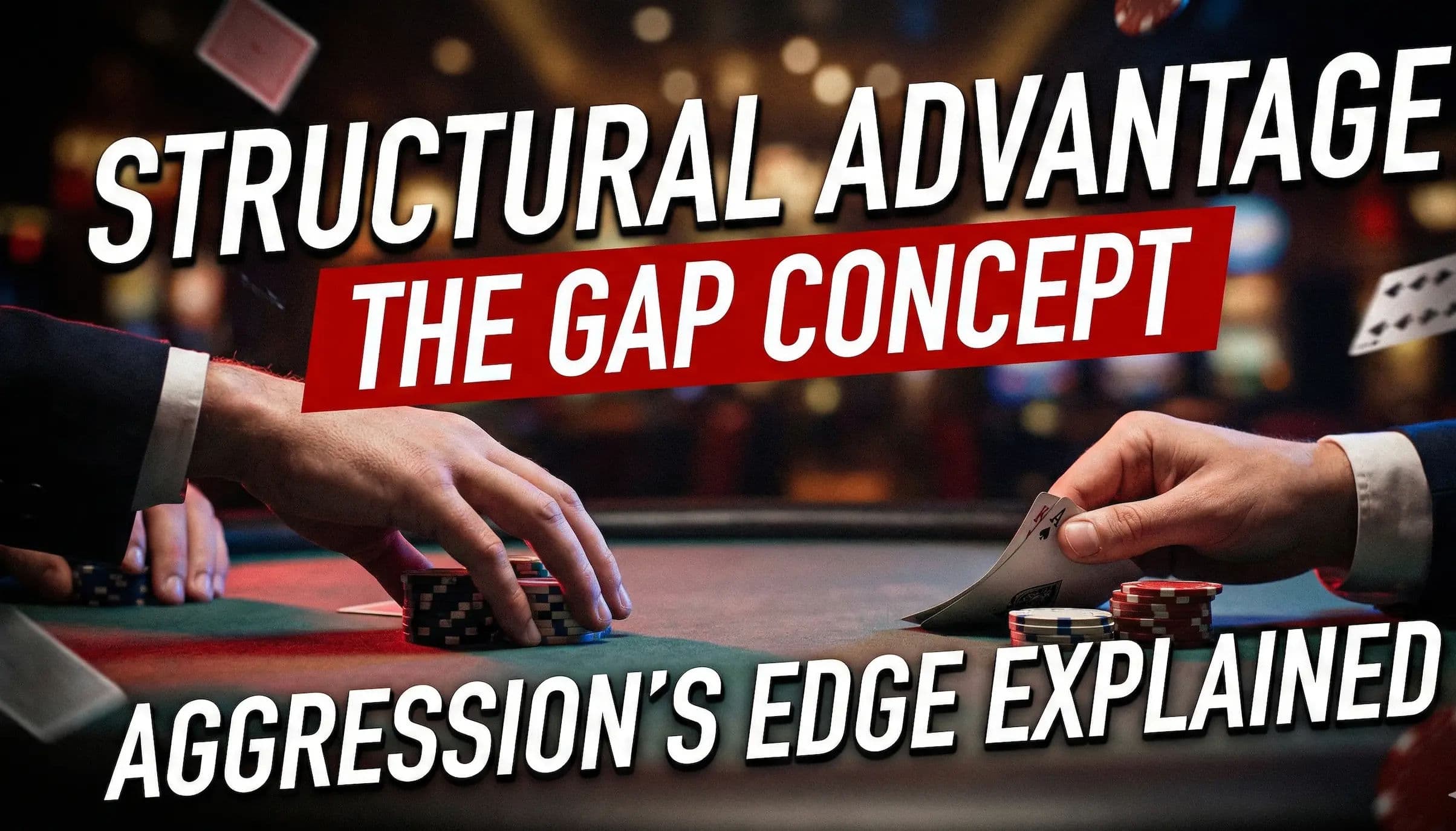
The strategic landscape of poker is rich with foundational theories that, despite the game's evolution, continue to underpin sound decision-making. Among these, David Sklansky's "Gap Concept", first articulated in his seminal work Tournament Poker for Advanced Players, stands out as a timeless principle. This concept asserts a critical tactical truth: a player typically requires a stronger hand to merely call an opponent's pre-flop raise than they would to initiate the opening raise themselves. This isn't just about hand strength; it's a profound insight into the psychological leverage and inherent advantages conferred upon the aggressor, guiding players towards more disciplined calling ranges and a proactive playing style. Understanding this fundamental disparity in required hand equity is paramount for anyone looking to refine their pre-flop strategy and cultivate a more profitable approach to the game.
The 'Gap Concept Poker' Explained: Aggression's Edge
The essence of the gap concept poker lies in recognizing the distinct paths to victory available to the aggressor versus the caller. When a player initiates a raise, they possess two fundamental ways to win the pot: either by holding the strongest hand at showdown or, more frequently, by inducing opponents to fold before the showdown.
This latter scenario, known as "folding equity", is a powerful advantage that the caller simply doesn't have. The caller's primary, and often sole, path to victory is by having the superior hand at showdown. Originally popularized through the David Sklansky Gap Concept, this foundational idea reshaped modern poker pre-flop strategy by emphasizing the structural advantage of aggression.
Consequently, to offset the absence of folding equity and to counteract the implied strength communicated by the opponent's pre-flop aggression, the calling hand must perform favorably against the opponent’s raising range. This difference in required hand strength - the "gap" - is a crucial metric for evaluating pre-flop decisions. It serves as a reminder that merely having a playable hand isn't always sufficient; the context of the action dictates true playability. Understanding how your poker calling range compares to an opponent’s poker raising strategy is essential when applying this concept in real time.
Dynamic Factors Influencing the Gap
The magnitude of this strategic gap is far from static; it dynamically adjusts based on a confluence of critical factors at the poker table. Mastering these nuances allows for a more adaptive and exploitative application of the concept.
Opponent's Playing Style
Against a tight, conventional player who typically raises with a narrow, robust range of premium hands (e.g., AA, KK, QQ, AK), the gap widens considerably. Here, calling with speculative or marginal hands becomes exceptionally risky, as your opponent is signaling genuine strength. Conversely, when facing a loose-aggressive (LAG) player or a habitual bluffer who frequently raises with a much broader and weaker range, the gap effectively shrinks, or may even vanish. In such scenarios, you might find profitable opportunities to call with a wider array of hands, or even re-raise, as the aggressor's range is less defined and often includes weaker holdings. Player profiling and accurate reads are therefore integral to effectively calibrating your calling strategy.
Positional Advantage
Position is arguably the most powerful non-card factor in poker, and its influence on the Gap Concept is profound. A player who open-raises from an early position (e.g., Under the Gun, UTG+1) is inherently communicating a stronger hand. This is because they must act before many other players, who could potentially hold even stronger hands. The more players yet to act, the greater the likelihood someone will wake up with a premium holding, thus necessitating a tighter opening range.
As such, the gap for calling an early position raise is significant. Conversely, a raise from a late position (e.g., Cutoff, Button) can be made with a much wider range of hands, as fewer opponents remain to act, and the positional advantage allows for more speculative plays or steals. Consequently, the gap for calling a late position raise is considerably smaller.
Tournament Stage and Stack Sizes
The Gap Concept finds particular resonance in tournament poker, where chip accumulation and survival are paramount. In the later stages of a tournament, or when approaching critical junctures like the bubble, blinds and antes become substantial relative to stack sizes. When a player's tournament life is on the line, the decision to call a raise demands an exceptionally strong hand. The potential for elimination amplifies the required hand strength, widening the gap dramatically.
Short-stack dynamics often lead to push-or-fold situations, where the gap becomes less about calling and more about the hand strength required to jam over an open. Understanding Independent Chip Model (ICM) implications further refines how the gap is perceived in tournament play. This is why the gap concept plays a central role in advanced tournament poker strategy, particularly when survival and pay jumps influence optimal decisions.
Number of Players
The number of active players at the table also directly impacts the gap. In a full-ring game (9-10 players), the probability of another player holding a strong hand is higher, thus requiring a tighter calling range and a wider gap. As the table shortens (e.g., 6-max, heads-up), the likelihood of a premium hand appearing elsewhere diminishes. This allows players to open-raise with a broader range, and consequently, the gap for calling becomes smaller, as there are fewer potential strong hands to contend with.
Modern Relevance in a GTO Era
Players who want to apply structured pre-flop concepts like the gap concept in real-game environments often compare leading online poker sites to find tables that reward disciplined aggression and strategic range construction.
While the Gap Concept originated decades ago, long before the advent of sophisticated poker solvers and Game Theory Optimal (GTO) strategies, its underlying principles remain profoundly relevant. Modern GTO poker principles, though more complex and finely tuned, implicitly validate the core idea of the gap.
GTO strategies emphasize range construction, where open-raising ranges are typically wider than calling ranges, especially against early position opens. The Gap Concept essentially provides an intuitive, conceptual framework for understanding the fundamental advantages of initiative and position, elements that are mathematically proven in GTO.
At its core, the gap concept poker framework is poker aggression explained in structural terms: the player with initiative applies pressure, while the caller must compensate with stronger hand strength. By promoting selective aggression and prudent calling, it fosters a long-term profitable playing style, helping players effectively manage risk and exploit opponents who fail to grasp these fundamental dynamics. It's not a replacement for GTO, but a foundational insight that helps contextualize GTO's more intricate solutions.
| Pros | Cons |
|---|---|
Encourages players to be highly selective when calling raises, minimizing costly errors with weak or dominated hands and preserving chips. | The concept, if applied too rigidly, might oversimplify complex poker situations and lead to missed opportunities for profitable calls against certain player types or board textures. |
Underscores the significant advantage of being the aggressor, allowing for wins without showdown (folding equity) and applying pressure on opponents. | While its principles align with GTO, the Gap Concept is a heuristic, not a mathematically derived optimal strategy, and doesn't account for every variable. |
Teaches players to adjust their calling ranges based on opponent tendencies (tight vs. loose-aggressive), enabling more effective exploitation. | Primarily a pre-flop concept, its direct applicability diminishes post-flop where board texture, stack-to-pot ratio, and other dynamics become more dominant factors. |
Provides a basic, yet powerful, framework for understanding fundamental poker dynamics that remain relevant even in modern GTO contexts. | Effectively adjusting the "gap" against different opponents relies heavily on accurate player reads and profiling, which can be challenging for less experienced players. |
Related Poker Terms
6-Max
9-Max (Full Ring)
A-Game
ABC Poker
Bankroll
Bet Size
Bet Sizing
Blocker
Bluff
Bluff Catcher
Board
Bubble Factor
Button
Call
Check-Call
Check-fold
Check-Raise
Click-Back
Donkament
Double Barrel
First in
Gap Concept
GTO
Gutshot
Hot Streak
HUD
Image
Insta-Call
Isolation
Kicker
Leak
Limp
Limp-Fold
Limp-Raise
Middle Pair
Min-raise
Monotone
Monster
Multi-Way Pot
Nit
Nuts
One-Way Straight
Online Poker
Online Poker Strategies
Open Limp
Out of Line
Over the top
Over-Limp
Overblind
Overcall
Overcard
Overpair
Pat
Peel
Play Behind
Polarized
Pot Control
Potting Out
Preflop
Premium Hands
Probe Bet
Proposing Bets
Push or Fold
Put Down
Quads
Quartered
Quitting Time
Quorum
Ragged
Range
Range Advantage
Razz
Reverse Implied Odds
Rolled Up
Royal Flush
Runner Runner
Running Good
Sandbagging
Satellite
Sit and Go (SNG)
Slow Play
Smooth Call
Snap Call
Snapped Off
Soft Seat
Solid
Steal
Suited
Suited Gappers
Tank
Total air
Trap
Two-Gapper
Under the Gun (UTG)
Underpair
Value
Value Bet
Villain
Weak Ace
Window Card
Best Online Poker Bonus Codes


About the Editor

Bence Mitykó is a Somuchpoker poker writer, covering poker news and strategy. He spent four years playing poker professionally, primarily focusing on Heads-Up Sit & Go games, experience that continues to shape his understanding of poker strategy, online poker dynamics, and the wider poker industry.


