

Total air

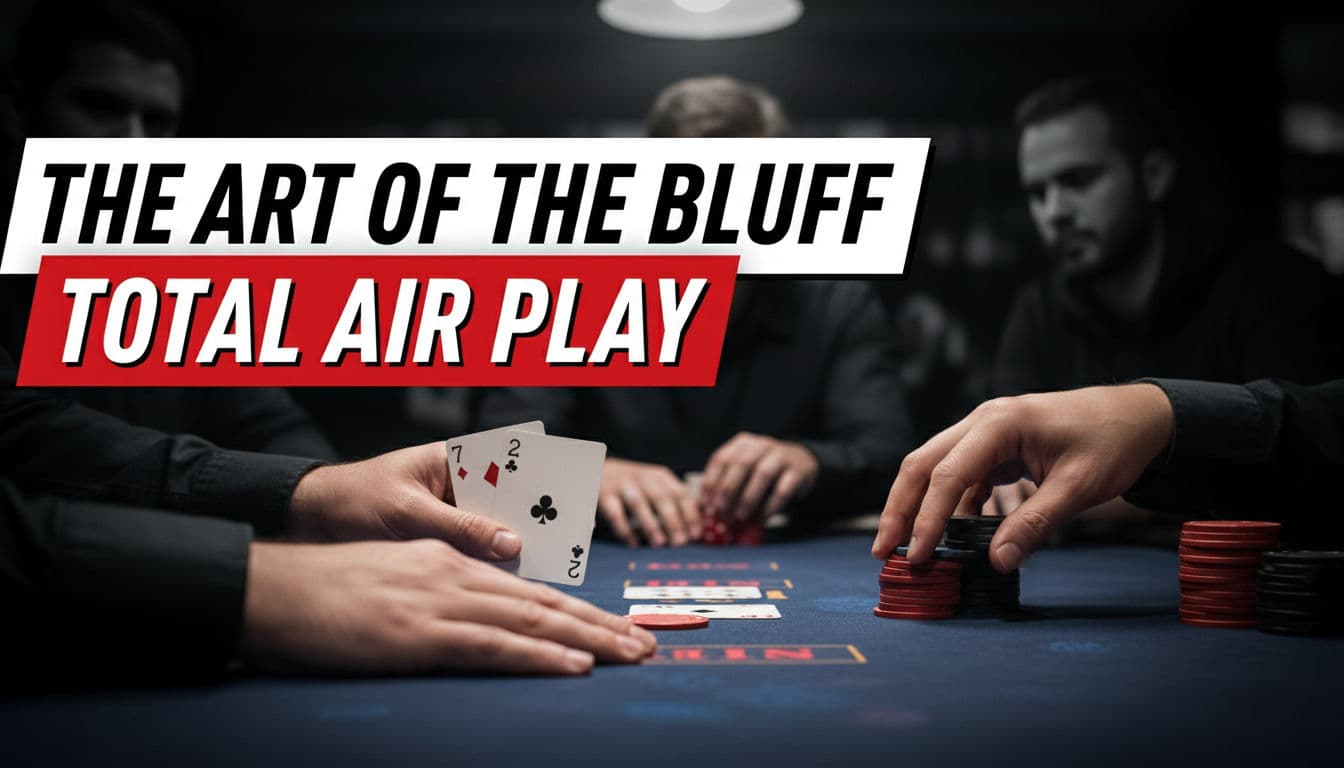
In poker, total air describes a hand that has absolutely no value at showdown and no potential to improve to a winning hand. It is the foundation of a pure, complete bluff, where the only way to win the pot is by forcing all your opponents to fold their cards. Understanding when and how to wield this high-risk, high-reward strategy can dramatically change your table presence.
What Exactly is Total Air in Poker?
When you hear a player say they had total air, it means their hand was completely worthless. This isn't just a weak hand; it's a hand with zero showdown value and no live draws to a better hand. For example, holding 7-2 offsuit on a board of K-Q-J rainbow is a classic case of total air. You have no pair, no straight draw, and no flush draw. Your only path to victory is through a successful bluff.
This concept is crucial for understanding the different types of bluffs in poker. A bet with total air is a pure bluff or a complete bluff. It stands in stark contrast to a semi-bluff, where a player bets with a hand that is currently weak but has the potential to improve to a very strong hand, like a flush or straight draw.
Total Air vs. A Semi-Bluff
The key difference lies in equity. A hand with total air has virtually 0% equity if called; you will lose the pot at showdown. A semi-bluff, however, has fold equity (the chance your opponent folds) plus drawing equity (the chance you hit your card and make the best hand). This makes semi-bluffing a fundamentally lower-risk play than bluffing with a nothing hand.
The Strategy of Bluffing with a Nothing Hand
Pulling off a successful bluff with air is one of the most satisfying plays in poker, but it requires careful planning and observation. It's not about randomly firing bets; it's a calculated risk based on several factors.
A great bluff tells a believable story. Your betting actions across the streets must be consistent with the strong hand you are trying to represent. If your story has holes, a good opponent will pick it apart.
Factors for a Successful Bluff
Opponent Tendencies: The ideal target for a pure bluff is a tight, thinking player who is capable of folding a decent hand. Avoid bluffing 'calling stations' who will call down with any pair.
Board Texture: Dry, uncoordinated boards (like A-9-4 rainbow) are much better for bluffing than wet, connected boards (like J-T-9 of two suits). Wet boards offer many more drawing possibilities for your opponent, making them less likely to fold.
Your Table Image: If you've been playing tight and only showing down strong hands, a bluff is more likely to be believed. If you've been caught bluffing before, opponents will be more suspicious.
Position: Bluffing from late position is always preferable. Acting last gives you the maximum amount of information about your opponents' hand strength before you have to commit chips.
Successfully executing advanced bluffs requires playing against the right mix of opponents in a reliable online poker environment. You can explore our list of the best online poker sites to find the most profitable platforms and secure top-tier welcome packages to support your gameplay.
The Risks and Rewards of a Pure Bluff
Deciding to pull the trigger with total air involves weighing the potential outcomes. It's a high-variance play that can significantly impact your chip stack and table dynamics.
Aspect | Risk | Reward |
|---|---|---|
Chip Stack | If your bluff is called, you lose all the chips you committed to the pot with no chance of winning. | You win the entire pot without ever needing to show your cards, adding valuable chips to your stack. |
Table Image | Getting caught can label you as a bluffer, making it harder to get paid off on your future value hands. | A successful bluff instills fear and uncertainty in opponents, which can cause them to fold to you more often. |
Information | A failed bluff gives your opponents information about your tendencies and willingness to play with nothing. | Winning uncontested keeps your hand a mystery and your strategy less predictable. |
Ultimately, using total air as a weapon is an advanced strategy. While it's a powerful tool in a skilled player's arsenal, it should be used selectively. Mastering the art of the complete bluff requires discipline, keen observation, and the courage to put your chips on the line with absolutely nothing.
| Pros | Cons |
|---|---|
The primary advantage is the ability to win a pot you have no statistical right to. It adds another way to accumulate chips beyond simply waiting for premium hands. | If your bluff gets called, you lose 100% of the time. This can be a devastating blow to your stack, especially in a tournament setting. |
Successfully bluffing with total air makes you unpredictable. Opponents will have a harder time putting you on a hand, which can help you get paid off more when you have a strong value hand. | Pure bluffs do not work against 'calling stations'—players who rarely fold. Attempting to bluff these opponents is often a recipe for disaster. |
Related Poker Terms
6-Max
9-Max (Full Ring)
A-Game
ABC Poker
Bankroll
Bet Size
Bet Sizing
Blocker
Bluff
Bluff Catcher
Board
Bubble Factor
Button
Call
Check-Call
Check-fold
Check-Raise
Click-Back
Donkament
Double Barrel
First in
Gap Concept
GTO
Gutshot
Hot Streak
HUD
Image
Insta-Call
Isolation
Kicker
Leak
Limp
Limp-Fold
Limp-Raise
Middle Pair
Min-raise
Monotone
Monster
Multi-Way Pot
Nit
Nuts
One-Way Straight
Online Poker
Online Poker Strategies
Open Limp
Out of Line
Over the top
Over-Limp
Overblind
Overcall
Overcard
Overpair
Pat
Peel
Play Behind
Polarized
Pot Control
Potting Out
Preflop
Premium Hands
Probe Bet
Proposing Bets
Push or Fold
Put Down
Quads
Quartered
Quitting Time
Quorum
Ragged
Range
Range Advantage
Razz
Reverse Implied Odds
Rolled Up
Royal Flush
Runner Runner
Running Good
Sandbagging
Satellite
Sit and Go (SNG)
Slow Play
Smooth Call
Snap Call
Snapped Off
Soft Seat
Solid
Steal
Suited
Suited Gappers
Tank
Total air
Trap
Two-Gapper
Under the Gun (UTG)
Underpair
Value
Value Bet
Villain
Weak Ace
Window Card
Best Online Poker Bonus Codes


About the Editor

Bence Mitykó is a Somuchpoker poker writer, covering poker news and strategy. He spent four years playing poker professionally, primarily focusing on Heads-Up Sit & Go games, experience that continues to shape his understanding of poker strategy, online poker dynamics, and the wider poker industry.


