

Quads

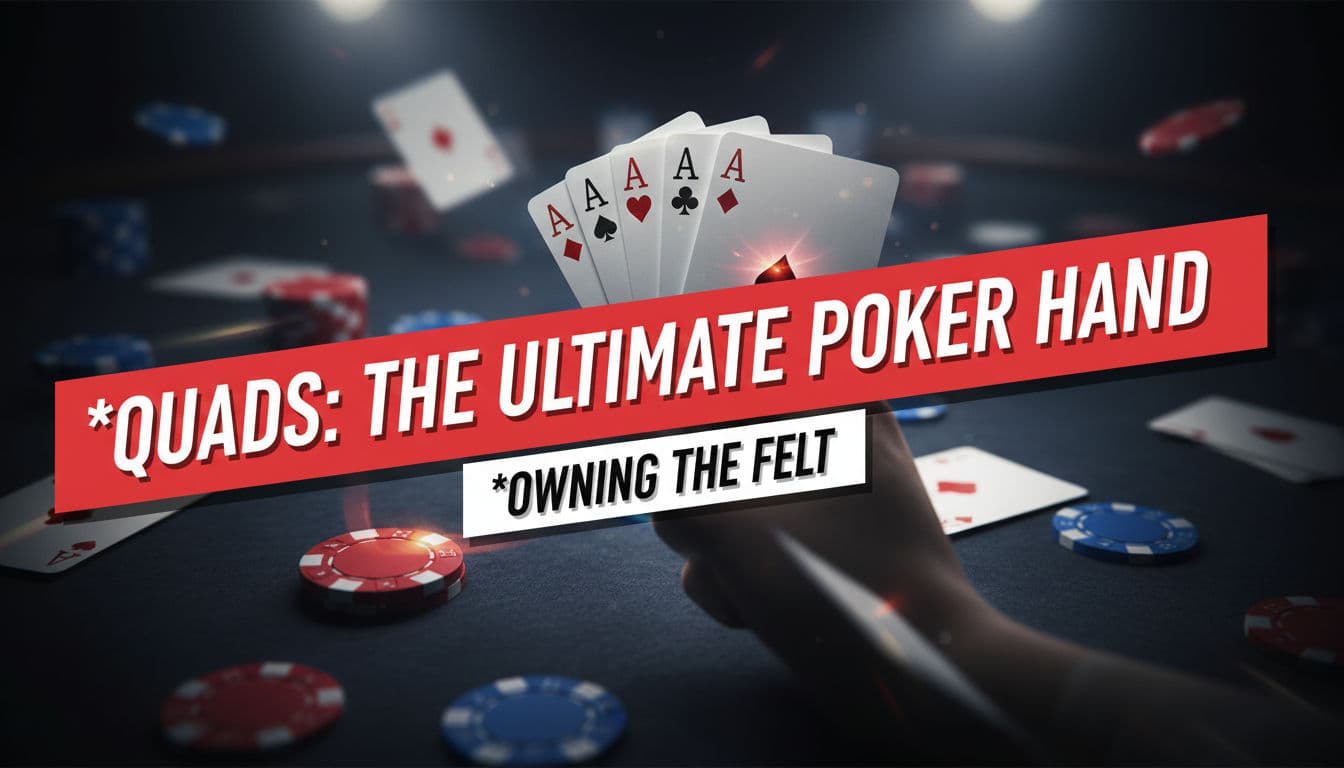
In the intricate landscape of poker, where probabilities and psychology intertwine, few hands command as much awe and strategic consideration as 'Quads,' or four-of-a-kind. Representing an exceedingly rare statistical anomaly, quads signify a near-unbeatable hand, surpassed only by the most elusive straight and royal flushes. However, the true mastery of playing quads extends far beyond merely holding these four identical ranks; it involves a nuanced understanding of board dynamics, opponent psychology, and astute pot management to maximize value without alerting your adversaries. This expert guide delves deep into the strategic intricacies of identifying, understanding, and expertly playing quads to ensure optimal chip accumulation.
Strategies for Playing Quads Poker Hands
In the realm of quads poker, achieving a 'Quad,' or 'four-of-a-kind,' stands as an exceptionally potent achievement, consisting of four cards of the same rank (e.g., four Aces, four Kings, four Fives). Its inherent strength lies in its statistical rarity and its ranking, which places it second only to the illustrious straight flush and royal flush in most conventional poker variants like Texas Hold'em . To illustrate, if a player holds 9♥9♣ and the community cards reveal 9♦9♠3♣, they have achieved quads on the flop – an almost insurmountable position.
While hitting such a monster hand is rare, many players look for the best bonus codes to boost their bankroll, giving them more opportunities to see the flops where these legendary combinations can occur.
Probability, Rarity, and Poker Odds
The probability of being dealt or hitting quads is remarkably low, contributing to its mystique and power. In Texas Hold'em, the odds of being dealt a pocket pair and then hitting another two of that rank on the flop are approximately 0.25% (or 1 in 408). This extreme rarity means that when you do achieve quads, you hold a hand with significant implicit value, demanding a carefully considered strategic approach. The beauty of the quads poker is not just their statistical improbability but the near-absolute certainty of victory they provide against almost any other conceivable holding.
Quad Scenarios in Play
Quads can materialize in a few distinct ways:
With a Pocket Pair: Holding a pocket pair (e.g., J J) and two more of that rank appearing on the board (e.g., J J 7 2).
With One Card from Hand: Holding a single card (e.g., A) when three other Aces appear on the community board (e.g., A A A K 5).
Quads on the Board: All four cards of the same rank appear in the community cards (e.g., K K K K 7). This scenario has unique implications, often leading to split pots.
Strategic Play with Quads in Texas Holdem: Maximizing Value
When you hold quads in Texas Holdem, your primary objective shifts from merely winning the hand to extracting the maximum possible value from your opponents. This requires a nuanced understanding of board texture, opponent tendencies, and calculated betting patterns.
Slow Play vs. Fast Play: A Delicate Balance
The decision to slow-play or fast-play your quads poker hand is paramount:
Slow Play (Trapping): This four of a kind strategy involves checking or making small bets in early streets to entice opponents to build a pot with weaker hands or even to bluff. By exercising a form of poker pot control in the early stages, you avoid scaring off opponents, keeping them invested on 'dry' boards (unlikely to complete strong draws). The goal of this deceptive poker pot control is to give them false hope or encourage bluffs that you can then punish with a substantial raise on later streets.
Fast Play (Aggressive Betting): On 'wet' or coordinated boards (e.g., with potential straight or flush draws), a more aggressive approach might be necessary. Betting large or raising quickly can protect your hand against improbable but devastating straight flushes, and it forces opponents to pay to see future cards. This is also suitable when opponents are likely to call down with weaker holdings or drawing hands.
Reading Opponents and Board Texture
Your strategic choices must be informed by external factors:
Opponent Profiling: Are your opponents loose-aggressive (LAG) and likely to pay off big bets, or tight-passive (TAG) and will fold to significant pressure? Tailor your bet sizing and aggression accordingly. LAGs are prime targets for large value bets, while TAGs might require more subtle inducement.
Board Texture Analysis: Consider the potential for other strong hands. A board with three to a flush or four to a straight (e.g., 7♠8♠9♠T♦) might mean opponents have strong draws or even a completed straight/flush, making them more likely to call large bets. Conversely, a disconnected board (e.g., 2♥7♣Q♦) might indicate less willingness from opponents to continue without a strong hand, necessitating a more cautious value extraction.
Bet Sizing for Maximum Impact
Avoid obvious bet sizing that screams strength. A normal-sized bet can often look like a bluff or a standard value bet, encouraging calls. Over-betting the pot can sometimes work against highly aggressive players who might perceive it as a bluff, but often it just scares weaker hands away.
Navigating Unique Quad Scenarios
While quads are overwhelmingly powerful, specific circumstances demand careful attention.
Quads on the Community Board
A critical scenario arises when all four cards of the same rank appear on the community board (e.g., 8♣8♦8♥8♠K♦). In this situation, *every* player remaining in the hand automatically uses the four eights as part of their five-card hand. The fifth card, the 'kicker,' determines the winner. If you hold an Ace and the board is 8888K, you would have 8888A. If an opponent holds a Queen, they would have 8888Q. In this case, your Ace kicker would win. If multiple players have the same highest kicker, the pot is split. If no player has a kicker higher than the fifth community card, the pot is split among all players using the full board.
The Psychological Edge
Due to the extreme rarity of quads, opponents often find it difficult to believe you actually hold them, even when your betting suggests immense strength. This psychological disbelief can be a powerful tool, allowing you to extract larger pots than you might with other strong but more common hands.
| Pros | Cons |
|---|---|
Quads are one of the absolute strongest hands in poker, only losing to a straight flush or royal flush, making them a very high-probability winner at showdown. | The immense strength can be too obvious, leading opponents to fold weaker hands prematurely, thus limiting the pot size if played too aggressively. |
The rarity and perceived strength of quads allow for significant value extraction through strategic betting, leading to larger pots. | Quads are an infrequent hand, meaning opportunities to employ advanced strategies for them are few and far between. |
Opponents often struggle to believe you hold quads due to their rarity, which can be exploited to get more calls or induce bluffs. | If all four cards of the same rank appear on the community board, the pot is split among players with the best kicker, diminishing the individual payout. |
Related Poker Terms
6-Max
9-Max (Full Ring)
A-Game
AAAKKK
ABC Poker
AKQJT
Bankroll
Bet Size
Bet Sizing
Blocker
Bluff
Bluff Catcher
Board
Broadway
Bubble Factor
Button
Call
Check-Call
Check-fold
Check-Raise
Click-Back
Donkament
Double Barrel
First in
Flush
Full House
Gap Concept
GTO
Gutshot
Hand Rankings
Hot Streak
HUD
Image
Insta-Call
Isolation
Kicker
Leak
Limp
Limp-Fold
Limp-Raise
Middle Pair
Min-raise
Monotone
Monster
Multi-Way Pot
Nit
Nuts
One-Way Straight
Online Poker
Online Poker Strategies
Open Limp
Out of Line
Over the top
Over-Limp
Overblind
Overcall
Overcard
Overpair
Pair
Pat
Peel
Play Behind
Pocket Pair
Polarized
Pot Control
Potting Out
Preflop
Premium Hands
Probe Bet
Proposing Bets
Push or Fold
Put Down
Range
Royal Flush
Second Pair
Sit and Go (SNG)
Slow Play
Smooth Call
Snap Call
Snapped Off
Soft Seat
Solid
Split Two Pair
Steal
Straight Flush
Suited
Suited Gappers
Tank
Total air
Trap
Trips
Two-Gapper
Under the Gun (UTG)
Underpair
Value
Value Bet
Villain
Weak Ace
Wheel
Window Card
Best Online Poker Bonus Codes


About the Editor

Bence Mitykó is a Somuchpoker poker writer, covering poker news and strategy. He spent four years playing poker professionally, primarily focusing on Heads-Up Sit & Go games, experience that continues to shape his understanding of poker strategy, online poker dynamics, and the wider poker industry.


