One-Way Straight

A "one-way straight" also frequently termed a "one-end straight" or "straight draw to one end" represents a specific type of four-card straight formation in poker where the sequence can only be completed by a single rank of card at one extremity. Unlike more versatile open-ended straight draws that offer two possible ranks for completion, a one-way straight draw presents a more constrained path to improvement. Understanding the nuances of these draws is absolutely critical for any player aspiring to elevate their strategic acumen, as it directly impacts decision-making regarding pot odds, implied odds, and overall hand equity. This expert guide delves deep into the characteristics, strategic implications, and proper evaluation of one-way straight draws, helping you discern when to pursue them and when to wisely fold.
Deconstructing the One-Way Straight Poker Draw
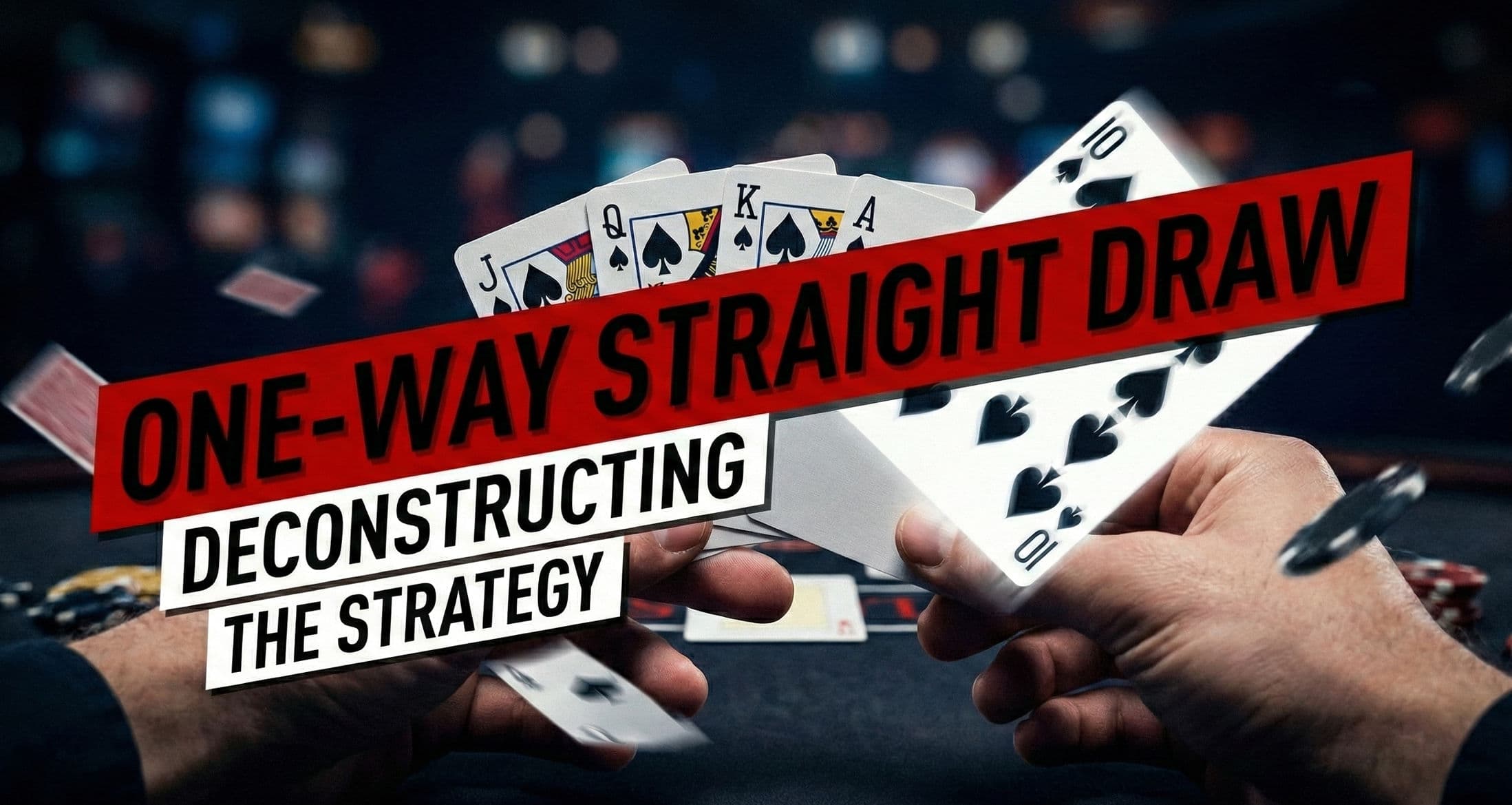
At its core, a one-way straight poker draw involves holding four cards in sequence, but only one specific card rank can complete the five-card straight. A classic example is holding J-Q-K-A. To form a straight, you exclusively need a Ten. No Nine or Queen (for instance) would extend this particular sequence into a five-card straight. Similarly, a one-end straight draw like A-2-3-4 would only complete a straight with a Five.
This contrasts sharply with an open-ended straight draw (OESD), such as 7-8-9-T, where either a Six or a Jack would complete the straight. An OESD provides eight outs (cards that complete your hand), while a one-way straight poker draw offers only four. These four outs correspond to the four cards of the specific rank needed (e.g., the four Tens in a J-Q-K-A scenario).
Understanding the stark difference in profitability between these two types of texas hold'em draws is a fundamental skill for anyone looking to maintain a winning edge in the competitive landscape of online poker .
The Mathematics of Outs and Probabilities
The fundamental difference in outs profoundly impacts the straight draw odds. With 4 outs, your chances of completing the straight on the next card (e.g., turn or river) are significantly lower compared to an 8-out OESD:
From Flop to Turn (with 4 outs): Approximately 4/47 (8.5%)
From Turn to River (with 4 outs): Approximately 4/46 (8.7%)
From Flop to River (with 4 outs, over two cards): Approximately 16.5%
Compare these to an OESD's probabilities (roughly 17% from flop to turn, 17.4% from turn to river, and 31.5% from flop to river), and the disparity becomes evident. This mathematical reality underscores why texas hold'em draws of the one-way variety demand a more conservative and calculated approach.
Strategic Implications for Expert Play
Navigating one-way straight draws effectively requires a deep understanding of poker dynamics, moving beyond simple card counting to encompass pot odds in poker, implied odds, and opponent tendencies.
Evaluating Pot Odds and Implied Odds
Given the reduced number of outs, directly calling bets with only a one-end straight draw often isn't mathematically sound based solely on pot odds in poker. Pot odds represent the ratio of money in the pot to the cost of your call. If the pot offers 5:1 odds (you need to pay $10 to win $50), and your chance of hitting is 8.5% (roughly 11:1), then a direct call is unprofitable.
However, implied oddscan sometimes justify a call. Implied odds consider not just the money currently in the pot, but also the additional money you expect to win if you hit your draw. If you are confident your opponent will pay you off with a significant stack if you complete your straight, a call might be warranted. This confidence hinges on:
Opponent's Stack Size: Do they have enough chips to make a big payout worthwhile?
Opponent's Tendencies: Are they likely to call big bets with a worse hand, or will they fold?
Board Texture: Will your straight be obvious or well-disguised?
Position and Hand Disguise
Playing one-way straight draws from in position is generally more advantageous. Being the last to act allows you to gather more information, control the pot size, and potentially check back to see a free card if no one bets. Out of position, you are often forced to check/fold or check/call, giving your opponent more control.
A one-way straight poker hand can sometimes be a well-disguised monster. If your hand completes a less obvious straight (e.g., T-J-Q-K-A where the Ten comes on the river, and the board doesn't obviously scream straight), you might get significant action from players holding two pair, sets, or even flushes.
Combination Draws and Board Interaction
The true strength of a one-way straight draw often emerges when it combines with other elements, transforming it into a combination draw. For instance, if you have a one-way straight draw along with an overpair, top pair, or even a flush draw, your overall poker equity significantly increases. A hand like K-Q on a J-T-X board gives you a one-way straight draw (needing an A) and two overcards. If you also had two spades and two spades were on the board, you'd have both a one-way straight and a flush draw, drastically boosting your odds.
When to Fold or Bluff
If you are out of position, facing a large bet, and lack significant implied odds poker or additional equity, folding a one-way straight draw is often the correct, disciplined play. Chasing these draws blindly can quickly deplete your chip stack.
Alternatively, in specific situations, a one-way straight draw can be used as a bluffing tool. If the board becomes very scary (e.g., straight-completing cards appear) and you're in position, a well-timed bluff can sometimes force opponents off stronger hands, especially if they perceive you could have hit a bigger hand.
Advanced Considerations: Reverse Implied Odds and Blocking Cards
A crucial concept in advanced poker play related to one-way straight draws is reverse implied odds. This occurs when you hit your straight, but it's the absolute bottom of the straight, and an opponent has a higher straight, a flush, or a full house.
For example, if you hold 5-6 on an A-2-3-4 board and hit your 5, you have A-2-3-4-5. However, if an opponent has 6-7, they have 3-4-5-6-7, a higher straight. In such scenarios, hitting your draw can lead to losing a large pot, which makes the draw less valuable. Consider blocking cards as well; if some of the cards that would complete your straight are already in your hand, your equity might be lower than it appears.
Mastering the One-Way Straight
The one-way straight draw is a seemingly simple concept with profound strategic implications. Its lower probability of completion compared to open-ended draws demands a more judicious approach, emphasizing the critical interplay of pot odds in poker, implied odds poker, and position.
By integrating these analytical frameworks into your game, you can transform a potentially costly chase into a calculated decision, distinguishing yourself as a truly expert player. Learning how to play straight draws and mastering these nuanced situations is not just about understanding the cards; it's about understanding the game at a deeper, advanced poker play level, as outlined in this professional poker strategy guide.
| Pros | Cons |
|---|---|
When a one-way straight completes, especially if the board texture doesn't overtly suggest a straight, it can be a well-disguised hand that leads to larger payouts from opponents who don't suspect it. | With only 4 outs, the probability of completing a one-way straight is significantly lower than open-ended straight draws (8 outs), making it an infrequent hit. |
Its value significantly increases when combined with other draws (e.g., an overpair, top pair, or a flush draw), creating a powerful combination draw with enhanced equity. | Chasing these draws without strong implied odds or additional equity is often mathematically unsound and can lead to consistently losing money in the long run. |
Hitting a one-way straight, particularly if it's the bottom end, can expose you to losing a large pot if an opponent holds a higher straight, a flush, or a full house. |
Related Poker Terms
6-Max
9-Max (Full Ring)
A-Game
ABC Poker
Backdoor Flush
Backdoor Straight
Bankroll
Bet Size
Bet Sizing
Blocker
Bluff
Bluff Catcher
Board
Bubble Factor
Button
Call
Check-Call
Check-fold
Check-Raise
Click-Back
Donkament
Double Barrel
Downswing
Effective Stack
Equity
Expected Value (EV)
First in
Gap Concept
GTO
Gutshot
Hot Streak
HUD
ICM
Image
Implied Odds
Insta-Call
Isolation
Kicker
Leak
Limp
Limp-Fold
Limp-Raise
Middle Pair
Min-raise
Monotone
Monster
Multi-Way Pot
Nit
Nuts
Odds
One-Way Straight
Online Poker
Online Poker Strategies
Open Limp
Out of Line
Outs
Over the top
Over-Limp
Overblind
Overcall
Overcard
Overpair
Pat
Peel
Play Behind
Polarized
Pot Committed
Pot Control
Pot Odds
Preflop
Price
Push or Fold
Range
RFI (Raise First In)
ROI
Royal Flush
Sit and Go (SNG)
Slow Play
Smooth Call
Snap Call
Snapped Off
Soft Seat
Solid
Steal
Suited
Suited Gappers
Tank
Total air
Tournament Fee
Trap
Two-Gapper
Under the Gun (UTG)
Underpair
Upswing
Value
Value Bet
Variance
Villain
Weak Ace
Window Card