

Two-Way Hand

In the intricate world of poker, understanding and exploiting drawing hands is fundamental to long-term success. Among these, the 'two-way hand' stands out as a particularly potent weapon in a player's arsenal. Far more than just a simple draw, a two-way hand offers dual pathways to making a strong, often winning, combination. This expert guide delves deep into the mechanics, strategic implications, and profitable execution of two-way hands, equipping you with the knowledge to maximize your equity and turn marginal situations into significant wins.
The Power of the Two-Way Hand Poker Strategy
A two-way hand poker situation refers to a holding on the flop or turn that provides two strong drawing possibilities simultaneously. The most classic and powerful example is a hand that offers both an open-ended straight draw and a flush draw. This unique combination significantly amplifies your 'outs' – the number of cards that can improve your hand – thereby dramatically increasing your equity in the pot.
Understanding how to capitalize on these high-equity situations is a hallmark of successful players on top-tier online poker platforms, where the ability to balance semi-bluffing and value-seeking is key.
Understanding the Mechanics: What Defines a Two-Way Hand Poker?
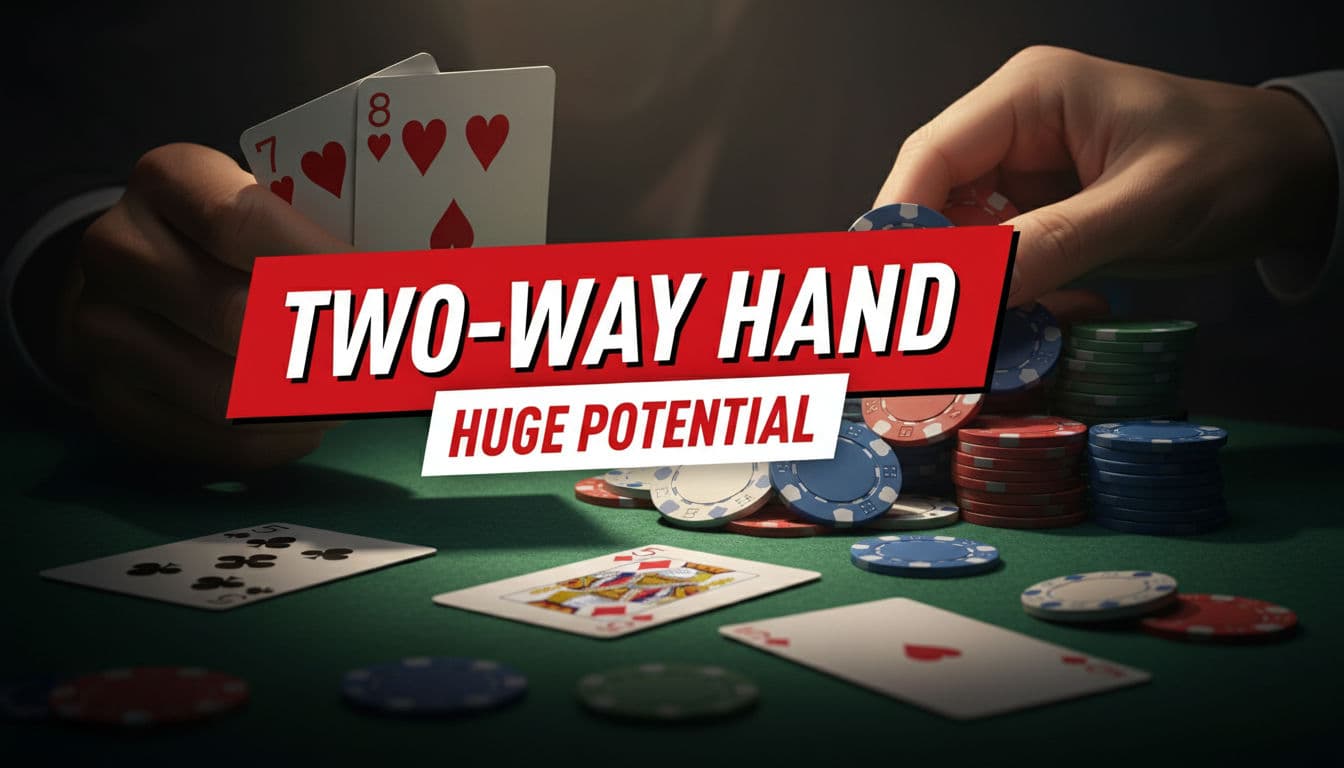
At its core, a two-way hand gives you multiple routes to victory. Consider holding 7 of Hearts and 8 of Hearts, and the flop comes 5 of Hearts, 6 of Spades, 9 of Diamonds. In this scenario, you have:
An Open-Ended Straight Draw: Any 4 or 10 will complete a straight (4-5-6-7-8 or 5-6-7-8-9). This provides 8 outs (four 4s and four 10s).
A Flush Draw: Any heart will complete your flush. Since there are two hearts already in your hand and two on the board, there are 9 remaining hearts in the deck (13 total hearts - 4 known hearts = 9).
When these two draws do not overlap (as in the example above, where a 4 or 10 of hearts would count for both, but here they are distinct), you simply add the outs. In this case, 8 (straight) + 9 (flush) = 17 outs. To put this in perspective, a made pair of aces against two overcards before the flop typically has around 80% equity, while a two-way straight and flush draw on the flop can have anywhere from 30% to 50% equity against a strong made hand, depending on specific cards and opponent holdings. This makes it an incredibly strong drawing hand, often favored over even a single pair.
Variations of Two-Way Draws
While the open-ended straight and flush draw is the most common, other variations exist:
Open-Ended Straight Flush Draw: The absolute strongest, where completing either the straight or the flush results in a straight flush. For example, 7h8h on a 5h6h9c flop (8 straight outs + 9 flush outs - 2 overlapping cards (4h, Th) = 15 outs for the straight or flush, plus 2 specific straight flush outs (4h, Th), leading to even higher equity).
Gutshot Straight Draw + Flush Draw: Less powerful than an open-ended straight draw combined with a flush draw, but still potent. Example: 7h8h on a 4h6s9c flop. Here you have a gutshot (only a 5 completes the straight) for 4 outs, plus 9 flush outs. Total 13 outs.
Strategic Implications: Playing Two-Way Hands Effectively
The high equity of two-way hands opens up several advanced strategic options:
1. Counting Outs Accurately
Precision in counting outs is paramount. Always be mindful of "blockers" (cards in your hand or on the board that reduce an opponent's potential hand strength or your own outs) and "overlaps" (cards that satisfy both draws). For example, if you have 7h8h on a 5h6s9h board, the 4h and 10h fulfill both draws. You'd count 8 straight outs + 9 flush outs - 2 overlapping outs = 15 distinct outs to hit a straight or a flush (or both if it's a straight flush). For an open-ended straight and flush draw where no outs overlap, it's a simple addition as shown earlier (8+9=17).
2. Pot Odds and Implied Odds
With a high number of outs, the two-way hand poker situation often justify calling larger bets. Your raw pot odds (the ratio of money in the pot to the cost of your call) improve with more outs. Crucially, two-way hands are excellent for their implied odds. When you hit a straight or a flush, it's often a very strong hand, capable of winning a large pot from an opponent who has a lesser made hand (like two pair or a set). This potential for winning a big pot after hitting makes calling even when direct pot odds aren't perfect often profitable, especially against opponents likely to pay you off.
3. The Power of the Semi-Bluffing in Poker
This is where two-way hands truly shine. A semi-bluff involves betting or raising with a drawing hand. If your opponents fold, you win the pot immediately without needing to hit your draw. If they call, you still have substantial equity to improve to a winning hand on a later street. This dual advantage – immediate win or strong equity – makes semi-bluffing with two-way hands incredibly powerful. It puts pressure on your opponents and builds the pot for when you hit your monster draw.
4. Position and Stack Depth
Position: Playing two-way hands in position (acting last) is significantly more advantageous. It allows you to see your opponent's action before making your decision, giving you valuable information and control over the pot size.
Stack Depth: Deeper stacks enhance the value of two-way draws due to the increased implied odds. With more chips behind, you have a greater opportunity to win a large pot if you complete your strong hand. Conversely, shallow stacks reduce implied odds, making pure drawing less appealing.
5. Board Texture and Opponent Analysis
Always consider the board texture. Is it paired? This reduces your flush outs. Are there many possible straight combinations? This could mean your opponent also has a strong draw or a made hand. Also, analyze your opponents: are they tight and likely to fold to aggression, making semi-bluffs more effective? Or are they calling stations who will pay you off when you hit, thus emphasizing implied odds?
Common Mistakes to Avoid
Overvaluing Weaker Draws: Not all "two-way" hands are created equal. A small gutshot + small flush draw, for instance, has fewer outs and less likelihood of making the nut hand than an open-ended straight flush draw.
Ignoring Stack-to-Pot Ratio (SPR): With a high SPR (deep stacks), drawing hands are more valuable. With a low SPR (shallow stacks), it's often better to either go all-in or fold, as you don't have the chips to realize your implied odds.
Chasing Too Often Out of Position: Without the benefit of seeing your opponent's action, playing drawing hands out of position can be costly, as you have less control and less information.
Failing to Semi-Bluff: Many players are too passive with two-way hands, only calling. This misses a significant opportunity to win the pot outright or build it for when your draw completes.
Mastering two-way hands transforms your poker game from reactive to proactive. By understanding their inherent strength, counting outs precisely, and employing strategic aggression, you can significantly enhance your win rate and consistently put pressure on your opponents, turning complex board textures into profitable opportunities.
| Pros | Cons |
|---|---|
Two-way hands boast a significantly higher number of outs compared to single draws, greatly increasing your chances of making a strong winning hand. | Despite high equity, it's still a drawing hand. You will miss your draw a significant percentage of the time, leading to lost bets if you don't improve. |
They provide excellent opportunities for semi-bluffing, allowing you to win the pot immediately or retain strong equity if called, putting opponents under pressure. | Playing these hands aggressively can commit a lot of chips. If you miss and your opponent has a strong hand, you might face tough decisions or heavy losses. |
When you hit your draw, you often complete a very strong hand (straight or flush), leading to large payoffs from opponents with lesser made hands. | Playing two-way hands effectively requires careful management of pot size and information, which is harder to achieve when out of position. |
Related Poker Terms
6-Max
9-Max (Full Ring)
A-Game
ABC Poker
Backdoor Flush
Backdoor Straight
Bankroll
Bet Size
Bet Sizing
Blocker
Bluff
Bluff Catcher
Board
Bubble Factor
Button
Call
Check-Call
Check-fold
Check-Raise
Click-Back
Donkament
Double Barrel
Downswing
Effective Stack
Equity
Expected Value (EV)
First in
Gap Concept
GTO
Gutshot
Hot Streak
HUD
ICM
Image
Implied Odds
Insta-Call
Isolation
Kicker
Leak
Limp
Limp-Fold
Limp-Raise
Middle Pair
Min-raise
Monotone
Monster
Multi-Way Pot
Nit
Nuts
Odds
One-Way Straight
Online Poker
Online Poker Strategies
Open Limp
Out of Line
Outs
Over the top
Over-Limp
Overblind
Overcall
Overcard
Overpair
Pat
Peel
Play Behind
Polarized
Pot Committed
Pot Control
Pot Odds
Preflop
Price
Push or Fold
Range
RFI (Raise First In)
ROI
Royal Flush
Sit and Go (SNG)
Slow Play
Smooth Call
Snap Call
Snapped Off
Soft Seat
Solid
Steal
Suited
Suited Gappers
Tank
Total air
Tournament Fee
Trap
Two-Gapper
Under the Gun (UTG)
Underpair
Upswing
Value
Value Bet
Variance
Villain
Weak Ace
Window Card
Best Online Poker Bonus Codes


About the Editor

Bence Mitykó is a Somuchpoker poker writer, covering poker news and strategy. He spent four years playing poker professionally, primarily focusing on Heads-Up Sit & Go games, experience that continues to shape his understanding of poker strategy, online poker dynamics, and the wider poker industry.


