

Second Pair

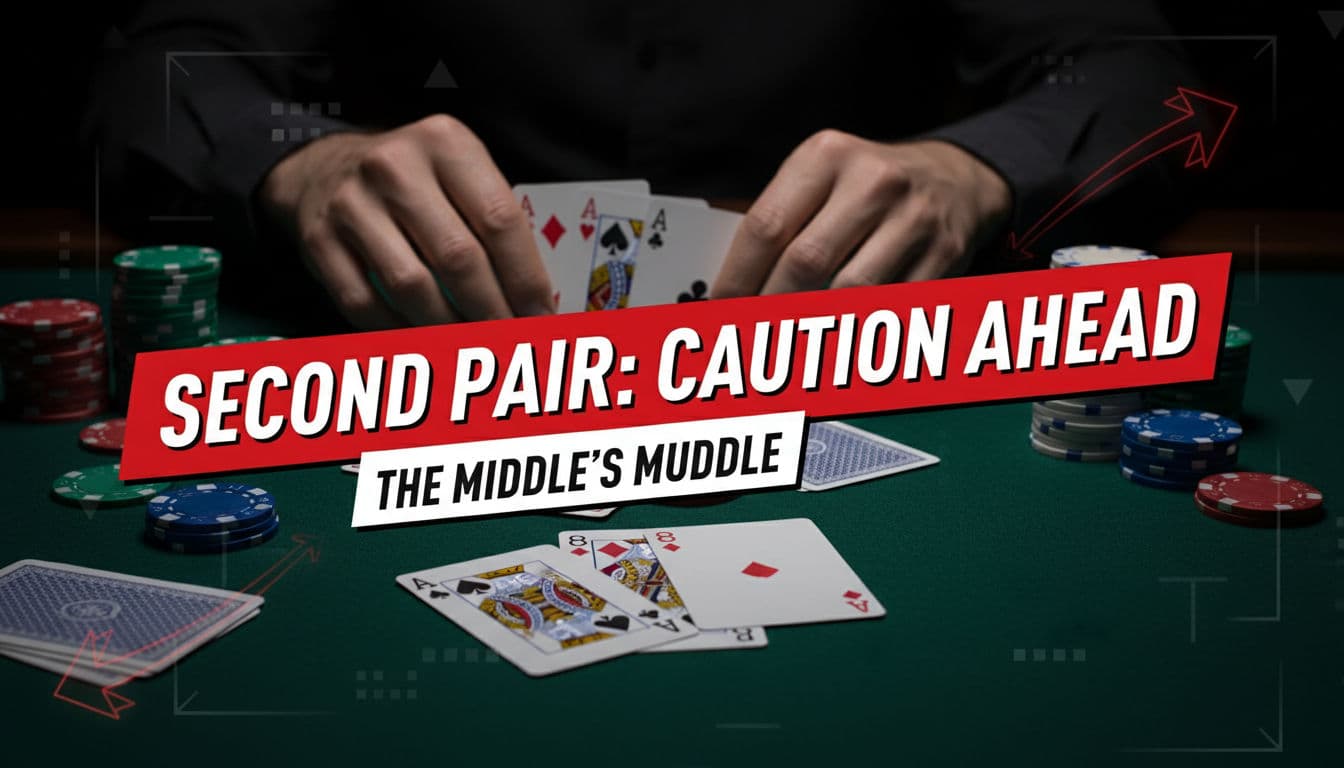
In Texas Hold’em, second pair is one of the most frequently misunderstood post-flop holdings. While it can appear strong enough to continue, it is rarely a hand that comfortably withstands sustained aggression. The true value of second pair depends heavily on board texture, position, and how your opponents construct their ranges across streets. Misplaying these situations often leads to inflated pots, difficult turn and river decisions, or unnecessary losses against stronger hands. Developing a sound second pair poker strategy requires discipline, accurate hand strength assessment, and a clear understanding of when to control the pot - and when to step away entirely.
Second Pair Poker Strategy Basics
The term 'second pair,' sometimes referred to as a middle pair poker hand, arises specifically in community card games like Texas Hold'em or Omaha , after the flop. It describes a situation in which a player's hole cards pair with the second-highest card on the board. For instance, imagine the board displays A♠ 8♦ 5♣. If you hold 8♥ 7♦, your 8♥ pairs with the 8♦ on the board, making you a second pair. Your hand is now a pair of eights, which is the second-highest pair possible on that board texture, following only a pair of aces.
Understanding this concept is crucial because a second pair rarely represents the nuts and is often vulnerable. Its strength is entirely dependent on the board's texture, the actions of your opponents, and your position at the table. This is where second pair poker strategy becomes essential for avoiding overcommitment and controlling pot size.
Many players improve poker decision making with marginal hands like second pair by gaining experience in online poker rooms , where repeated situations help refine hand strength evaluation and pot-control strategies.
Differentiating Your Hand: Two Pair vs Second Pair
A common mistake for less experienced players is to conflate these two concepts, but understanding the nuances of two pair vs second pair is essential for accurate hand evaluation. While both involve pairs, their fundamental definitions and implications for hand strength are vastly different.
Understanding 'Two Pair'
A 'two pair' is a specific five-card poker hand ranking, positioned above a single pair but below three of a kind. It consists of two distinct pairs of cards and a fifth unpaired card, known as a kicker. For example, if you hold 9♦ 7♦ and the board is K♥ 9♠ 7♣ 2♦ A♣, you have two pair: nines and sevens, with an Ace kicker (your best five cards would be K♥ 9♠ 9♦ 7♣ 7♦). If two players both have two pair, the winner is determined by the highest pair first, then the second pair, and finally the kicker if both pairs are identical.
Key Differences in Hand Ranking and Strength
The primary distinction lies in their inherent strength and construction. A 'second pair' is a single pair, making it a relatively weak hand that is easily dominated by top pair, two pair, three of a kind, or straights. 'Two pair,' on the other hand, is a recognized hand ranking that is significantly stronger than any single pair. This fundamental difference dictates vastly different strategic approaches in post-flop play.
Strategic Implications of Playing a 'Second Pair' Hand
Playing a second pair effectively demands a nuanced understanding of various factors:
Board Texture and Opponent Awareness: A second pair on a dry, uncoordinated board (e.g., K-7-2 rainbow) is stronger than on a wet, connected board (e.g., J-T-9 with two spades), where straights or flushes are more likely. Always consider what stronger hands your opponents could be holding based on the board.
Position Matters: Playing a second pair from an early position is exceptionally tricky, as you'll have to act first on subsequent streets without knowing your opponents' intentions. In contrast, playing from late position allows you to gather more information, making it easier to control the pot or make informed folds.
When to Proceed with Caution: Often, a second pair is a hand to check-call or check-fold, especially against aggressive players or on dangerous boards. Avoid building large pots without significant improvements or strong reads.
Navigating 'Two Pair' Hands: Strength and Vulnerability
While significantly stronger than a single 'second pair,' a 'two pair' hand is not infallible:
High vs. Low Two Pair: The strength of your two pair depends heavily on the rank of your pairs. Two high pairs (e.g., Aces and Kings) are formidable, while two low pairs (e.g., Fours and Twos) can be easily outdrawn or beaten by a higher two pair, three of a kind, or a straight.
Common Threats to Two Pair: Be wary of boards that complete straights, flushes, or provide opportunities for opponents to hit three of a kind (sets). Overcards can also diminish the value of lower two pairs, particularly on later streets.
Mastering Your Post-Flop Decisions
Ultimately, whether you're holding a vulnerable second pair or a robust two pair, success in poker hinges on your ability to accurately assess hand strength relative to the board and your opponents. These advanced poker tips emphasize that prudent poker decision making, careful pot control, and a willingness to fold when necessary are hallmarks of an expert player navigating these complex hand scenarios. By integrating these strategies, you can turn marginal situations into long-term profit.
| Pros | Cons |
|---|---|
On very dry, unthreatening boards with passive opponents, a second pair can sometimes be sufficient to win a small pot, especially if the top pair is also weak or non-existent. | A second pair is frequently beaten by top pair, overpairs, two pair, three of a kind, straights, or flushes, making it highly susceptible to losing larger pots. |
Playing a second pair passively allows you to keep the pot small, minimize losses, and potentially see future streets cheaply if you have good implied odds or are unsure of your opponent's strength. | It's often hard to build a big pot with a second pair because strong hands will call, and weak hands will fold, leaving you in an awkward spot or facing a better hand. |
When you improve your second pair (e.g., hit two pair or trips), there's a significant risk that a stronger hand already exists or will improve further, leading to you losing a larger amount. |
Related Poker Terms
Best Online Poker Bonus Codes


About the Editor

Bence Mitykó is a Somuchpoker poker writer, covering poker news and strategy. He spent four years playing poker professionally, primarily focusing on Heads-Up Sit & Go games, experience that continues to shape his understanding of poker strategy, online poker dynamics, and the wider poker industry.


