

Wheel

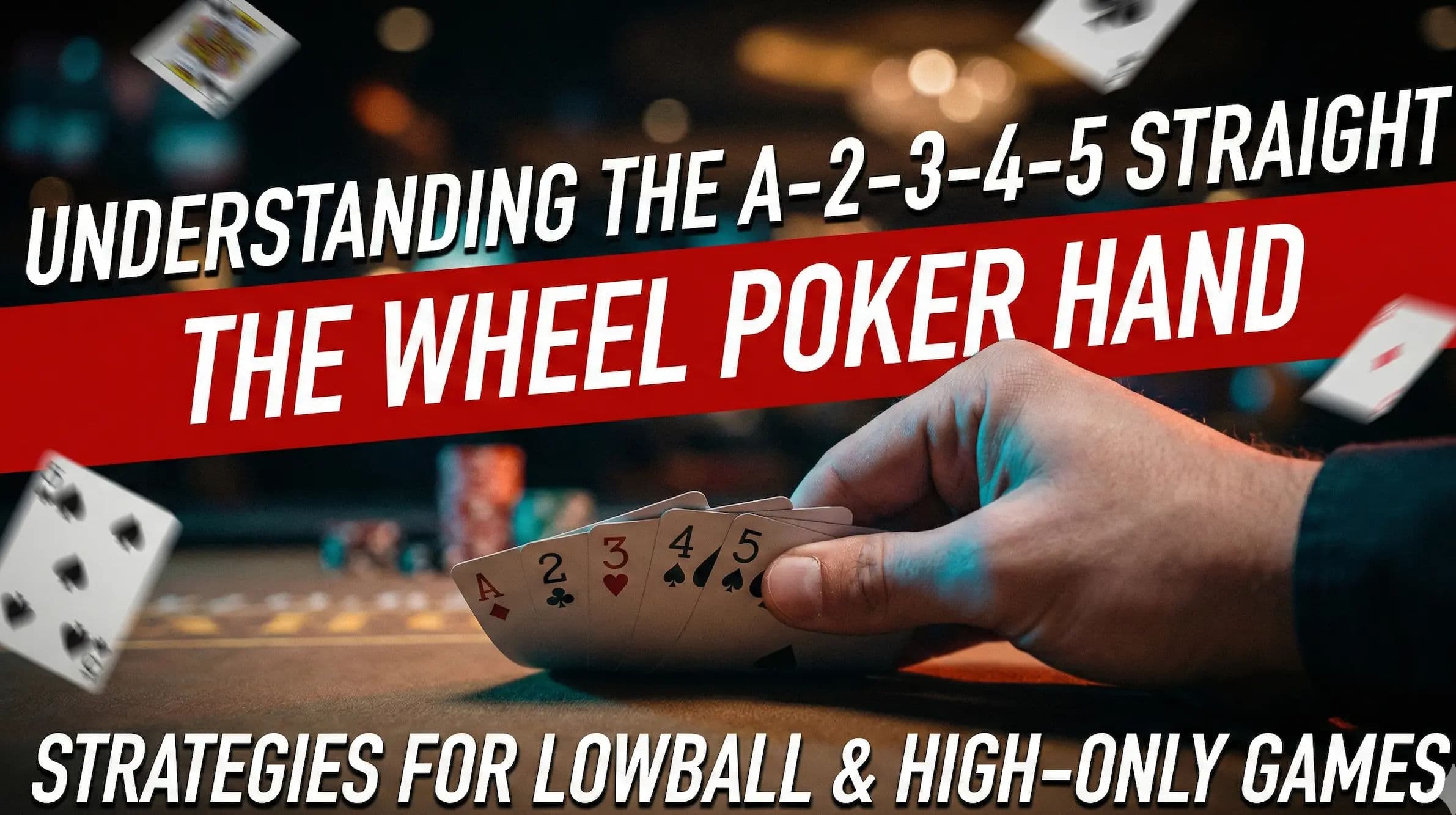
In the intricate world of poker, certain hands carry a unique mystique, demanding a nuanced understanding of their power dynamics across diverse game formats. Among these, the “Wheel” stands out. Often referred to as a “bicycle” or “bike,” this specific straight comprising Ace, Two, Three, Four, and Five (A-2-3-4-5) holds a fascinating dual identity. While it’s inherently the lowest possible straight in traditional poker rankings, its true strategic significance blossoms in variants where low hands are paramount, transforming it into an unbeatable powerhouse. Grasping the strategic implications of the Wheel is crucial for any player aiming to elevate their game beyond basic hand recognition.
What is Exactly Wheel Poker? Understanding the A-2-3-4-5 Straight
The Wheel, often referred to as wheel poker, or the Bicycle, is a poker hand consisting of an Ace, a Two, a Three, a Four, and a Five, all in sequence. It's classified as a straight according to standard poker hand rankings, because the cards run consecutively, with the Ace acting as a 'low' card to complete the sequence. This unique characteristic is what gives the Wheel its distinct role.
It's important to remember that for any other straight, an Ace always acts as a high card (e.g., A-K-Q-J-T), but for the Wheel, it seamlessly bridges the gap between the lowest possible cards.
Understanding this fundamental definition is the first step to appreciating its varying strengths and weaknesses across the myriad of poker games. The visual representation of these five lowest cards forming a continuous chain makes it easy to remember and identify, but its strategic utility is anything but simple.
The Unrivaled Power: The Wheel as the 'Nut Low'
Where the Wheel truly shines and earns its formidable reputation is in poker variants that value low hands. In these specific games, the A-2-3-4-5 straight isn't just a good low hand; it's often the unbeatable "nut low."
A-5 Lowball Games (e.g., Razz, A-5 Lowball Triple Draw)
In A-5 lowball games such as razz poker, the objective is to make the lowest possible five-card hand, where straights and flushes do not count against you for low, and Aces are always low. The ranking system prioritizes the highest card first, then the next highest, and so on. A perfect low hand would be 5-4-3-2-A. Guess what hand that is? The Wheel.
Because it contains the five lowest cards and straights don't penalize its low value, it becomes the absolute best possible low hand. Any other low hand, even a 6-4-3-2-A, is inferior because it contains a 6, which is higher than the 5 in the Wheel. This makes the Wheel an automatic winner for the low half in these formats, commanding significant strategic weight.
Hi-Lo Split Games (e.g., Omaha Hi-Lo, Seven Card Stud Hi-Lo)
In hi-lo variants, the pot is split between the best high hand and the best low hand (provided a qualifying low hand exists, typically an 8-or-better). Here, the Wheel can potentially win both halves of the pot simultaneously – a scoop! As established, it's the nut low. Furthermore, because it's a legitimate straight, it can also be a strong contender for the high half of the pot, especially if no higher straight, flush, or full house materializes. Scooping the pot with a Wheel is one of the most satisfying outcomes in hi-lo poker, demonstrating its incredible versatility and power.
The Wheel's Place in High-Only Poker Variants
While the Wheel is a king in lowball and hi-lo, its stature is considerably diminished in high-only games like No-Limit Texas Hold'em or Pot-Limit Omaha (where there are no low hand considerations). In these formats, a straight is a solid hand, but the Wheel, being the lowest possible straight, holds a precarious position.
Vulnerability: Any other straight (e.g., 2-3-4-5-6, 3-4-5-6-7, all the way up to T-J-Q-K-A) will beat the Wheel. This means that if the board allows for multiple straights, the Wheel is easily dominated.
Beaten by Stronger Hands: Beyond higher straights, a Wheel is also vulnerable to flushes, full houses, four-of-a-kind, and straight flushes. While it's a strong starting point against pairs or two pairs, its ceiling is relatively low.
Reading the Board: In high-only games, players holding a Wheel must be acutely aware of the board texture. A board that shows 3-4-5, for example, might entice opponents with higher connectors to pursue higher straights. Betting and raising with a Wheel in these scenarios requires caution and a strong read on opponents' likely holdings.
Players interested in experiencing formats like Razz on the biggest stage can look toward the World Series of Poker , where lowball events remain part of the annual schedule. Through platforms such as GGPoker , qualifiers regularly run that give players a pathway to compete at the WSOP and explore how low-hand poker formats differ from traditional poker hand rankings in high-only games.
Therefore, while still a straight and often a profitable hand to play, particularly if it's disguised or completes on a dry board, the Wheel demands a more conservative approach in high-only contexts compared to its dominant role in low-oriented games. Understanding this dichotomy is fundamental to mastering its strategic application.
| Pros | Cons |
|---|---|
The A-2-3-4-5 straight is the absolute best possible low hand in A-5 lowball variations, guaranteeing victory for the low half of the pot. | In standard high-only poker, the Wheel is the weakest straight and can be easily beaten by any higher straight, flush, or stronger hand. |
In Hi-Lo games, the Wheel often serves as both the nut low and a legitimate high straight, offering an excellent chance to win the entire pot. | If a board allows for multiple straights, your Wheel is the most likely to be counterfeited or outranked, leading to significant losses if played aggressively. |
Its dual nature makes it extremely powerful in games where both high and low hands are considered, allowing for robust action and value extraction. | Unlike higher straights or sets, the Wheel often offers fewer redraw possibilities to stronger hands (e.g., straight flushes) in high-only contexts. |
Related Poker Terms
Best Online Poker Bonus Codes


About the Editor

Bence Mitykó is a Somuchpoker poker writer, covering poker news and strategy. He spent four years playing poker professionally, primarily focusing on Heads-Up Sit & Go games, experience that continues to shape his understanding of poker strategy, online poker dynamics, and the wider poker industry.


