

Hand Rankings


In the complex and dynamic world of poker, an in-depth understanding of hand rankings is not merely a prerequisite for play; it is the bedrock of strategic mastery. Beyond simply memorizing the hierarchy, a nuanced grasp of how hands are formed, their relative strengths, and crucially, how tie-breakers function, empowers players to make informed decisions, manage risk, and ultimately, gain a decisive edge at the table. This expert guide delves into the definitive ranking of poker hands, from the elusive Royal Flush to the foundational High Card, providing the analytical framework necessary for both aspiring enthusiasts and seasoned strategists to elevate their game across all poker variants, including Texas Hold'em, Omaha, and Seven Card Stud.
Poker Hand Rankings: The Hierarchy of Hands
For every poker player, from the novice to the high-stakes professional, a clear comprehension of hand strengths is paramount. This section meticulously details each standard poker hand, ordered from the absolute strongest to the weakest, complete with explanations and critical insights into their formation and how they interact in competitive scenarios.
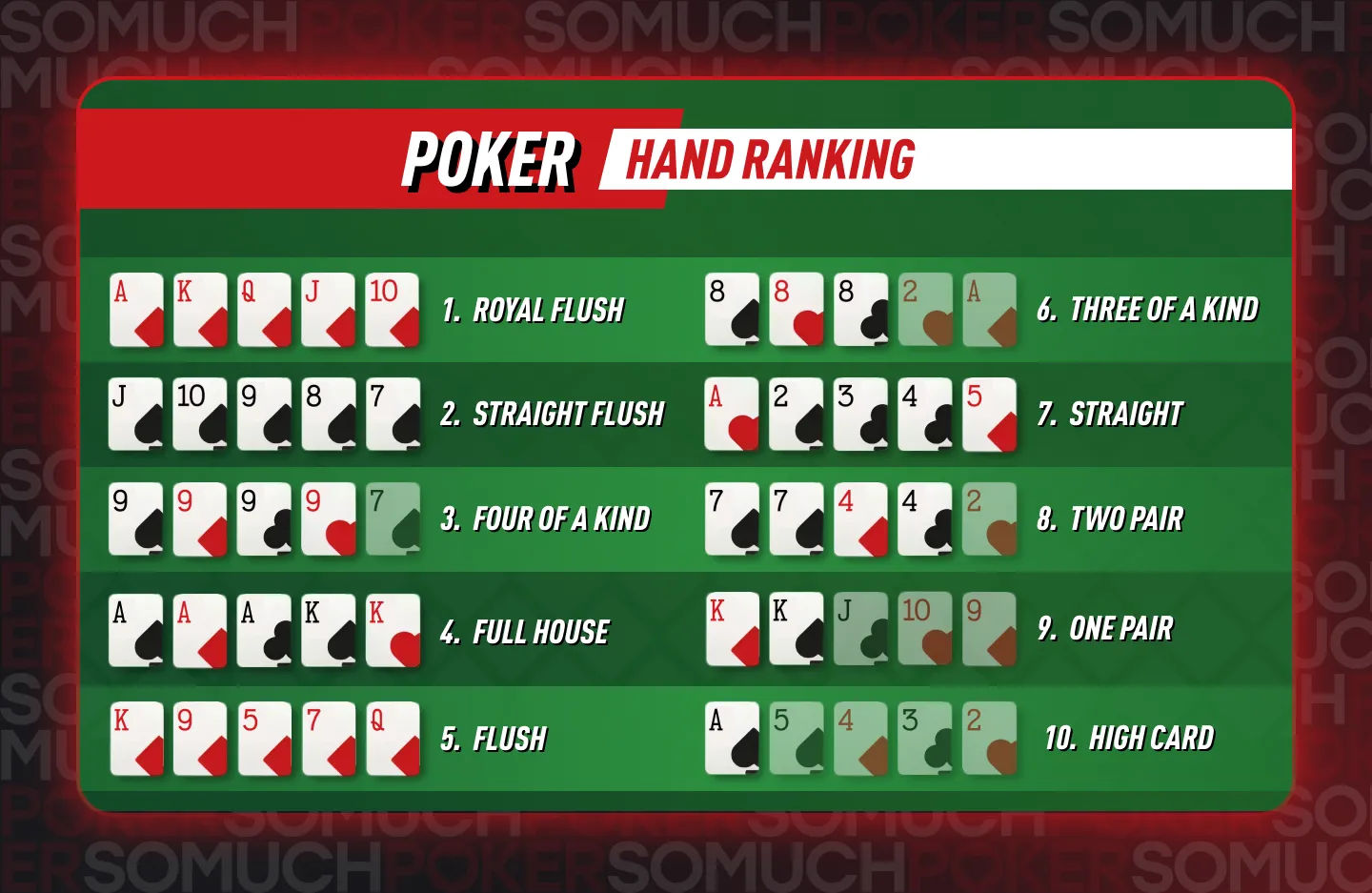
1. Royal Flush
The pinnacle of poker hands, the Royal Flush is an unbeatable combination. It comprises five consecutive cards of the same suit, specifically Ten, Jack, Queen, King, and Ace (T-J-Q-K-A). Its extreme rarity means that its appearance often signals an almost guaranteed win, making it the most coveted hand in the game.
2. Straight Flush
Just a notch below the Royal Flush, a Straight Flush consists of any five consecutive cards of the same suit, provided it does not include the A-K-Q-J-T sequence. Examples include 9-8-7-6-5 all of Spades, or 5-4-3-2-A all of Clubs. The Ace can function as both high and low in a straight, but only at the ends (A-2-3-4-5 or 10-J-Q-K-A). It's a powerful and exceedingly rare hand, virtually unbeatable in most scenarios.
3. Four of a Kind (Quads)
Also colloquially known as "Quads", Four of a Kind is formed by four cards of the same rank, accompanied by one unrelated "kicker" card. For instance, four Queens and a 7. When two players hold Four of a Kind, the hand with the higher-ranked four cards prevails. If players have the same ranked quads (possible in community card games if four of a kind are on the board), the highest kicker card determines the winner.
4. Full House
A formidable hand, the Full House combines Three of a Kind with One Pair. An example would be three Kings and two 7s. In situations where multiple players have a Full House, the player with the higher-ranked Three of a Kind component wins. If the three-of-a-kind components are identical (again, possible with shared community cards), the higher-ranked pair breaks the tie.
5. Flush
A Flush is constituted by any five cards of the same suit that are not in consecutive order. For example, an Ace, King, 8, 4, 2 all of Hearts. When multiple players achieve a Flush, the winner is determined by the highest-ranked card within their flush. If the highest cards are identical, the next highest card is compared, and so on, down to the fifth card.
6. Straight
A Straight is composed of five cards in consecutive rank, but with at least two different suits. An example is 9 of Spades, 8 of Hearts, 7 of Diamonds, 6 of Clubs, 5 of Spades. As with Straight Flushes, an Ace can act as either the highest card (10-J-Q-K-A) or the lowest card (A-2-3-4-5). If two players have a Straight, the one with the highest-ranking card at the top of their sequence wins.
7. Three of a Kind (Trips/Set)
This hand consists of three cards of the same rank and two other unrelated cards, known as kickers. For instance, three Queens with an Ace and a 5. In Texas Hold'em, this is often called a "Set" if formed with a pocket pair and one board card, or "Trips" if formed with one pocket card and two board cards. If two players have Three of a Kind, the player with the higher-ranked set of three wins. If the three-of-a-kind ranks are identical (e.g., three 8s on the board), the highest kicker, then the second highest kicker, determines the winner.
8. Two Pair
A very common hand, Two Pair consists of two distinct pairs of cards and one unrelated kicker. An example is two Kings, two 7s, and an Ace kicker. When comparing Two Pair hands, the highest pair wins first. If both players have the same highest pair, the second highest pair is compared. If both pairs are identical, the highest kicker card determines the winner.
9. One Pair
One Pair is formed by two cards of the same rank, along with three other unmatched cards. For example, two Queens with an Ace, 8, and 3. This is the most frequently occurring hand beyond High Card. If multiple players hold One Pair, the highest-ranked pair wins. Should the pairs be identical, the highest kicker card is compared, followed by the second highest, and then the third, until a winner is determined.
10. High Card
When no other poker hand combination can be made, the hand is ranked solely by its highest individual card. For instance, if a player has A-K-7-5-2 with no flush or straight, their hand is "Ace High". If two or more players have the same highest card, the next highest card is compared, and so on, until a winner is established. This is the weakest possible hand in poker.
Strategic Implications of Hand Rankings
Understanding the strict hierarchy of poker hands is more than rote memorization; it's a foundational element of poker strategy. Knowing not only your hand's absolute strength but also its relative strength against potential opponent holdings allows for sophisticated decision-making in betting, raising, calling, and folding. This knowledge, often highlighted in any comprehensive card player guide, influences pre-flop hand selection, post-flop continuation betting, and critical river decisions. An expert player constantly assesses the board, the betting patterns, and their opponents' ranges, all filtered through the lens of the best poker hands and implied probabilities.
Mastering the nuances of tie-breaking rules, particularly with hands like Full Houses, Flushes, and Two Pair, is equally vital. Overlooking a kicker or misinterpreting a board's potential can lead to costly errors. Develop an analytical approach to hand evaluation, considering not just what you have, but what others could have, and how your hand stacks up in that context. This deep understanding is what separates casual players from consistent winners.
If you're ready to put this strategy into practice, you can find the best action at these online poker sites .
| Pros | Cons |
|---|---|
A comprehensive understanding of hand rankings allows players to make more informed choices regarding betting, calling, raising, or folding, directly impacting their win rate. | For absolute beginners, memorizing all ten hand rankings and their respective tie-breaker rules can initially feel overwhelming. |
Knowing hand values eliminates hesitation, leading to quicker decisions and a more confident demeanor, which can influence opponents. | In fast-paced live games or multi-table online tournaments, miscalculating hand strength or tie-breakers under time constraints can still occur, even with good knowledge. |
By internalizing probabilities and hand strength, players can more accurately infer opponents' potential holdings based on their actions, crucial for advanced play. | |
A thorough grasp of tie-breaker rules and kicker importance avoids common errors that can lead to losing pots unnecessarily. |
Related Poker Terms
AAAKKK
AKQJT
Ante
Bet
Big Blind
Big Blind Ante
Broadway
Buy-In
Check
Chips
Floor Manager
Flop
Flush
Fold
Full House
Gambling
Hand Rankings
No Limit
Omaha
Open Game
Open Seat
Out Button
Overlay
Pair
Peel
Peg
Pips
Pocket Pair
Poker network
Poker Room
Poker Rules
Position
Postflop
Pot
Pot-Limit
Protect
Quads
Qualifier
Quorum
Rack
Rake
Razz
Rebuy
Redeal
River
Rolled Up
Round of Play
Royal Flush
Running It Twice
Seat Position
Seating List
Second Pair
Seven-card Stud
Seven-Deuce Game
Seventh Street
Short Buying
Short Handed
Shot Clock
Showdown
Shuffle
Side Bet
Side Pot
Sit Out
Sixth Street
Small Blind
Split
Split Two Pair
Stack
Straight
Straight Flush
Structure
Stub
Stud Games
Suit
Table Stakes
Texas Hold'em
Third Street
Tie
Time Bank
Trips
Turn
Two Pair
Uncle Doc
Upcard
Verbal Declaration
Visible Cards
Wheel
Winning Hand
Best Online Poker Bonus Codes


About the Editor

Bence Mitykó is a Somuchpoker poker writer, covering poker news and strategy. He spent four years playing poker professionally, primarily focusing on Heads-Up Sit & Go games, experience that continues to shape his understanding of poker strategy, online poker dynamics, and the wider poker industry.


