

Middle Pair

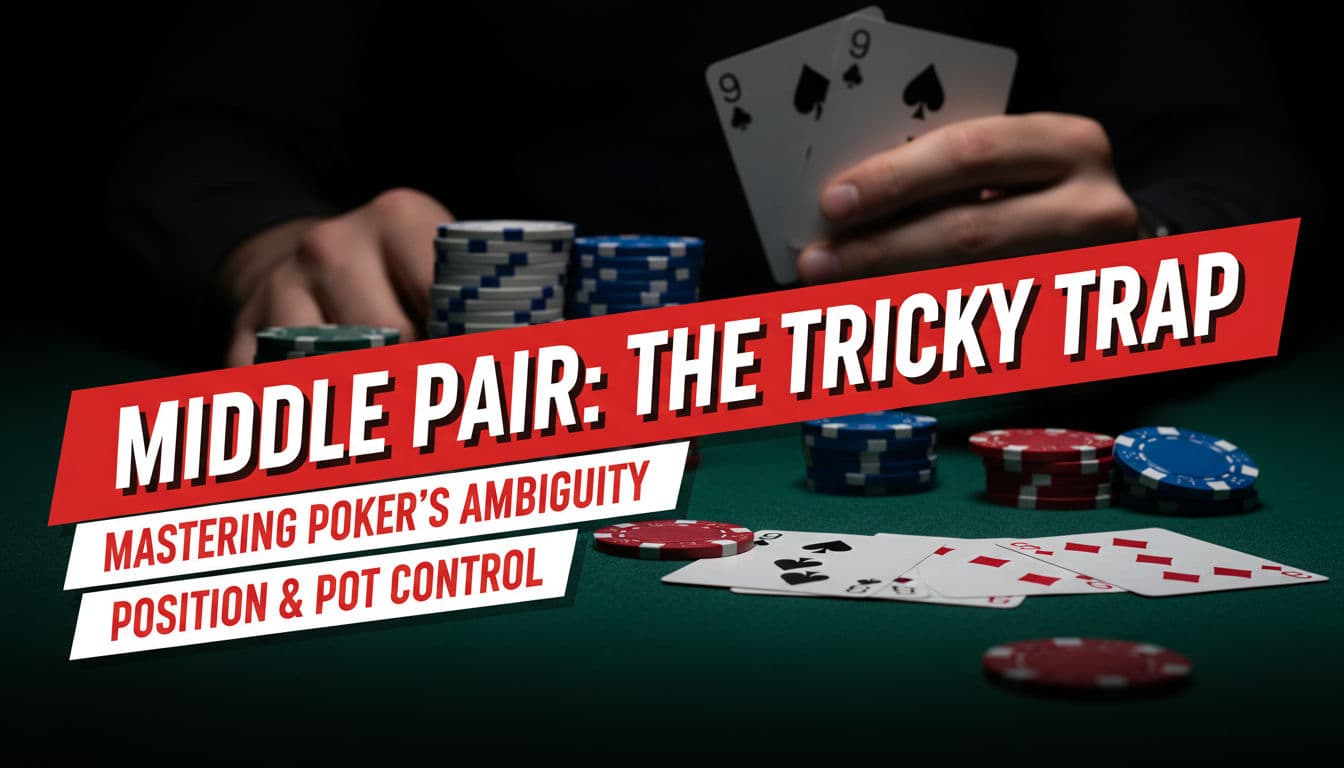
In the intricate world of poker, understanding the value and strategic implications of various hand strengths is paramount. Among these, the "middle pair" often presents one of the most challenging and nuanced scenarios. Unlike top pair, which usually provides a clear-cut path, or bottom pair, which is often easy to fold, middle pair occupies a precarious position – strong enough to tempt players into investing, yet vulnerable enough to punish overconfidence. This analytical guide delves deep into the strategic intricacies of playing middle pair in Texas Hold'em, equipping you with expert insights to navigate these tricky situations, maximize your equity, and avoid costly errors.
Middle Pair Strategy: Navigating Ambiguity on the Flop
Mastering your middle pair strategy is a crucial part of any comprehensive poker guide. The term "middle pair" refers to a pair formed with one of your hole cards and the second-highest ranking card on the community board. For example, if you hold 9♠ 8♠ and the flop comes K♦ 9♦ 3♣, you have middle pair (a pair of nines, with the King being the highest card on the board). This hand strength is inherently ambiguous; it's often good enough to be ahead on the flop but susceptible to being outdrawn or already behind a stronger pair.
Defining Middle Pair: More Than Just a Number
While the literal definition is straightforward, the strategic value of this hand is anything but. It's rarely the nut hand, but it's far from a complete bluff catcher. The key to successfully playing middle pair lies in its relative strength against your opponent's likely range and the future potential of the board. As a fundamental pillar of solid Texas Hold'em strategy, factors like stack sizes, player tendencies, and especially position, will dictate whether you play it aggressively for value, cautiously for pot control, or simply fold.
Strategic Considerations for Playing Effectively
Navigating these situations requires a careful balance of aggression, caution, and analytical foresight. Here are the core pillars of an expert approach:
Position Matters Immensely
In Position (IP): Playing from a late position (e.g., button, cutoff) grants you a significant advantage. You get to see your opponent's action before making your own decision, allowing for more informed calls, raises, or folds. You can control the pot size more effectively, check back to get a free card, or bluff when appropriate.
Out of Position (OOP): Playing from an early position (e.g., blinds, under the gun) is considerably more challenging. You're forced to act first on subsequent streets. Often, checking and calling (check-calling) is a viable strategy to keep the pot small, but it leaves you vulnerable to bluffs.
Analyzing Board Texture and Potential Draws: A huge part of your poker flop strategy is evaluating the texture of the board. A dry, disconnected board with no obvious draws (e.g., A♠ 9♦ 4♣ when you hold 9♥ 7♥) makes your hand relatively strong. Conversely, a wet, connected board with many draws (e.g., J♣ 9♣ 7♠ when you hold 9♦ 8♦) significantly diminishes its value. On such boards, protection bets and careful evaluation are crucial.
Understanding Opponent Tendencies: Proper poker hand analysis dictates that your opponent's playing style should heavily influence your strategy. Against tight-aggressive (TAG) players, a middle pair might be strong enough for a call, as their betting range is usually stronger. Against loose-aggressive (LAG) players, however, it can be a tricky hand. Pay attention to their betting patterns and how they react to aggression.
Pot Control vs. Value Betting: Deciding whether to build a pot or keep it small is a fundamental aspect. If you believe your hand is strong enough to be ahead and can get called by worse, value betting is appropriate. However, if the board is dangerous, or you suspect your opponent has a stronger hand, pot control becomes vital.
Common Mistakes to Avoid
Even experienced players can stumble when it comes to these ambiguous spots. Here are some pitfalls to steer clear of:
Overplaying It: The most common error is treating it as if it's the top pair. It rarely warrants three streets of value betting. Don't commit your entire stack without strong evidence of being ahead.
Not Protecting It: On draw-heavy boards, simply checking can be a mistake. Allowing opponents free cards to hit their straights or flushes can be costly.
Ignoring Kicker Problems: Your kicker card is incredibly important. A pair with a strong kicker (e.g., Q9 on K94) is far more robust than one with a weak kicker (e.g., 92 on K94).
Advanced Poker Tips for Maximizing Value
Consider Thin Value Betting: On the river, if you believe your hand is still good but your opponent's range is narrow, a small "thin value" bet can often pick up chips from a weaker calling range.
Semi-Bluffing: If you have a pair and a strong draw (e.g., 9♦ 8♦ on J♣ 9♣ 7♠), you can semi-bluff. You have equity if called, and you win outright if your opponent folds.
Folding When Necessary: The greatest skill is often knowing when to fold, especially against strong betting lines.
Conclusion
Handling these situations is a cornerstone of proper post-flop play. It challenges players to think critically, balance risk, and adapt to dynamic board textures and opponent behaviors. By meticulously analyzing position, board characteristics, and opponent tendencies, you can transform these often-ambiguous hands into consistent sources of profit.
To put your newly refined skills to the test, finding the right tables makes all the difference. Be sure to check out our carefully curated list of the best online poker sites to find the perfect games and welcome offers for your playstyle.
| Pros | Cons |
|---|---|
Middle pair is often ahead of many un-paired hands and weaker draws on the flop, providing a foundational advantage. | Easily outdrawn by stronger pairs, straights, or flushes, especially on connected or draw-heavy boards. |
Can be played cautiously to keep pot sizes small, minimizing losses when facing stronger hands. | It's challenging to determine if middle pair is strong enough for multiple streets of value betting without risking being called by better hands. |
When combined with a strong draw, middle pair can be used effectively for semi-bluffs, offering two ways to win the pot. | Often loses to similar pairs with better kickers, significantly reducing its showdown value in many situations. |
Related Poker Terms
6-Max
9-Max (Full Ring)
A-Game
ABC Poker
Bankroll
Bet Size
Bet Sizing
Blocker
Bluff
Bluff Catcher
Board
Bubble Factor
Button
Call
Check-Call
Check-fold
Check-Raise
Click-Back
Donkament
Double Barrel
First in
Gap Concept
GTO
Gutshot
Hot Streak
HUD
Image
Insta-Call
Isolation
Kicker
Leak
Limp
Limp-Fold
Limp-Raise
Middle Pair
Min-raise
Monotone
Monster
Multi-Way Pot
Nit
Nuts
One-Way Straight
Online Poker
Online Poker Strategies
Open Limp
Out of Line
Over the top
Over-Limp
Overblind
Overcall
Overcard
Overpair
Pat
Peel
Play Behind
Polarized
Pot Control
Potting Out
Preflop
Premium Hands
Probe Bet
Proposing Bets
Push or Fold
Put Down
Quads
Quartered
Quitting Time
Quorum
Ragged
Range
Range Advantage
Razz
Reverse Implied Odds
Rolled Up
Royal Flush
Runner Runner
Running Good
Sandbagging
Satellite
Sit and Go (SNG)
Slow Play
Smooth Call
Snap Call
Snapped Off
Soft Seat
Solid
Steal
Suited
Suited Gappers
Tank
Total air
Trap
Two-Gapper
Under the Gun (UTG)
Underpair
Value
Value Bet
Villain
Weak Ace
Window Card
Best Online Poker Bonus Codes


About the Editor

Bence Mitykó is a Somuchpoker poker writer, covering poker news and strategy. He spent four years playing poker professionally, primarily focusing on Heads-Up Sit & Go games, experience that continues to shape his understanding of poker strategy, online poker dynamics, and the wider poker industry.


