

Board Texture

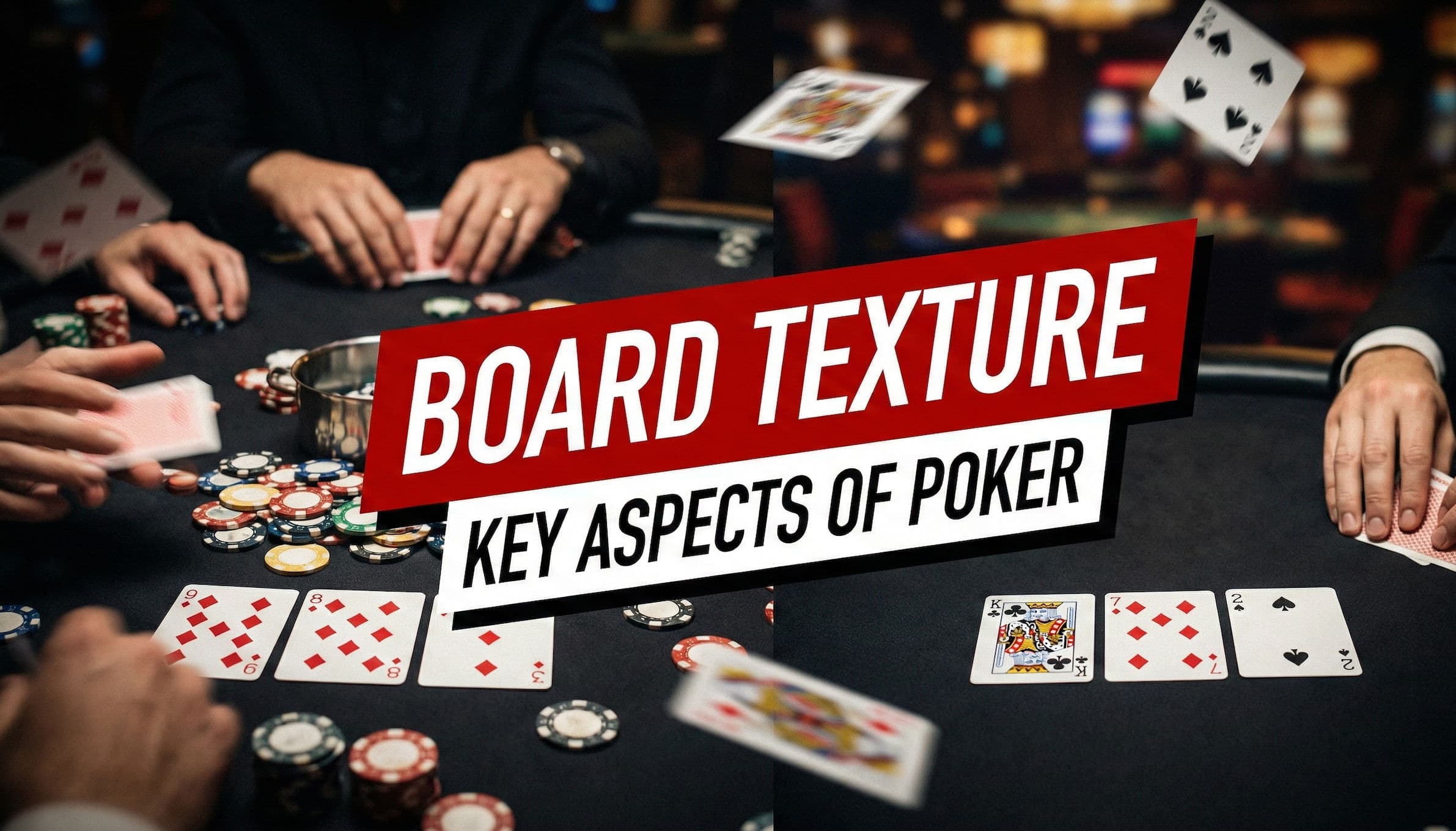
In the intricate landscape of Texas Hold'em, where incomplete information reigns supreme, the "texture" of the community cards stands as a pivotal determinant of strategic advantage. Far more than mere visual components, the flop, turn, and river collectively paint a dynamic canvas that dictates the evolving probabilities of hand strength, potential draws, and optimal betting lines. An expert understanding of board texture is not merely beneficial; it is an imperative discipline for any serious player seeking to elevate their decision-making, refine their hand reading abilities, and ultimately, maximize their expected value (EV) at the tables.
This comprehensive guide delves into the nuances of board texture, dissecting its various classifications and illuminating their profound implications for every facet of your poker strategy. By meticulously analyzing the characteristics of the community cards, you can transcend basic hand valuations and adapt your play with precision, transforming ambiguous situations into exploitable opportunities.
Decoding the Dynamics: Key Aspects of Board Texture Poker
The community cards presented on the felt are rarely static in their impact. Their inherent characteristics significantly alter the strategic landscape of a hand. Recognizing and categorizing these textures is the foundational step towards advanced poker play.
Wet vs. Dry Boards: Understanding Action Probability
The most fundamental distinction in board texture lies in its 'wetness' or 'dryness,' indicating the potential for drawing hands and the likelihood of strong connections.
Wet Boards: These are highly coordinated boards, brimming with potential for powerful drawing hands. They typically feature multiple suited cards (e.g., 9♦ 8♦ 3♦, creating flush draws), connected cards (e.g., J♠ T♠ 9♥, offering straight draws), or a potent combination of both (e.g., 7♥ 6♥ 5♠, which could yield both straight and flush possibilities). On a wet board, the probability of multiple players having strong draws or even already completed hands (like a flopped flush or straight) increases dramatically. This often leads to more aggressive action, larger bet sizes for protection and value, and frequently, bigger pots as players battle for supremacy.
Dry Boards: In stark contrast, dry boards present very few drawing opportunities and exhibit minimal connectivity. Examples include disparate, unsuited cards (e.g., K♣ 7♦ 2♠). On these boards, it's far less likely for players to have connected strongly with their hole cards to form a straight or flush draw. Strong made hands, like an overpair or top pair, top kicker, hold considerably more relative strength here. This environment often results in more cautious play, smaller continuation bets, and a reduced likelihood of large multi-way pots, creating opportunities for well-timed bluffs.
Paired Boards: The Shift in Hand Hierarchy
When the community cards include a pair (e.g., A♠ A♥ 7♦), the entire hierarchy of hand strength undergoes a significant re-evaluation. On a paired board, making two pair becomes much more difficult and less valuable, as it's often dominated by three of a kind (trips). Conversely, the probability of hitting trips (either with a pocket pair or one of your hole cards matching the board pair) or a full house increases. This dynamic can either slow down the action if no one has trips or lead to colossal pots when a player does, demanding careful consideration of opponent ranges.
Monotone Boards: The Flush Threat
A board where all three (or more) community cards share the same suit (e.g., Q♥ J♥ 8♥) is termed 'monotone.' On such a board, a flush is either highly probable or already completed. This significantly diminishes the value of many traditionally strong hands, such as two pair, sets, or even trips, if they do not also contribute to a flush. Players must be acutely aware of the flush threat, adjusting their valuation of non-flush hands downwards and playing flushes or strong flush draws with aggressive intent.
Connected vs. Disconnected Boards: Straight Potential
The spacing of card ranks on the board profoundly influences straight possibilities.
Connected Boards: These boards feature cards that are numerically close in rank (e.g., 9-8-7 or T-J-Q). Such layouts create numerous possibilities for straights (open-ended or gutshots). The more connected the board, the higher the probability that a player holds a straight or a strong straight draw, leading to more action and the need for protective play.
Disconnected Boards: Boards with cards far apart in rank (e.g., K-7-2) are considered disconnected. On these textures, the likelihood of a straight is significantly reduced, making high-card hands or isolated pairs much stronger relative to the board.
Why Board Texture Matters: Strategic Imperatives
A nuanced understanding of board texture is not merely academic; it is the cornerstone of advanced poker strategy, enabling players to make dynamically informed decisions that maximize profitability and minimize losses.
1. Assess Hand Strength Dynamically
Board texture provides critical context for evaluating your hand's true strength. A pair of aces, while inherently strong, will play vastly differently on a K♣ 7♦ 2♠ dry board compared to a 9♥ 8♥ 7♠ wet, connected, monotone-threatening board. Expert players understand that absolute hand strength is less important than relative strength, which is heavily influenced by how the community cards interact with potential opponent holdings.
2. Adjust Betting Strategy with Precision
Optimal betting strategy is intrinsically linked to board texture. On wet, dangerous boards, larger bet sizes are often warranted to protect your strong hands from numerous draws and to extract maximum value from opponents chasing. Conversely, on dry, uncoordinated boards, smaller continuation bets can be highly effective for winning pots cheaply, as opponents are less likely to have connected, and larger bets may only get called by stronger hands.
3. Read Opponents' Ranges Accurately
Board texture is an invaluable tool for narrowing down an opponent's possible hand range. If a player bets aggressively on a highly wet and connected board, their range is heavily skewed towards strong draws, completed hands, or very strong overpairs. On a dry board, an aggressive bet might indicate an isolated strong pair or could be a well-placed bluff, as there are fewer credible hands for the opponent to represent.
4. Bluff Effectively and Exploit Vulnerabilities
The success rate of bluffs is profoundly affected by board texture. Bluffs tend to be significantly more successful on dry boards, where opponents are less likely to have connected with the community cards and are therefore more inclined to fold. On wet boards, however, bluffs carry a much greater risk, as opponents are far more likely to hold a strong draw or a completed hand that can call or even re-raise. Understanding these dynamics allows for more calculated and profitable bluffing opportunities.
| Pros | Cons |
|---|---|
A deep understanding of board texture provides invaluable insights into the relative strength of your hand and potential opponent holdings, leading to more profitable and strategic decisions. | Constantly analyzing and interpreting board textures in real-time adds a significant mental burden, which can be challenging, especially for less experienced players. |
The ability to tailor bet sizing and aggression levels to the specific board conditions optimizes value extraction from strong hands and minimizes losses with weaker ones. | An incorrect assessment of board texture can lead to costly strategic errors, such as overvaluing a hand on a dangerous board or bluffing into an unbreakable holding. |
Board texture allows for more accurate opponent profiling and hand range construction, enabling more effective bluffs and value bets against specific player tendencies. | Over-reliance on board texture without considering other critical factors like position, stack sizes, and opponent tendencies can lead to flawed strategic choices. |
Related Poker Terms
Best Online Poker Bonus Codes


About the Editor

Bence Mitykó is a Somuchpoker poker writer, covering poker news and strategy. He spent four years playing poker professionally, primarily focusing on Heads-Up Sit & Go games, experience that continues to shape his understanding of poker strategy, online poker dynamics, and the wider poker industry.


