Expected Value (EV)

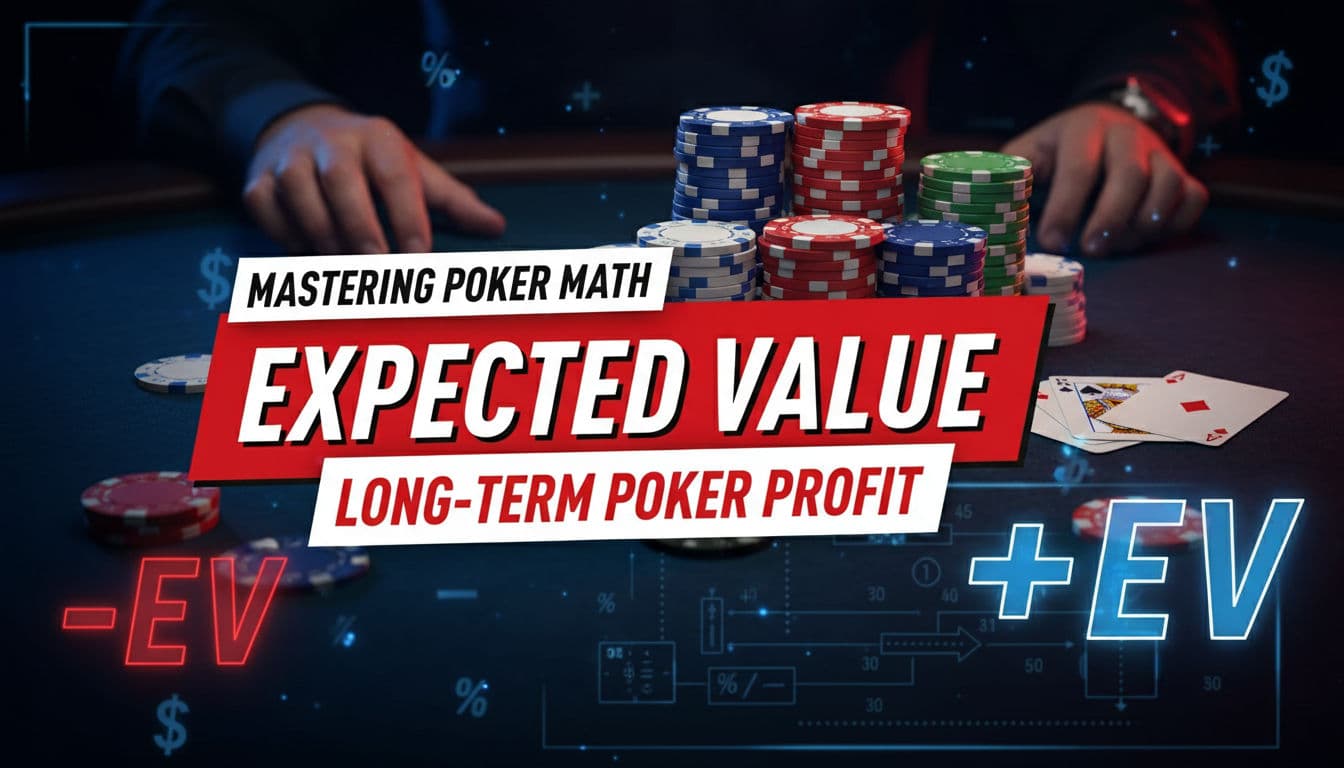
In poker, Expected Value (EV) is the most critical mathematical concept for long-term success. It measures the average amount of money you can expect to win or lose by making a certain play over and over again. By consistently choosing actions with a positive Expected Value (+EV), you guarantee profitability over time, regardless of short-term luck.
Expected Value Poker: What is EV and How Does It Work?
Mastering "expected value poker" is what separates amateurs from serious players. It's not just about winning a single hand; it's about making decisions that are profitable in the long run. Essentially, poker EV represents your long-term average profit or loss. Every decision you make at the table – betting, calling, folding, or raising – has an associated EV, which can be positive, negative, or neutral (zero).
A positive EV play is one that, on average, makes you money. A negative EV poker play is one that loses you money over time. The goal of a winning poker player is to maximize the number of +EV decisions they make and minimize the -EV ones. Even if a +EV play results in you losing a specific pot, it was still the correct decision because if you repeated that same scenario thousands of times, you would show a profit.
"Great poker players don't focus on the results of one hand. They focus on making the highest EV decision with the information they have. The money follows the correct plays, not the other way around."
How to Calculate Expected Value
While performing complex math in the heat of a hand is difficult, understanding the formula is key to developing intuition. The basic formula for a simple EV calculation is:
EV = (% Chance of Winning x $Amount You Win) - (% Chance of Losing x$ Amount You Lose)
Let's break this down with a practical example.
A Classic Turn Call Scenario
Imagine you are on the turn in a No-Limit Hold'em cash game. You have a flush draw.
Pot Size: $200
Opponent's Bet: $50
Your Hand: You need one more spade on the river to make the flush.
Your Assessment: You are certain you will win the hand if you hit your flush and lose if you don't.
To make the calculation, you first need to determine your probability of winning. There are 9 spades (outs) left in the deck among the 46 unseen cards. So, your chance of hitting the flush is 9/46, which is approximately 19.6% (let's round to 20% for simplicity). This means your chance of losing is 80%.
Now, let's plug the numbers into the formula:
Amount You Win: The $200 in the pot plus your opponent's $50 bet, totaling $250.
Amount You Lose: The $50 you have to call.
EV = (0.20 x $250) - (0.80 x $50)
EV = $50 - $40
EV = +$10
In this scenario, calling has a positive Expected Value of $10. This means that every time you make this specific call, you will, on average, profit $10. Sometimes you will lose your $50, and sometimes you will win $250, but over the long term, the decision is profitable. Therefore, calling is the correct play.
Thinking in Terms of Poker EV Beyond Math
While direct expected value poker calculations are powerful, the game is more complex than a simple turn call. Factors that influence EV include:
Concept | Description |
Implied Odds | The potential to win additional money on future streets if you complete your draw. This can make a call that is technically -EV on the current street a +EV play overall. |
Reverse Implied Odds | The risk of losing additional money on future streets when you hit your hand, but your opponent makes an even better one. |
Opponent Tendencies | Your opponent's playing style heavily impacts EV. For example, bluffing is more +EV against a tight player who folds often than against a loose 'calling station'. |
Maximize Your Edge
The easiest way to increase your win rate is by playing against opponents who consistently make mathematically incorrect (-EV) decisions. Check out our top online poker recommendations to find the most profitable games on trusted, independently audited poker rooms where the competition is soft and your bankroll is completely safe.
Conclusion: Make EV Your North Star
You don't need to be a math genius to master expected value poker. The key is to shift your mindset from short-term results to long-term profitability. Start by analyzing situations away from the table. The more you practice thinking about the potential outcomes and their probabilities, the more intuitive making +EV decisions will become. Consistently choosing the path with the highest poker EV is the single most important skill for achieving long-term profit.
| Pros | Cons |
|---|---|
Using EV as your guide ensures that you will be a winning player over time by focusing on profitable decisions, independent of short-term luck. | Performing precise EV calculations during a timed hand can be very difficult, especially with multiple variables like implied odds in play. |
It provides a logical, mathematical framework for making choices, removing emotion and guesswork from your strategy. | The accuracy of any EV calculation depends on how accurately you can estimate your opponent's range and your own equity, which is never perfect. |
Understanding EV helps players cope with bad beats, as they know they made the correct play regardless of the unfortunate outcome. | Making +EV plays doesn't guarantee you will win the current hand or session. Variance can lead to significant short-term losses even with perfect play. |
Related Poker Terms
Best Online Poker Bonus Codes


Bence Mitykó is SoMuchPoker's Poker Content Writer, covering poker strategy grounded in his own experience as a former professional player. He learned card games from his father as a child, discovered poker during the boom years, and later spent four years playing professionally, focused mainly on Heads-Up Sit and Go tournaments, before moving into full time writing.