

Open Ended

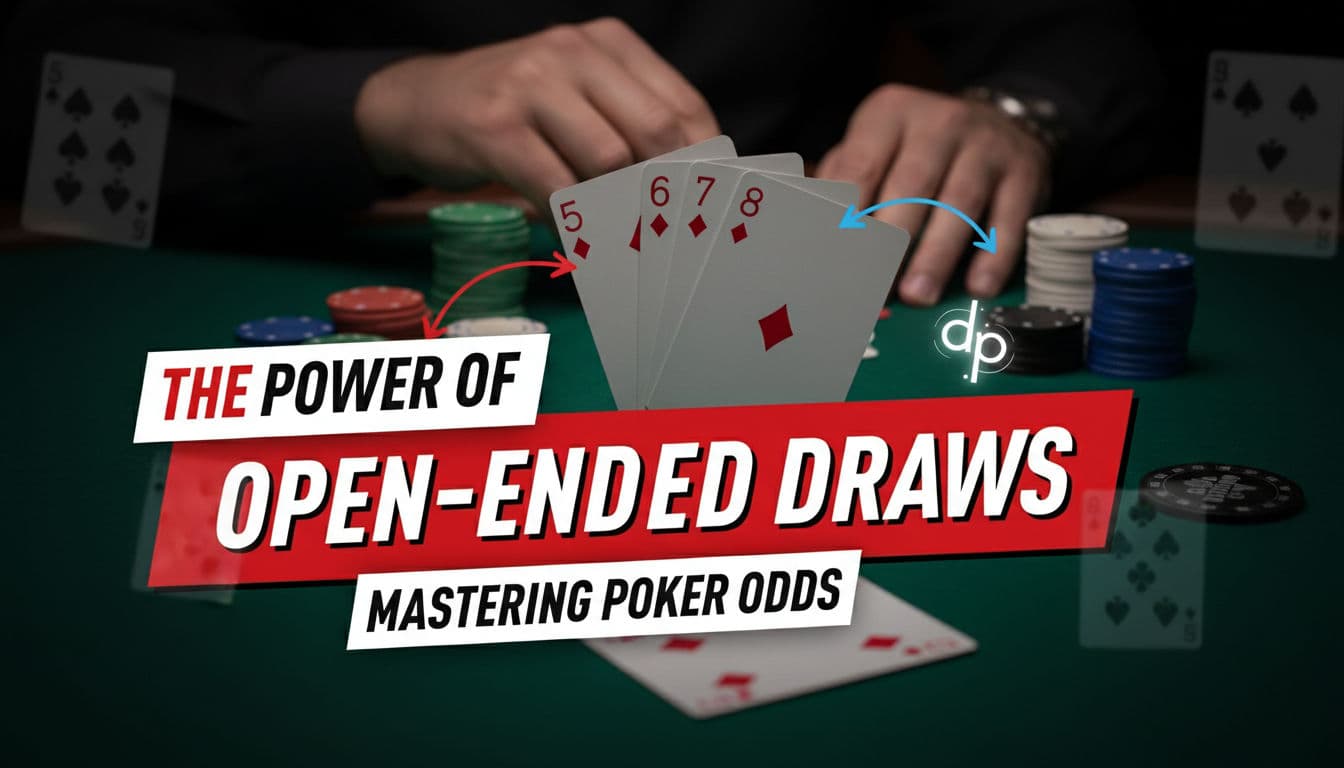
The open-ended straight draw (OESD) is a fundamental yet often misunderstood component of advanced poker strategy. More than just a collection of four consecutive cards, it represents a potent blend of raw equity and significant semi-bluffing potential, capable of transforming a seemingly mediocre hand into a dominating force. This article dissects the OESD, moving beyond its basic definition to explore its intricate strategic value, optimal deployment, and the critical considerations necessary to avoid common pitfalls at the poker table. Mastering the OESD is a hallmark of an expert player, offering a versatile tool for both aggression and calculated risk-taking in various poker formats.
Understanding the Open-Ended Straight Draw Strategy
In the lexicon of poker, an Open-Ended Straight Draw (OESD) signifies a powerful prospective hand where a player holds four sequential cards, requiring one specific card from either end of that sequence to complete a formidable five-card straight. This dynamic drawing hand is a recurring feature across popular poker variations such as Texas Hold'em, Omaha, and Seven-Card Stud, presenting significant strategic depth.
Illustrative Examples of an OESD
Consider a scenario where a player holds 5-6-7-8. Any 4 or 9 would complete their straight, providing two distinct ranks for completion.
Another common instance arises when a player's hole cards combine with the community cards. If a player holds 6♦ 7♦ and the flop reveals 8♣ 9♠ K♥, they possess an OESD. A 5 or a 10 would grant them the straight, making their hand potent.
The Power of Outs: Calculating OESD Odds
The inherent strength of an OESD stems from its generous allocation of "outs" – the specific cards remaining in the deck that will complete the desired hand. An OESD provides exactly eight such outs: four cards of the lower rank needed and four cards of the higher rank needed. For example, with 5-6-7-8, there are four 4s and four 9s left in the deck.
Understanding these odds is foundational for profitable play:
On the next card (e.g., from flop to turn, or turn to river), the probability of hitting an OESD is approximately 17%, which translates to roughly 1 in 6.
When there are two cards yet to come (e.g., on the flop, needing a card on the turn or river), the odds of completing the straight surge to approximately 31.5%, or about 1 in 3. These percentages underscore why OESD often played with considerable aggression.
Understanding these probabilities is essential for long-term success in online poker , where recognizing and pricing your draws correctly can be the difference between a losing session and a massive win.
Strategic Deployment of the Open-Ended Straight Draw
An OESD is widely regarded as one of the most valuable drawing hands, not only due to its numerous outs but also its inherent flexibility. Savvy players frequently leverage OESDs for strategic advantages.
Aggression and Semi-Bluffing with OESDs
The substantial equity an OESD carries makes it an excellent candidate for semi-bluffing. By betting or raising with an OESD, a player achieves two primary objectives:
They build a larger pot if they hit their straight.
They generate "fold equity," forcing opponents with marginal holdings to fold, thereby winning the pot outright without needing to complete the draw. This strategy is particularly effective from a late position, where one has observed opponent actions, or against weaker opponents prone to folding.
Position as a Force Multiplier
Playing an OESD from a late position grants a crucial informational advantage. Observing the actions of players before you allows for more informed decisions regarding whether to call, raise, or fold. This positional advantage can significantly enhance the profitability of chasing an OESD, enabling more effective semi-bluffs and better control over pot size.
Navigating Stack Dynamics and Implied Odds
The depth of your stack relative to your opponents' and the pot size profoundly impacts the value of chasing an OESD. "Implied odds" – the potential future money you stand to win if you complete your hand – are critical. A deep stack allows you to maximize your winnings when you hit your straight, making OESDs more attractive. Conversely, shallow stacks limit implied odds, often making speculative draws less profitable.
Mitigating Risks: Understanding Reverse Implied Odds
Despite their strength, OESDs are not without risk. A significant pitfall is the potential for "reverse implied odds." This occurs when completing your straight might still lead to a loss against an even stronger hand held by an opponent. For instance, if you hit a straight on a board that also completes a higher straight for an opponent, or worse, a flush, your seemingly strong hand could be crushed. Recognizing board texture and opponent tendencies is paramount to avoid these costly situations, especially on boards with multiple drawing possibilities.
Optimal Play Considerations
Beyond the raw odds, several factors dictate the optimal strategy for playing an OESD:
Board Texture: Is the board paired? Are there flush draws possible? A wet board can diminish the relative strength of your straight.
Opponent Tendencies: Are your opponents tight or loose? Aggressive or passive? Tailoring your play to their styles is crucial.
Stack Depth: As discussed, deep stacks enhance implied odds.
Number of Hole Cards Used: Two-card OESDs (using both hole cards to form the draw) are generally preferred as they keep your opponent guessing about your hand strength and leave more potential for higher kickers or secondary draws. One-card OESDs often advertise your hand more clearly and might be less profitable.
OESD vs. Other Draws: A Comparative Analysis
It's beneficial to compare the OESD with other common draws to fully appreciate its standing:
Gutshot Straight Draw: A gutshot, or inside straight draw, has only four outs (e.g., 5-7-8-9 needing a 6). This is half the outs of an OESD, making it significantly less likely to complete. Consequently, gutshots typically require much better implied odds or a strong semi-bluffing opportunity to be profitably played.
Flush Draw: A pure flush draw (e.g., four cards of the same suit) also has nine outs, making it slightly stronger than an OESD in terms of raw completion probability. When combined (e.g., a straight-flush draw), these hands become incredibly powerful.
Combo Draws: The true power of poker often emerges with "combo draws" – hands combining an OESD with another draw, such as a flush draw. A hand like 6♦ 7♦ on a 8♣ 9♦ 2♥ board gives you an OESD (8 outs) and a flush draw (9 outs), totaling 15 outs (two of them overlap: the 5♦ and 10♦). These hands possess immense equity and are almost always worth playing aggressively.
Understanding these distinctions allows players to accurately assess their hand's true equity and make more informed strategic decisions.
| Pros | Cons |
|---|---|
With eight 'outs' to complete, the Open-Ended Straight Draw offers solid statistical odds of hitting the desired card on subsequent streets, significantly more than a gutshot. | A significant risk is completing the straight only to find an opponent has a higher straight, a flush, or a full house, leading to potential significant losses. |
The substantial equity of an OESD makes it an excellent hand for semi-bluffing, allowing players to win the pot outright through fold equity or build a large pot when they hit. | On certain board textures, the presence of an OESD can be transparent to observant opponents, making it harder to extract value or successfully semi-bluff. |
When an OESD completes, it often results in a strong, disguised hand, allowing the player to extract maximum value from opponents, especially with good implied odds. | If the draw does not hit, players can incur considerable losses from chasing, particularly if they bet or called large amounts without sufficient implied odds. |
Related Poker Terms
Best Online Poker Bonus Codes


About the Editor

Bence Mitykó is a Somuchpoker poker writer, covering poker news and strategy. He spent four years playing poker professionally, primarily focusing on Heads-Up Sit & Go games, experience that continues to shape his understanding of poker strategy, online poker dynamics, and the wider poker industry.


