

Board

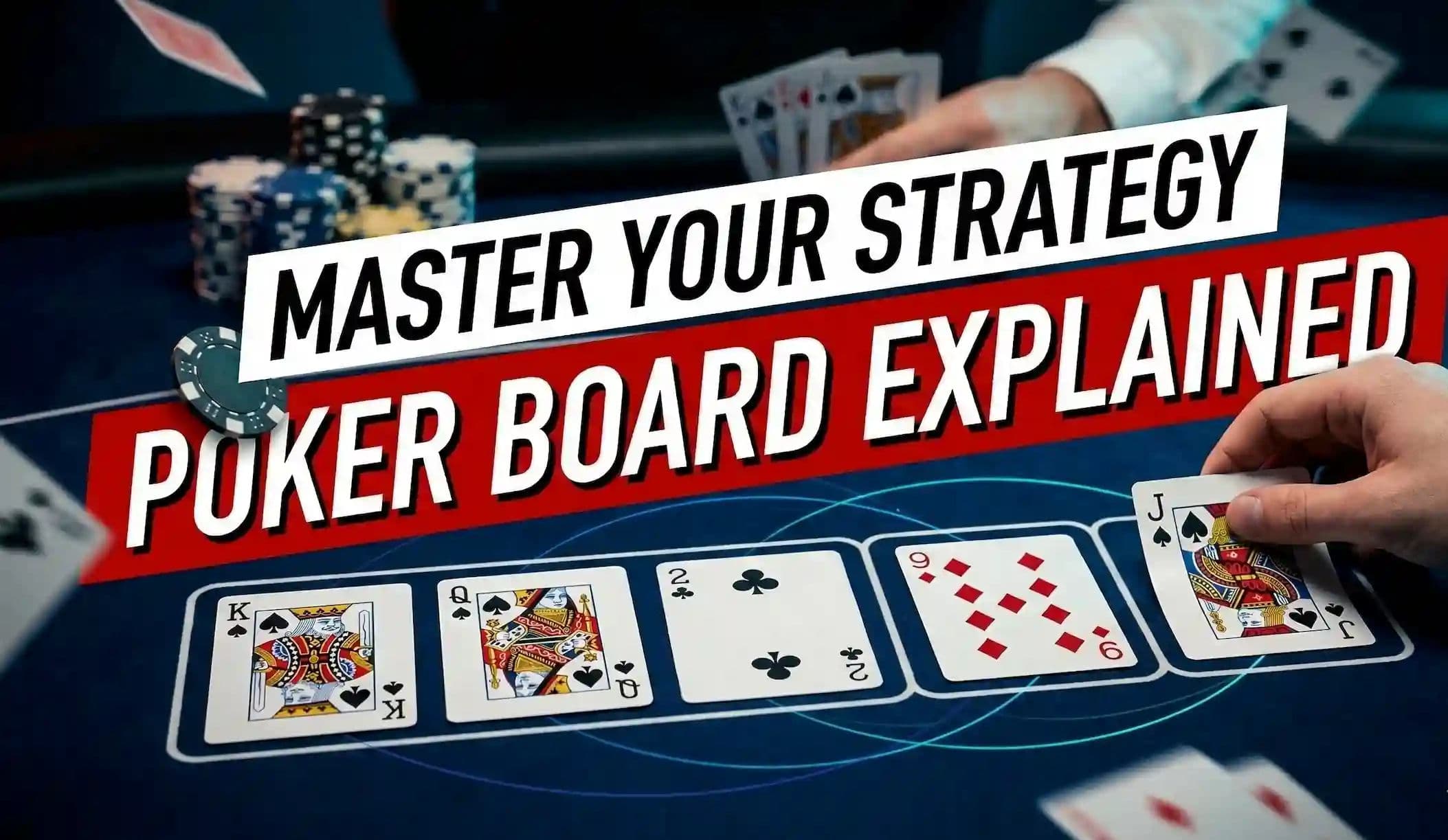
In the intricate ecosystem of poker, particularly in popular variants like Texas Hold'em and Omaha, the 'board' stands as a pivotal element dictating the flow of the game and the potential of every hand. Far more than just a collection of cards, the board represents the communal canvas upon which all players paint their strategic masterpieces. Mastering the art of reading and interpreting these shared cards is not merely a beneficial skill; it is an absolute necessity for any player aspiring to move beyond basic play and consistently outmaneuver their adversaries. This comprehensive guide will dissect the multifaceted aspects of the poker board, providing an expert framework for analytical understanding and strategic application.
Poker Board Explained: What is the Board in Poker?
At its core, getting the poker board explained is simple: it refers to the community cards that are dealt face-up in the center of the table, accessible to all players. If you are wondering what is the board in poker, it is the shared area where cards are placed to combine with your private 'hole cards' to form the strongest possible five-card poker hand. In the context of 'flop games'–such as the immensely popular Texas Hold'em and Pot-Limit Omaha–the board unfolds in three distinct stages:
The Flop: The initial three community cards, dealt simultaneously after the first betting round.
The Turn: A single fourth community card, dealt after the second betting round.
The River: The final, fifth community card, dealt after the third betting round, concludes the community card distribution.
Mastering your flop turn river strategy means understanding that each new card on the board dramatically alters the landscape, presenting fresh opportunities and potential threats that demand continuous re-evaluation.
The Indispensable Skill of Reading the Board
Beyond merely identifying the cards displayed, learning how to read the poker board is a sophisticated analytical skill crucial for strategic prowess. This process involves a meticulous assessment of the community cards to:
Determine Your Own Hand Strength: Objectively gauge the current value and potential of your hand in combination with the board.
Estimate Opponent Hand Ranges: Critically infer the plausible hands your opponents might hold, based on their pre-flop and post-flop actions in relation to the board texture.
An adept player not only understands poker hand rankings but also possesses the acute ability to visualize how various hole card combinations interact with the communal cards. Misinterpreting the board can lead to catastrophic errors, ranging from overplaying weak hands and costly bluffs to folding strong hands against perceived threats that simply don't exist.
Strategic Considerations: Deconstructing Board Texture
When developing your community cards strategy, it's paramount to analyze the board's 'texture' – the inherent characteristics that define the range of hands it facilitates. This goes beyond just individual cards and delves into the collective implications:
Coordinated or 'Wet' Boards: Boards featuring multiple cards of the same suit (e.g., K♠ Q♠ 7♠) or consecutively ranked cards (e.g., 9♦ T♥ J♣) are considered 'wet' or 'coordinated.' These textures significantly amplify the possibility of flush draws, straight draws, or even completed flushes and straights for opponents. Such boards demand caution and often encourage aggressive play from players holding strong draws or made hands.
Uncoordinated or 'Dry' Boards: Conversely, 'dry' or 'uncoordinated' boards present disparate cards with little connectivity (e.g., A♣ 8♦ 3♥). On these boards, strong draws are less frequent, implying that completed strong hands are also less likely. This texture often favors players holding strong single pairs or overpairs, as the probability of being outdrawn is lower.
Paired and Tripled Boards: The presence of a pair (e.g., 9♣ 9♥ 5♠) or even three of a kind (e.g., K♦ K♠ K♣) on the board fundamentally alters hand values. These textures make full houses and four of a kind possible, dramatically impacting the strength of even strong two-pair hands and requiring players to reassess their equity against potentially monster hands.
In advanced poker board play, expert players continuously project opponent hand ranges onto the board, anticipating how these communal card combinations influence betting patterns and strategic decision-making on every street.
Illustrative Example of Board Dynamics
Let's consider a practical example in Texas Hold'em. You hold A♥ K♥ (Ace-King suited hearts). The flop is J♥ T♥ 7♦. With your hand, you immediately recognize a powerful nut flush draw and an inside straight draw, also known as a gutshot (needing a Queen for the Broadway straight). Your hand holds significant equity and numerous paths to victory.
Now, imagine the turn card is the J♣. The board becomes J♥ T♥ 7♦ J♣. This development is crucial:
The board now contains a pair of Jacks. An opponent holding a Jack in their hand, or even a smaller pocket pair, could now have a full house or trips.
Your nut flush draw remains highly potent.
Your inside straight draw remains unchanged, still requiring a Queen to complete your straight.
This dynamic shift in board texture necessitates a complete reassessment of your hand's relative strength, your opponents' potential holdings, and your subsequent strategic actions.
Developing Your Board Reading Skills
Consistent practice and a methodical approach are key to mastering poker board analysis. Here are some essential poker hand reading tips:
Understand Hand Rankings: Absolute mastery of all poker hand rankings is the foundational step.
Practice Hand Range Analysis: Regularly work through hand examples, considering what hands your opponents could logically hold given their actions and the board.
Identify Board Texture: Immediately categorize the board as wet, dry, paired, etc., to quickly infer likely hand possibilities.
Utilize Poker Software: Tools that allow you to analyze historical hands or run simulations can greatly accelerate learning.
Post-Session Review: Critically review your play, focusing on how well you interpreted the board in various scenarios.
Common Board Play Mistakes to Avoid
Even experienced players can fall prey to common errors when interacting with the board:
Tunnel Vision: Focusing solely on your own hand's potential and ignoring what the board might offer your opponents.
Ignoring Opponent Actions: Disconnecting opponent betting patterns from the board's texture. Aggressive betting on a wet board likely signifies a strong hand or draw, not just a bluff.
Overvaluing Marginal Hands: Mistaking a decent hand on a dry board for a monster hand on a coordinated one.
Failure to Adapt: Not adjusting your strategy as the board evolves on the turn and river.
Mastery of the poker board is a continuous journey that requires analytical rigor, keen observation, and disciplined practice. By internalizing these principles, you can transform the community cards from mere information into a powerful strategic weapon.
Ready to turn these board reading skills into real profit? Put your texture analysis to the test by choosing one of our highly recommended online poker sites and start outplaying the competition today.
| Pros | Cons |
|---|---|
A deep understanding of the board's texture and potential allows for significantly more informed and profitable decisions regarding betting, folding, and raising. | Mastering board analysis requires extensive practice, knowledge of hand rankings, and understanding of combinatorics, making it challenging for beginners. |
Skillful board reading enables players to accurately narrow down the range of hands an opponent might possess, leading to better bluffs and hero calls. | Focusing too heavily on the board without considering opponent tendencies or stack sizes can lead to missed opportunities or costly misreads. |
Knowing how the board interacts with various holdings helps in precisely calculating your hand's equity against opponent ranges, a cornerstone of advanced poker. | For less experienced players, the sheer volume of information presented by the board, combined with betting actions, can lead to analytical paralysis. |
Related Poker Terms
6-Max
9-Max (Full Ring)
A-Game
ABC Poker
Bankroll
Bet Size
Bet Sizing
Blocker
Bluff
Bluff Catcher
Board
Bubble Factor
Button
Call
Check-Call
Check-fold
Check-Raise
Click-Back
Donkament
Double Barrel
First in
Gap Concept
GTO
Gutshot
Hot Streak
HUD
Image
Insta-Call
Isolation
Kicker
Leak
Limp
Limp-Fold
Limp-Raise
Middle Pair
Min-raise
Monotone
Monster
Multi-Way Pot
Nit
Nuts
One-Way Straight
Online Poker
Online Poker Strategies
Open Limp
Out of Line
Over the top
Over-Limp
Overblind
Overcall
Overcard
Overpair
Pat
Peel
Play Behind
Polarized
Pot Control
Potting Out
Preflop
Premium Hands
Probe Bet
Proposing Bets
Push or Fold
Put Down
Quads
Quartered
Quitting Time
Quorum
Ragged
Range
Range Advantage
Razz
Reverse Implied Odds
Rolled Up
Royal Flush
Runner Runner
Running Good
Sandbagging
Satellite
Sit and Go (SNG)
Slow Play
Smooth Call
Snap Call
Snapped Off
Soft Seat
Solid
Steal
Suited
Suited Gappers
Tank
Total air
Trap
Two-Gapper
Under the Gun (UTG)
Underpair
Value
Value Bet
Villain
Weak Ace
Window Card
Best Online Poker Bonus Codes


About the Editor

Bence Mitykó is a Somuchpoker poker writer, covering poker news and strategy. He spent four years playing poker professionally, primarily focusing on Heads-Up Sit & Go games, experience that continues to shape his understanding of poker strategy, online poker dynamics, and the wider poker industry.


