Poker Cash Games: Tactics, Insights, and Hidden Edges for Winning More


Do you want to know how poker cash games work? Picture this: it is just past midnight, and you are in a cardroom somewhere in Las Vegas. The air is heavy with the faint scent of worn leather chairs, stale coffee that’s been sitting on a warmer too long, and a ghost of cigarette smoke from the days before the indoor ban. The carpet’s been designed in loud, dizzying patterns meant to hide stains, but you know those dark patches by the drink cart have been there for years.
The hum of conversation floats over the steady clack of chips. Some players stack them neatly, others nervously riffle through them without even realizing. Under the warm, slightly yellowed lights, a dealer slides the flop into view. Three players lean forward, elbows on the padded rail, eyes locked on the felt as they could will the turn card into existence.
No tournament clock blinking in the corner. No blinds about to jump. Just a game that keeps rolling until the last person decides they’ve had enough. Here, you are the one who chooses the tempo: dig in for an eight-hour grind, or pull your chips after one well-played monster pot.
Now imagine an entirely different scene. You’re at home in your PJs, half-slouched in a chair that’s definitely not ergonomically approved. Your coffee went cold already, and your sandwich sits half-eaten on the desk, because you keep forgetting about it. Two online tables are open, maybe three.
The pace is breakneck, and the pressure to make decisions comes faster than you can finish a thought yourself. Sometimes you’re still mentally replaying a tricky river on table one when table two starts flashing “Your turn”. You can’t see your opponents’ eyes, but you can feel the pressure in the rhythm. It is relentless, mechanical, and, most of all, addictive.
Before the days of tournament TV coverage, before the bracelets, before poker rooms cared about branding their chip colors, cash games were poker’s heartbeat. They still are. For pros, they’re the daily bread. For casual players, they’re the most flexible way to play. And they’re the one format where you control not only how you play, but when and how long.

This isn’t a bullet-point “how to” list. This is the whole map: what cash games actually are, the differences between live and online , how to manage a bankroll so variance doesn’t steamroll you, why rake matters more than most think, strategies that survive the long term, the psychology that wins pots before cards are even turned, and the mistakes that keep people stuck in the same spot year after year. Along the way, there are stories, some cautionary, some inspiring, and, because it matters, a frank talk about responsible play when money’s on the line.
The Truth About Cash Games
In a poker cash game, every chip has a direct, fixed cash value. A $1/$2 game? Small blind is $1, big blind is $2, every hand, all night. Those $100 worth of chips in front of you aren’t symbolic. They’re real money you can take to the cage the moment you decide you’ve had enough.
Tournaments are different animals. Blinds creep upward like an incoming tide, forcing action whether you like it or not. Stack sizes are frozen until you bust or win, and walking away early means forfeiting your chips. In cash games, blinds don’t change, which means the game has its own natural pace, set by the players, not by a clock.
That steady structure allows for flexibility you simply can’t get in tournaments. You can buy in, play a single round, and cash out. You can stay until your coffee turns into cold sludge, or until the early morning cleaning crew politely vacuums around you. In Vegas, there are grinders who treat a specific seat in a specific game as their office desk. Same time, same table, every day.
Most cash games run No Limit Texas Hold’em, but Pot Limit Omaha has carved out a fan base that swears by the bigger pots and looser play. And then there are mixed games, a kind of mental obstacle course where formats change every round, testing adaptability and patience.
Plenty of pros argue that cash games measure raw poker skill better than tournaments. No payout ladders, no structure changes, just you, your opponents, and decisions that matter right now, not “after the next blind level.”
Live vs. Online Poker
On paper, live and online games follow the same rules. In reality, they’re two very different worlds.
Live poker moves at a crawl compared to online. 25 to 30 hands an hour if the dealer’s efficient. But that slow pace is prime observation time. You can watch the way someone picks up their chips when they’re bluffing versus when they’re holding the nuts. You can track who likes to talk in big pots and who goes stone silent. You can see if a player glances at their stack before betting big, a subtle tell that often means they’ve already decided to shove.
Some live regulars specialize in exploiting these rhythms. They’ll deliberately tank on a decision to see who leans back impatiently or who stares them down. They’ll limp into a pot not for the cards, but to watch how others react when the action shifts. The live environment has its own theater: laughter after bad beat stories, groans when a dealer spikes a miracle river, sudden silences when the air gets heavy before a showdown.
Online poker is the opposite: a machine gun of decisions. Sixty to ninety hands per hour per table. Multi-table, and you’re dealing with hundreds of hands in the time it takes a live dealer to finish a single orbit. There are no physical tells, so you rely on betting patterns, timing delays, and stats, lots of stats. HUD software lets you track tendencies over thousands of hands: how often someone three-bets from the cutoff, whether they continuation bet too much, or if they fold too often to river raises.
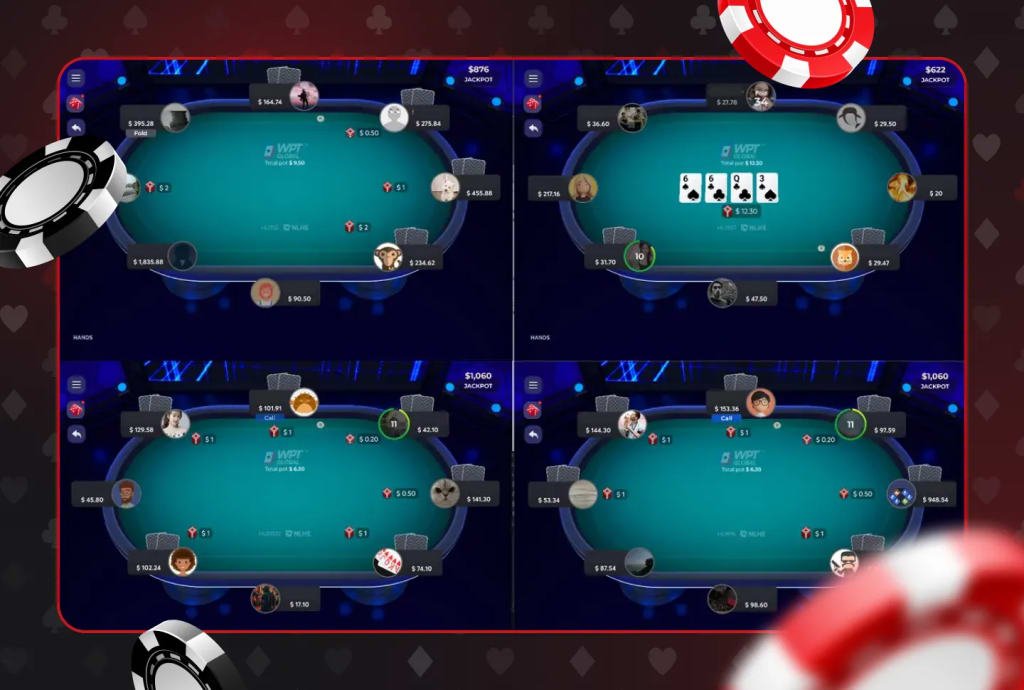
Neither is “better”. Just different. Live teaches patience, people-reading , and handling pressure in real time. Online sharpens technical precision and tests your ability to adapt quickly to constant action. Many strong players split their time between the two, using each to sharpen the other’s weak spots.
Bankroll Management: Your Built-In Safety Net
Bankroll management is poker’s least glamorous skill and its most important survival tool.
Keep your poker funds separate from your rent money. That’s not just discipline; it’s insurance. The general pro advice: keep 20 to 40 buy-ins for whatever stake you play. At $2/$5 with a $1,000 max buy-in, that’s $20k–$40k. At $0.50/$1 online with a $100 max buy-in, $2k–$4k.
It sounds like overkill until you hit a brutal downswing. The kind where you’re playing fine, but variance decides to remind you who’s boss. A healthy bankroll lets you keep playing when others are forced to step away.
Good bankroll management also means knowing when to step down. If you have lost one-fifth to one-third of your bankroll, you should drop to a smaller game. It’s not a pride thing. It’s survival. Playing under financial pressure changes your decision-making, often in ways you don’t notice until you’re wondering why you called off half your stack with second pair.
Rake: The Quiet Profit Drain
Poker rake is the game’s silent tax. The house takes a cut from nearly every pot, often around 5% up to a cap, maybe $3–$5 live, less online. At low stakes, that’s a killer.
Say you make $15/hour before rake. If poker rake takes $12/hour, you’re winning just enough for a couple of coffees. That’s why pros obsess over rake structures before sitting down.
Ways to fight poker rake: find “no flop, no drop” games, look for online rakeback programs (some offer up to 40% back), and play in games where the average pot size hits the rake cap often, making the percentage impact smaller.
Basic Cash Game Strategies That Actually Work
Countless books have been written on cash game strategy, and video courses on the game continue to be produced. There is not enough space in an article to give a comprehensive description of cash game strategies.
The easiest way to get started with cash games for most people is not to learn complicated strategy, but to try to adhere to some simple guiding principles:
- Tight-aggressive first. Pick your hands carefully, but play them with purpose.
- Position is gold. Acting later gives you information. And information is leverage.
- Bet sizing matters. Too small, and you give free draws. Too big, and you chase away value.
- Adjust constantly. Play the table, not just the cards.
- Trust your gut. Years of experience build instincts that your conscious mind can’t fully explain.
- Stay chill. Tilt ruins more bankrolls than bad beats.
The Mind Game Inside the Card Game
Poker’s a human drama acted out with cards and chips.
Live tells come in many flavors: breathing changes, posture shifts, chip-handling quirks. Online tells are about timing, sizing, and consistency, or sudden breaks from it.
Poker player and journalist Maria Konnikova, the author of the book The Biggest Bluff: How I Learned to Pay Attention, Master Myself, and Win, calls poker a masterclass in decision-making under uncertainty.
Every action is a piece of the puzzle; the skill is putting it together faster than your opponent.
Mistakes That Keep Players Stuck
The most common mistakes aren’t dramatic blowups. They are slow leaks: too many hands, calling too much, chasing losses, ignoring rake, playing in bad games. Fix one, and your win rate can shift dramatically. Fix more, and you are in a whole other league of poker players. Don’t try to fix all your leaks at once, though! Focus on just one, and be patient with yourself on your poker journey.
Tales From the Felt
Ben Foster left a $110k corporate job to play part-time online. Best year: $125k at 20 hours/week. But losing months tested his discipline. Many live grinders share the same refrain: freedom and flexibility on one hand, mental fatigue and high swings on the other.
Play Responsibly
Poker can be fun, even profitable, but for some players, it can also spiral into the dark side of the game. If you are dipping into your rent money, hiding your play, or chasing losses, stop. GamCare, GamblersAnonymous, and local helplines exist for a reason. In the U.S., about 2.9 million young people gamble; 580,000 play online poker.
Frequently Asked Questions (FAQ)
Are cash games more profitable than poker tournaments?
Often, yes. Cash games have steadier returns, lower variance, and the freedom to leave on your terms.
How many buy-ins should I have for cash games?
It is best always to have around twenty to forty buy-ins. More if you hate variance, fewer if you like living dangerously.
What is the best beginner cash game strategy?
Play a tight-aggressive style, respect position, and fold when you’re unsure.
Can you make a living by playing cash games?
Yes, but it is a mix of skill, discipline, and mental toughness.
Does rake matter in cash games?
Rake does absolutely matter in cash games. It is the leak you don’t notice until your bankroll starts to evaporate.
Should I start playing cash games live or online?
It depends on your goals. Online cash games give volume; live cash games teach people-reading.
What are the best sites to start playing cash games online?
We recommend Natural8, WPT Global , and CoinPoker . All of them are beginner-friendly, have lots of traffic at the cash game tables, and offer generous welcome bonuses for new players.
Are PLO cash games better than NLHE?
PLO cash games usually have more action, but also more swings. They are best if you are ready for volatility.
What are the signs of tilt in cash games?
The signs of tilt in cash games include chasing losses, calling without thinking, and bluffing just to “get even”.
Related Poker Game Types






Related Online Poker Rooms


Chaar-Lee is the Editor-in-Chief and Technical Architect of SoMuchPoker. With over 20 years across poker media, television production, and enterprise software development (including WorldSkills and EuroSkills recognition as a mentor and expert) he brings rare depth to every editorial and technical decision on this platform. He works exclusively on international poker and iGaming markets.