

One Chip Rule

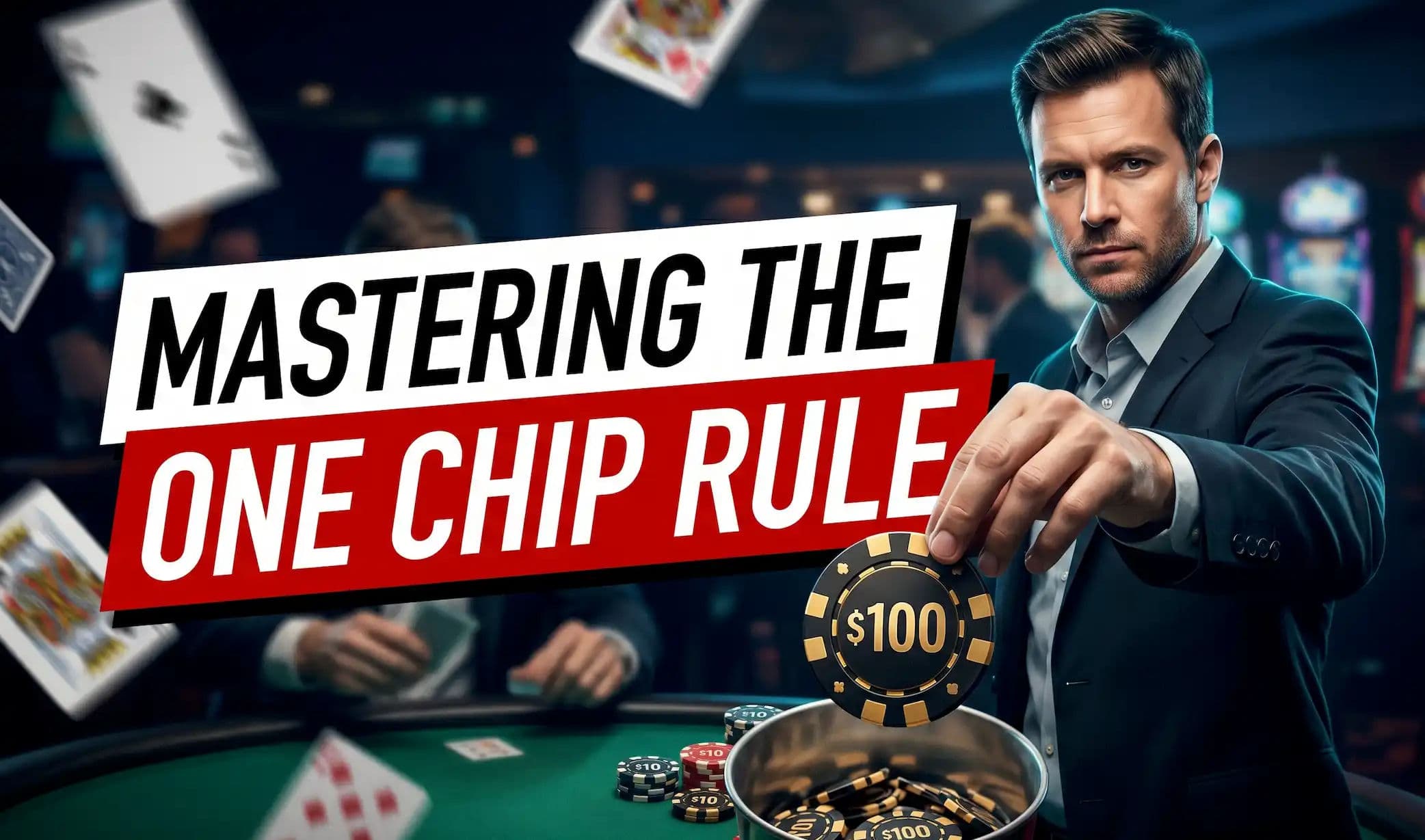
In the dynamic environment of live poker, clear communication and adherence to established rules are paramount for maintaining game integrity and ensuring a fair playing field. Among these crucial guidelines, the 'one chip rule,' often referred to as the 'oversize chip rule,' stands as a cornerstone of live betting etiquette. This fundamental regulation clarifies a player's action when a single chip is presented into the pot following an opponent's bet, particularly in the absence of any verbal declaration. Understanding this rule is not merely about avoiding penalties; it's about navigating the nuanced social contract of the poker table with confidence and precision.
Understanding the One Chip Rule Poker: A Complete Guide
If you are stepping into a casino for the first time and wondering what is the one chip rule, it is one of the most critical mechanics you must learn. At its core, the one chip rule poker dictates that if a player places a solitary chip into the pot without simultaneously or pre-emptively articulating a raise, their action is automatically interpreted as a call, irrespective of the chip's actual monetary value. This principle is a cornerstone of standard live poker rules worldwide, serving as a vital safeguard against ambiguity and potential angle-shooting.
Illustrative Scenarios
Scenario 1: Standard Call. Imagine a No-Limit Hold'em game where a player bets $10. The next player, intending to call, quietly slides a single $10 chip forward. This is unequivocally a call.
Scenario 2: Oversize Chip Call. If the same player bets $10, and the subsequent player places a single $100 chip into the pot without any verbal cue, the $100 chip is considered a call of the $10 bet. This specific situation is formally known as the oversize chip rule in poker. The dealer will then return $90 in change to the player, as their implied action was only to match the preceding bet.
Scenario 3: Multi-Street Action. This rule applies consistently across all betting streets. Whether it's the flop, turn, or river, a lone, unannounced chip is always a call.
The rationale behind this seemingly strict interpretation is to eliminate any potential for a player to gauge reactions before committing to a raise. Without this rule, a player could theoretically put out a large chip, observe opponents' discomfort, and then decide whether to declare a call or a raise, gaining an unfair advantage.
Why This Rule is Indispensable
The importance of this rule cannot be overstated. It primarily serves several critical functions:
Game Protection: It prevents players from exploiting uncertainty. Without it, opportunistic players might use a large chip to intimidate, then retreat to a call if met with strong resistance. Enforcing this rule ensures absolute poker game integrity.
Clarity and Efficiency: It streamlines gameplay by providing a clear, unambiguous interpretation of actions. This reduces disputes, speeds up the game, and allows dealers to manage the action efficiently.
Fairness: By enforcing a consistent standard, the rule ensures that all players operate under the same set of expectations, promoting a level playing field.
Etiquette and Professionalism: It reinforces the importance of clear communication at the table, encouraging everyone to follow proper poker betting etiquette.
Avoiding Common Pitfalls and Avoiding Accidental Calls Poker
While the rule is straightforward, many new or even experienced players occasionally fall prey to its implications. The most common mistake is the assumption that placing a chip of a higher denomination than the current bet automatically signifies a raise.
Here is how to raise in live poker correctly to ensure your intentions are clear:
Verbalize Your Action: The simplest and most effective way to avoid any misunderstanding is to make a clear poker verbal declaration. Before or as you place your chips, say "Call" or "Raise". If raising, state the amount explicitly, e.g., "Raise to $50".
Use Multiple Chips for Raises: If you intend to raise without speaking (though not recommended for clarity), you must place enough chips to clearly constitute a raise. For example, if the bet is $10 and you want to raise to $30, you could place three $10 chips, or a $25 chip and a $5 chip. However, a single $25 chip alone would still be a call of the $10 bet.
Know House Rules: While the one-chip rule is standard, always be aware of any specific house rules that might have minor variations, though this is rare for this fundamental rule.
When the One-Chip Rule Does Not Apply
It's important to note the specific contexts where this rule typically does not govern play:
Online Poker: The one-chip rule is generally irrelevant in online poker environments. Actions are dictated by clicking buttons (e.g., 'Call', 'Raise', 'Fold') and inputting specific amounts, removing the ambiguity of physical chip placement.
Multiple Chips: If a player places multiple chips into the pot that, in combination, clearly exceed the required calling amount, this is typically interpreted as a raise, even without a verbal declaration. However, the exact interpretation can sometimes depend on the specific chip denominations and house rules regarding minimum raise amounts.
While the one-chip rule poker is a staple of the live game, you can avoid these physical complexities entirely by playing in a digital environment. Head over to our top-rated online poker sites to enjoy a seamless experience where every bet and raise is perfectly automated for you.
| Pros | Cons |
|---|---|
The rule prevents players from using chip placement to 'angle shoot' or gain unfair information by observing reactions before committing to a raise. | Inexperienced players unfamiliar with the rule might inadvertently call a bet when their true intention was to raise, leading to frustration and lost opportunities. |
By providing a clear, unambiguous interpretation of a single chip action, it minimizes confusion at the table and speeds up gameplay by avoiding arguments. | Players must be diligent in their actions and verbal declarations; a momentary lapse can lead to an unintended action that cannot be easily reversed. |
It encourages players to adopt best practices of verbally declaring their intentions, leading to smoother and more professional live game environments. |
Related Poker Terms
Best Online Poker Bonus Codes


About the Editor

Bence Mitykó is a Somuchpoker poker writer, covering poker news and strategy. He spent four years playing poker professionally, primarily focusing on Heads-Up Sit & Go games, experience that continues to shape his understanding of poker strategy, online poker dynamics, and the wider poker industry.


