

93: Nine-Three

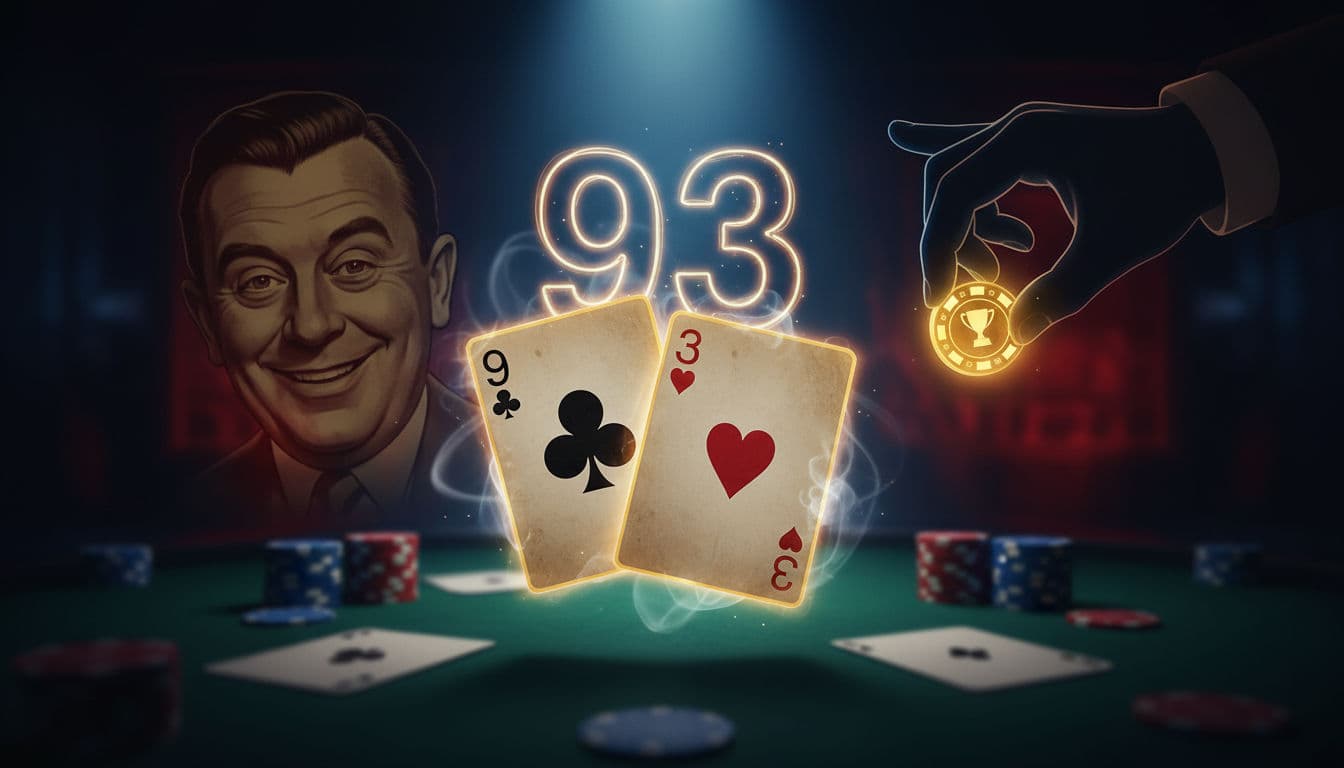
In the vast lexicon of poker, many starting hands have earned nicknames that reflect the game’s long-standing traditions and cultural quirks. The 93 poker hand, despite being widely regarded as one of the weakest combinations in Texas Hold’em, is one such example. Often overlooked at the table, this unassuming hand has nonetheless secured a small but notable place in poker folklore, most famously through its association with the nickname “Jack Benny”. Beyond the name itself, the 93 hand offers an interesting case study in how weak holdings are perceived, remembered, and occasionally misplayed, making it a useful lens for examining both strategic discipline and the psychological side of the game.
The Enigmatic 93: A Hand of Contradictions
The 93 poker hand, typically referred to as 9-3 offsuit unless specified otherwise, is generally considered one of the weakest starting hands in Texas Hold'em Poker. Its lack of connectedness, low card values, and inability to form high straights or flushes directly contribute to its low pre-flop equity. Despite its statistical shortcomings, the 93 has carved out a unique place in poker lore, primarily due to the compelling stories behind its two principal nicknames.
The 93 Poker Hand in Poker Folklore
Within poker culture, the 93 poker hand occupies a curious place that goes far beyond its raw mathematical value. Although widely classified among weak poker hands, 9-3 offsuit has become a recurring symbol in poker folklore, representing the chaotic and psychological side of Texas Hold’em rather than optimal strategy. Players tend to remember hands like this precisely because they defy expectations: when a marginal holding such as 9-3 wins a pot, it often leaves a stronger emotional imprint than yet another routine victory with pocket aces. Over time, these moments contribute to the informal mythology of the game, where unlikely hands gain personality, stories, and sometimes even nicknames.
This phenomenon highlights why discussions around poker hand nicknames so often focus on the weakest holdings. Trash hands like 9-3 offsuit are frequently involved in controversial showdowns, hero calls, or unexpected bluffs, making them ideal candidates for storytelling at the table and in poker media. While no serious professional would recommend incorporating 9-3 into a standard opening range, its presence in anecdotal poker history reinforces an important lesson: poker is not remembered purely through correct decisions, but through emotionally charged outcomes. In this sense, the 93 offsuit strategy is less about long-term profitability and more about understanding variance, perception, and how single hands can influence table dynamics and player psychology.
While strategy guides emphasize the math, the real thrill of the game often comes from these unpredictable moments. If you're looking to experience the full spectrum of Texas Hold’em action, you can find the most vibrant tables and competitive games on online poker sites available today.
Strategic Considerations for Playing 93 Offsuit
Given its generally poor statistical profile, the 93 hand should be approached with extreme caution. Under most circumstances, especially in early or middle positions, it is a clear fold. However, an expert player might consider playing 93 in very specific, highly nuanced scenarios:
Late Position & Cheap Pot: If you are in a late position (e.g., button, cutoff) and the action has been folded to you, or there are multiple limpers, you might consider limping in to see a cheap flop. The goal here is to hit a two-pair or trip 9s or 3s, or a very disguised straight draw if the board somehow connects (e.g., 6-7-8, 5-6-7, J-Q-K with a 9, but these are rare).
Deep Stacks & Implied Odds: With very deep stacks, you might entertain playing 93 from a late position if you can see a flop cheaply, hoping to hit a monster hand that pays off big. The chances are slim, but the reward could be significant if you flop trips or two pair against someone with a strong overpair.
Table Dynamics & Image: If you have an extremely tight image, occasionally playing a hand like 93 and winning a small pot can help balance your range and prevent opponents from putting you on a strong hand every time you enter a pot. Conversely, if you're a loose player, adding 93 to your opening range can be catastrophic.
Heads-Up Play: In heads-up situations, hand values increase significantly, and marginal hands become more playable. However, even then, 93 remains on the weaker end of the spectrum and requires careful consideration.
Ultimately, playing 93 successfully requires a deep understanding of game flow, opponent tendencies, and an acute awareness of pot odds and implied odds. It is a hand for expert players looking to exploit specific table conditions, rather than a standard part of anyone's opening range.
Conclusion: More Than Just Two Cards
The 93 poker hand, with its dual identities of "Jack Benny" and "The Sandy," transcends its humble statistical value. It serves as a microcosm of poker itself: a game where skill, psychology, history, and a touch of serendipity intertwine. Whether it's the enduring comedic genius of Jack Benny or the unlikely championship run of Sandy Dunlop, these nicknames inject personality and narrative into what would otherwise be just another pair of low cards. For the discerning player, understanding these stories not only adds flavor to the game but also reinforces the strategic nuance required to navigate the unpredictable currents of the poker table.
| Pros | Cons |
|---|---|
Since 93 is widely regarded as a weak hand, playing it can lead opponents to underestimate your strength if you hit a strong board, allowing for larger pots when you connect. | Statistically, 93 has very low pre-flop equity against most other hands, making it difficult to win pots consistently without significant post-flop skill or luck. |
Occasionally playing a weak hand like 93 (especially from late position) can make your playing range less predictable, preventing astute opponents from easily putting you on only premium hands. | Your 9s and 3s are often dominated by higher cards (e.g., A9, K9, A3, K3), and connecting with the board can still leave you with a weaker kicker or a lower pair. |
It's hard to make strong hands with 93 (like flushes or straights), and often you'll hit a single pair that's vulnerable or a weak draw, leading to difficult decision-making and potential losses. |
Related Poker Terms
22233
3322
36TJK
4444
5432A
555
666
76: Seven-Six
77: Pocket Sevens
84: Eight-Four
85: Eight-Five
86: Eight-Six
87: Eight-Seven
88: Pocket Eights
93: Nine-Three
95: Nine-Five
96: Nine-Six
98: Nine-Eight
99: Pocket Nines
A2: Ace-Deuce
A3: Ace-Three
A3A6
A4: Ace-Four
A5: Ace-Five
A6: Ace-Six
A7: Ace-Seven
A8: Ace-Eight
A9: Ace-Nine
AA: Pocket Aces
AA88: Dead Man's Hand
AAA
AAAA
AAAAK
AAJJ
AJ: Ace-Jack
AK47
AQ: Ace-Queen
AT: Ace-Ten
J8: Jack-Eight
J9: Jack-Nine
JA55
JJ: Pocket Jacks
JT: Jack-Ten
K3: King-Three
K4: King-Four
K5: King-Five
K6: King-Six
K7: King-Seven
K8: King-Eight
K9: King-Nine
KJ: King-Jack
KK: Pocket Kings
KKKAA
KKKK
KKKQQ
KKQQ
KQ: King-Queen
KQJT9
KT: King-Ten
Q7: Queen-Seven
Q9: Queen-Nine
QJ: Queen-Jack
QQ: Pocket Queens
QQQQ
QT: Queen-Ten
Steel Wheel
T2: Ten-Deuce
T8: Ten-Eight
T9: Ten-Nine
TT: Pocket Tens
TTT: Trip Tens
Best Online Poker Bonus Codes


About the Editor

Bence Mitykó is a Somuchpoker poker writer, covering poker news and strategy. He spent four years playing poker professionally, primarily focusing on Heads-Up Sit & Go games, experience that continues to shape his understanding of poker strategy, online poker dynamics, and the wider poker industry.


