K9: King-Nine

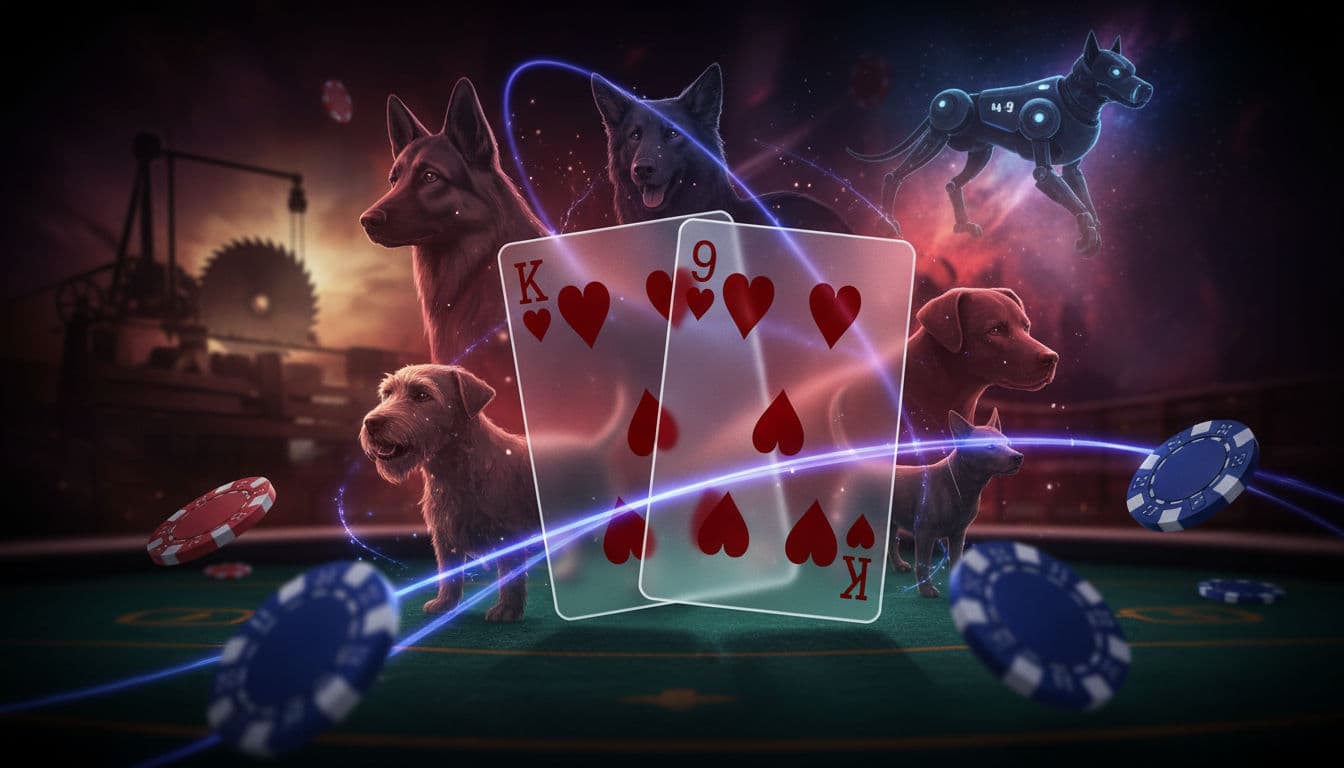
In the vast lexicon of poker nicknames, some hands stand out more for their colorful monikers than their inherent strength. The King-Nine, or K9, is undoubtedly one such hand. Often sitting in the ambiguous middle ground of starting hand rankings, K9 has carved out a fascinating niche in poker lore, distinguished by an array of nicknames primarily rooted in its phonetic resemblance to "canine." From lighthearted references to beloved pets to more controversial allusions and even a storied origin in a Texas poker room, the K9 hand embodies the rich tapestry of poker culture. This article delves into the unique history and strategic nuances surrounding K9, exploring its memorable aliases and offering expert insights into playing this intriguing hand effectively.
Decoding the K9 Poker Hand
The poker world is replete with unique poker slang and poker nicknames, and the K9 poker (King-Nine hand) is a prime example of this vibrant linguistic tradition. While not considered a premium starting hand, K9 holds a special place due to its extensive and often amusing collection of aliases, predominantly linked to the phonetic similarity between "K-Nine" and "canine." Understanding these nicknames not only adds to a player's poker vocabulary but also offers a glimpse into the game's rich history and the creative minds of those who play it.
The Canine Connection: A Pack of Nicknames
The most straightforward and widely recognized origin for K9's nicknames stems directly from its sound. The "K" for King and "9" for Nine combine to form "K-Nine," which is phonetically identical to "canine," the scientific term for dogs. This simple linguistic link has spawned a host of dog-related monikers:
Canine: The foundational nickname, directly referencing the phonetic match. It's a straightforward descriptor, instantly understood by seasoned players.
Dogs: A natural extension of "canine," this is a common and informal way to refer to K9. Hearing a player declare they "had the dogs" often means they held King-Nine.
Bow-wow: A more playful and onomatopoeic nickname, "Bow-wow" further emphasizes the dog connection, evoking the sound of a barking dog.
Fido: A classic dog name, "Fido" serves as another affectionate and universally recognized term for a pet dog, thus becoming an apt nickname for K9.
Suited vs. Offsuit: Distinctions within the Pack
Just as there are different breeds of dogs, poker players often distinguish between suited and offsuit variations of K9, bestowing specific nicknames to reflect their respective strengths:
Mongrel (offsuit): An offsuit K9, meaning the King and Nine are of different suits (e.g., K♦9♠), is often dubbed "Mongrel" or "Mutt." These terms suggest a mixed breed, lacking the refined quality of a purebred. In poker terms, an offsuit hand generally has less drawing potential and playability compared to its suited counterpart, making "Mongrel" a fitting descriptor for a slightly weaker, less coordinated K9.
Mutt (offsuit): Similar to "Mongrel," "Mutt" also implies a mixed-breed dog, highlighting the less desirable nature of an offsuit K9. Both "Mongrel" and "Mutt" hands face challenges in creating strong flushes or flush draws, diminishing their overall equity.
Pedigree (suited): Conversely, a suited K9 (e.g., K♥9♥) earns the distinguished nickname "Pedigree." This term refers to a purebred dog with a documented lineage, implying higher quality and potential. In poker, suited connectors or gappers, like K9s, offer backdoor flush opportunities and often play better in multiway pots, giving them a "pedigree" edge over their offsuit counterparts.
Controversial and Pop Culture Allusions
Beyond the simple phonetic links, K9's nicknames extend into more specific cultural references, some quite controversial, demonstrating the diverse influences on poker slang.
Michael Vick: This is perhaps the most somber and controversial Michael Vick poker hand nickname. It refers to the former NFL quarterback Michael Vick, who was infamously convicted for his involvement in an illegal dog-fighting ring. The nickname serves as a dark and sobering reminder of that scandal, highlighting the more unsavory side of human behavior, even within the context of a poker game.
Rin Tin Tin: A more lighthearted and nostalgic reference, "Rin Tin Tin poker" pays homage to the legendary German Shepherd dog star who featured in numerous Hollywood films and was often depicted as a K9 police dog. This nickname evokes a sense of heroism and loyalty, a stark contrast to the "Michael Vick" moniker.
The Doctor Who: This nickname draws from popular culture, specifically the long-running British science fiction television series, Doctor Who. Doctor Who is the name of the robotic dog companion who frequently assisted the Doctor in his adventures. This reference showcases the playful and often nerdy side of poker culture, where obscure pop culture elements find their way into the game's lexicon.
The Legend of "Sawmill": A Story of Hardship and K9
One of the most evocative and enduring nicknames for K9 is "Sawmill poker" a term with a fascinating origin story directly tied to a professional poker player's experience. Byron 'Cowboy' Wolford, a well-known figure in the poker community, recounted the tale that immortalized K9 as "Sawmill":
"Milton Butts and I were playing poker in Bryan, Texas, where they had a good game going on the weekends. We'd been playing for a couple of days when a hand came up in which I had a K-9. I made a pretty good hand with it, but lost the pot and went broke. As I was driving back home to Houston with Milton, feeling kind of disgusted about going broke with that K-9, we passed by a sawmill where a man was sawing logs in the lumberyard.
'As hard as that guy works for his money, I'll bet he would never go broke with a K-9,' I told Milton. And that's how K-9 got named 'Sawmill.' Some of those names are still going around – Doyle Brunson mentioned the sawmill hand in his book, Super/System."
This story captures the essence of poker's emotional highs and lows. Wolford's frustration at losing with a K9 hand, combined with the stark contrast of the sawmill worker's grueling labor, gave birth to a nickname that reflects a sense of financial hardship. The fact that poker legend Doyle Brunson validated this nickname in his seminal work, Super/System, solidifies "Sawmill poker" as a permanent fixture in poker history.
Strategic Considerations When Playing K9
Beyond its colorful nicknames, K9 is a hand that demands careful consideration at the poker table. While not a premium hand like Ace-King or pocket Aces, it offers playability and potential, particularly when suited or in specific situations.
Pre-Flop Play
Position is Paramount: in Texas Hold'em K9 plays significantly better from late position. This allows you to see how other players act before making your decision, giving you valuable information. From early position, K9 is generally a fold due to its vulnerability and limited equity against stronger opening ranges.
Suited vs. Offsuit: A suited K9 ("Pedigree") has better equity than an offsuit K9 ("Mongrel"). Suitedness adds flush draw potential and can lead to more disguised strong hands on the flop. Offsuit K9 lacks this crucial dimension and should be played even more cautiously.
Stack Sizes: In deeper stack situations, K9s can be worth speculating with, especially when suited, as you have more chips to realize its flush or straight potential. In shallower stack games, its value diminishes rapidly.
Opponent Tendencies: Against tight players who rarely open, K9 is a speculative call or fold. Against loose, aggressive players, it might be a decent re-steal candidate from the button or cutoff, but be prepared to fold to resistance under a solid King Nine strategy.
Post-Flop Play
Top Pair, Weak Kicker: If you hit a King on the flop with K9 offsuit, you've made top pair. However, your Nine kicker is weak. This situation can be tricky against opponents who also hold a King with a better kicker (e.g., KJ, KQ, KA). Proceed with caution, especially if the board is coordinated.
Drawing Potential: A suited K9 provides backdoor flush draws and sometimes straight draws (e.g., on a board of 7-8-X, you could pick up a gutshot). These draws offer implied odds, but don't overcommit without strong equity.
Avoid Overplaying: K9 is rarely the best hand pre-flop, and it often remains a marginal hand post-flop. Avoid getting deeply invested unless you hit a very strong hand (two pair, trips, flush) or have strong reads on your opponent as part of your poker strategy K9.
Conclusion
The K9 poker hand, with its rich tapestry of nicknames, from the playful "Bow-wow" to the storied "Sawmill" and the controversial "Michael Vick poker hand," offers a unique lens through which to view the culture and history of poker. While its strategic value lies in careful, positional play, its folklore is undeniably its most captivating aspect. Understanding these terms not only enriches your poker slang lexicon but also provides insight into the diverse influences that shape the game. Next time you're dealt a King-Nine, you'll be holding more than just two cards; you'll be holding a piece of poker history, ripe with stories and strategic possibilities.
| Pros | Cons |
|---|---|
Can hit a strong top pair or two pair that opponents might not expect, allowing for potential value betting. | If you hit top pair (King) with K9o (offsuit King-Nine), your 9 kicker is often problematic against opponents holding a King with a better kicker. |
K9s (suited King-Nine) offers backdoor flush and straight draws, increasing its implied odds and playability. | Offsuit K9 is a relatively weak hand pre-flop and prone to being dominated by stronger King-X hands, leading to reversed implied odds. |
Can be used effectively for semi-bluffs on coordinated boards, especially when suited, to represent stronger hands. | Requires strong positional awareness to play profitably; it's generally a fold from early position due to limited information and control. |
Related Poker Terms
22233
33: Treys
3322
36TJK
4444
5432A
555
666
76: Seven-Six
77: Pocket Sevens
84: Eight-Four
85: Eight-Five
86: Eight-Six
87: Eight-Seven
88: Pocket Eights
93: Nine-Three
95: Nine-Five
96: Nine-Six
98: Nine-Eight
99: Pocket Nines
A2: Ace-Deuce
A3: Ace-Three
A3A6
A4: Ace-Four
A5: Ace-Five
A6: Ace-Six
A7: Ace-Seven
A8: Ace-Eight
A9: Ace-Nine
AA: Pocket Aces
AA88: Dead Man's Hand
AAA
AAAA
AAAAK
AAJJ
AJ: Ace-Jack
AK47
AKo (Ace-King Offsuit)
AKs: Ace-King Suited
AQ: Ace-Queen
AT: Ace-Ten
J8: Jack-Eight
J9: Jack-Nine
JA55
JJ: Pocket Jacks
JT: Jack-Ten
K3: King-Three
K4: King-Four
K5: King-Five
K6: King-Six
K7: King-Seven
K8: King-Eight
K9: King-Nine
KJ: King-Jack
KK: Pocket Kings
KKKAA
KKKK
KKKQQ
KKQQ
KQ: King-Queen
KQJT9
KT: King-Ten
Offsuit
Q7: Queen-Seven
Q9: Queen-Nine
QJ: Queen-Jack
QQ: Pocket Queens
QQQQ
QT: Queen-Ten
Starting Hand
Steel Wheel
Suited Connectors
T2: Ten-Deuce
T8: Ten-Eight
T9: Ten-Nine
TT: Pocket Tens
TTT: Trip Tens