33: Treys

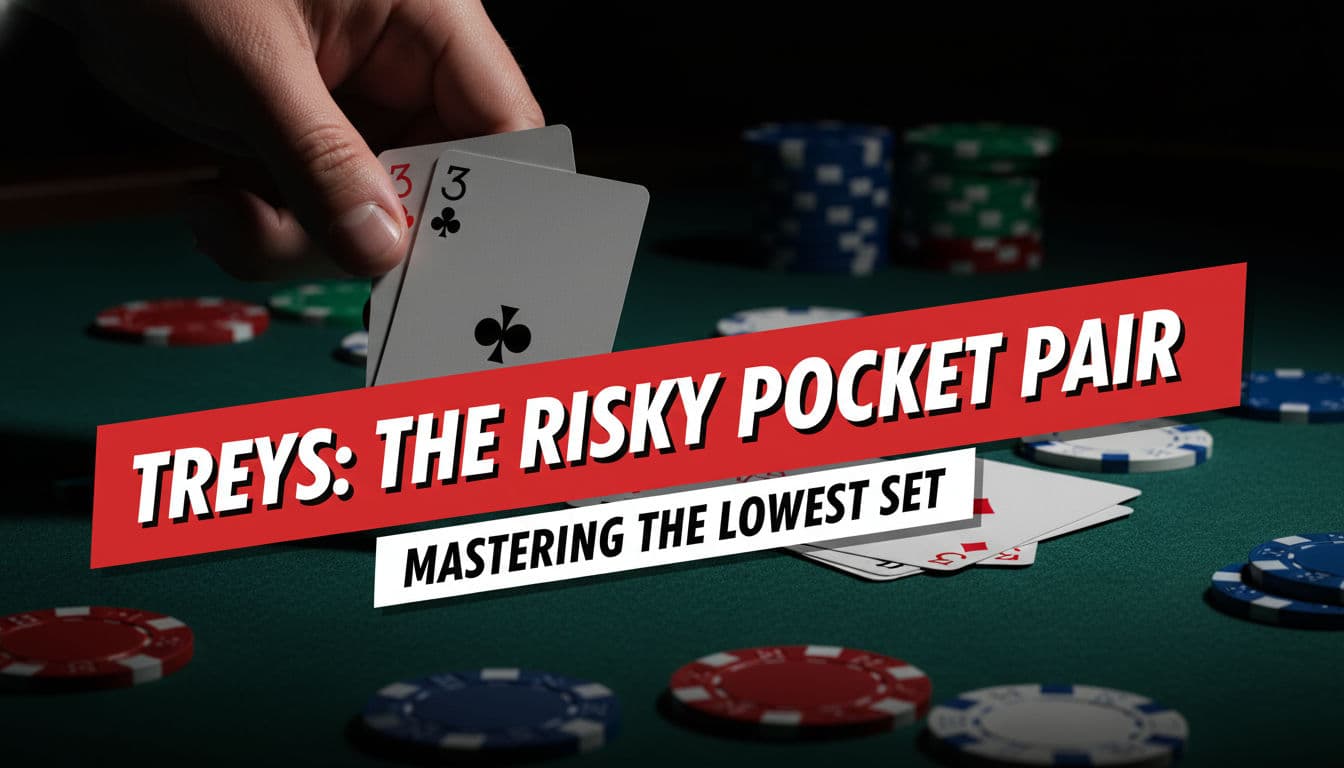
In the intricate world of poker, mastering its unique lexicon is as crucial as understanding the probabilities. Among the foundational terms, "treys" stands out, specifically referring to any card with a rank of three. While seemingly simple, the presence of a trey - whether in your starting hand or on the community board - carries significant strategic weight. This guide will meticulously break down the definition, strategic nuances, and practical implications of the number three card in various poker scenarios, elevating your understanding and decision-making at the tables.
Defining The 'Treys Poker Hand: The Number Three Card
In poker terminology, treys simply means the three card. This straightforward definition underpins its usage across various contexts in the game:
Pocket Treys: When a player is dealt two cards with a value of three as their initial hand (3h3d, 3s3c, etc.), these are known as "pocket treys" or "pocket threes."
Trey on the Board: If a community card (flop, turn, or river) reveals a three, poker players will often refer to it as a "trey on the board."
Understanding such poker terms explained is not merely about speaking the poker language; it's about rapidly processing information and communicating complex hand dynamics, a critical skill in fast-paced games.
The Strategic Nuances of Pocket Treys (3-3) Pre-Flop
Pocket treys represent one of the lowest possible pocket pairs in Texas Hold'em, making their pre-flop play a delicate balance of risk and reward. Unlike premium pairs, pocket threes are primarily played for their "set value" Utilizing a solid pocket 3s strategy requires patience.
Set Mining with Pocket Treys
The primary set mining strategy for playing pocket treys pre-flop is "set mining." This involves calling a raise (or sometimes opening with a small raise) with the specific intention of hitting a third three on the flop to make a set. A set (three of a kind) is a very strong hand, often disguised, and can win large pots. However, successful set mining relies on several critical factors:
Implied Odds: You need sufficient implied odds to justify the call. This means there must be enough money in the pot, or potential money to be won from your opponents, to make up for the times you don't hit your set. If you hit, you stand to win a lot; if you miss, you lose a small amount.
Opponent Stack Sizes: Set mining is most profitable against deep-stacked opponents who are likely to pay you off when you hit your set. Against short stacks, the implied odds diminish significantly.
Position: Playing pocket treys in position (late position) is generally more advantageous, allowing you to see what opponents do before you act, giving you more information and control over the pot size.
Multi-way Pots: While a set is strong, a multi-way pot can be tricky. More opponents mean a higher chance someone else has a strong hand or is also on a draw.
Conversely, frequently calling large raises with pocket treys when implied odds are poor (e.g., against short stacks or without position) is a common leak for less experienced players.
Trey on the Board: Impacting Post-Flop Play
The appearance of a trey among the community cards can dramatically alter poker hand strength and influence betting patterns, whether you hold a three or not.
When You Hold a Trey
If you have a hand like A-3 and a trey hits the board, you've flopped a pair. While a pair of threes is often a weak hand, its strength depends heavily on the rest of the board and your kicker. If you hold 3-4 and the board is 3-5-K, you've made a pair with a strong straight draw.
When Opponents Might Have a Trey
A trey on the board can create various possibilities for your opponents:
Sets: If a player was set mining with pocket treys, they've just flopped a monster hand. This is often disguised and can be very dangerous.
Two Pair: A board like K-3-7 could mean someone with K-7 or K-3 now has two pair or a set.
Straight Draws/Straights: A trey is crucial for many low straights. For example, if the board is 3-4-5, anyone holding 6-7, or even A-2, could have a straight or straight draw. A board like A-2-3 offers a low straight.
Kicker Play: Even if no one has a strong hand with the trey, it contributes to the overall board texture, potentially affecting high-card hands or flush draws.
Analyzing the impact of a trey on the board requires careful consideration of possible hand combinations and the tendencies of your opponents. Is it likely someone flopped a strong hand? Or is the trey just an inconsequential low card on a high board?
General Strategic Considerations for Low Cards
Understanding treys poker extends to a broader appreciation for how low-value cards fit into playing low pocket pairs:
Board Texture: Low cards like treys contribute to "low boards" (e.g., 3-5-7), which are generally more draw-heavy and less favorable for big overpairs.
Straight Possibilities: They are vital components for many straights (e.g., A-2-3-4-5).
Blocking Cards: Holding a trey might prevent an opponent from having a specific straight or set. While less significant with treys than with high cards, it's still a factor.
Conclusion
In conclusion, while "treys" might seem like a simple term for the poker three card, its strategic implications are far-reaching. From the disciplined approach of a set mining strategy to deciphering the impact of a trey on the community board, a comprehensive understanding of this seemingly minor card is integral to developing an expert-level poker strategy. A firm grasp of poker hand strength and the nuances of playing low pocket pairs remains essential for long-term success.
| Pros | Cons |
|---|---|
When you hit a set of treys against deep-stacked opponents, your hand is often very disguised and strong, leading to large payouts as opponents often fail to put you on three of a kind. | If you don't hit your set with pocket treys, you are often left with a very weak pair (or just high cards) on boards filled with overcards, making it challenging to continue in the hand profitably. |
A trey on the board can complete crucial straight draws (e.g., A-2-3-4-5) or contribute to two-pair hands, adding versatility to various starting hand combinations for players. | Even when you hit a set of treys, you are still vulnerable to higher sets (e.g., pocket fours on the same board) or straights and flushes that might develop, especially on coordinated boards. |
Related Poker Terms
33: Treys
77: Pocket Sevens
88: Pocket Eights
98: Nine-Eight
99: Pocket Nines
A6: Ace-Six
A7: Ace-Seven
A8: Ace-Eight
A9: Ace-Nine
AA: Pocket Aces
AJ: Ace-Jack
AKo (Ace-King Offsuit)
AKs: Ace-King Suited
AQ: Ace-Queen
AT: Ace-Ten
J8: Jack-Eight
J9: Jack-Nine
JJ: Pocket Jacks
JT: Jack-Ten
K9: King-Nine
KJ: King-Jack
KK: Pocket Kings
KQ: King-Queen
KT: King-Ten
Offsuit
Q9: Queen-Nine
QJ: Queen-Jack
QQ: Pocket Queens
QT: Queen-Ten
Starting Hand
Suited Connectors
T9: Ten-Nine
TT: Pocket Tens