

The Main Differences Between Poker Rebuy and Re-Entry Tournaments

If you want to understand how second chances/poker rebuy work on the green felt, you're in the right place. Before we get into where these rules came from, let's nail down three terms you'll see over and over: freezeout, rebuy, and re-entry.
A freezeout is the original format. You pay one buy-in, get one stack, and once it's gone, you're gone - no way back in.
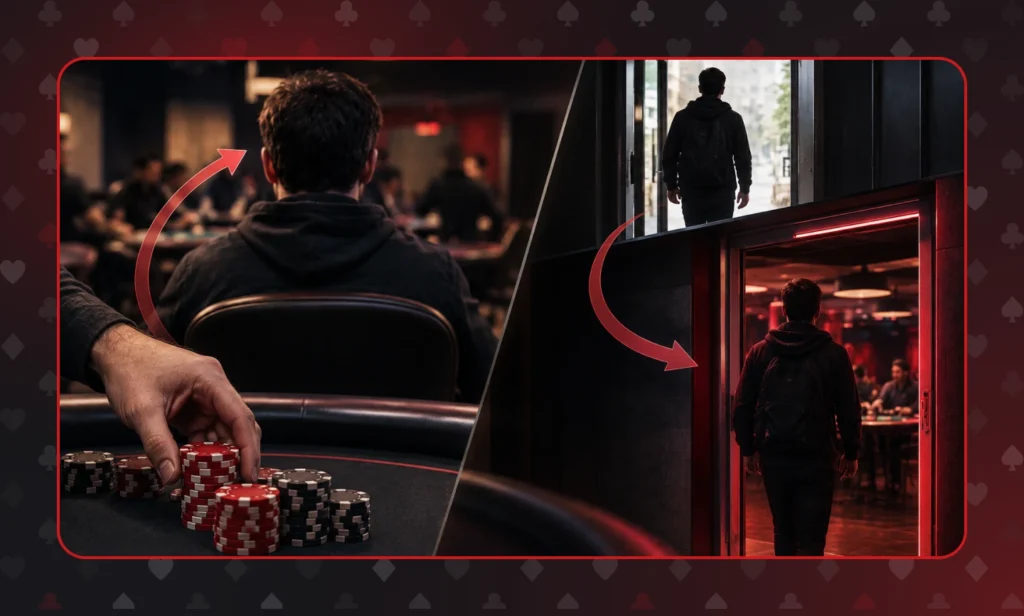
A rebuy lets you buy a fresh stack without ever leaving your seat, as long as you're still inside the tournament's rebuy period. You bust (or drop low enough), you pay the dealer, you keep playing.
A re-entry works differently. You have to be fully eliminated first, then walk over to registration any time before the late registration period ends, and pay again as a brand-new entry - usually landing at a different table.
Different tournament formats offer different safety nets for players who experience early bad luck or make a mistake, and knowing which one you're sitting down to play changes how you should approach the first few hours.
A Deep Dive into Poker History
Before massive casino arenas and televised final tables existed, the game was played very differently.
In poker's early history, cash games ruled - you'd find them in gambling halls, saloons, and other informal gaming environments. No tournament directors, no blind schedules, no payout brackets. Every single chip on the table had a direct, one-to-one cash value.
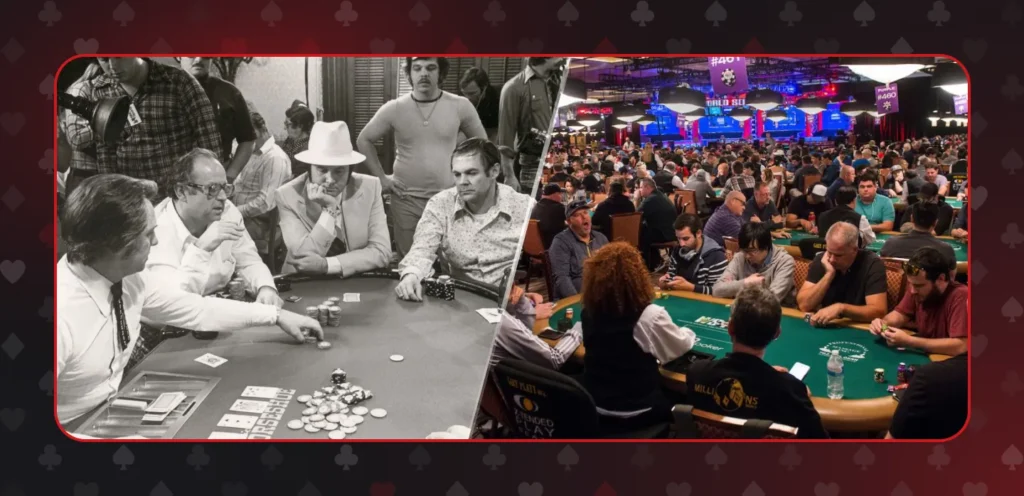
The modern tournament era took shape around the birth of the WSOP in Las Vegas in the early 1970s. According to official historical records, casino owners and players wanted a structured way to crown a definitive champion. The first event in 1970 ran as a small cash-game gathering, with a player vote choosing the world champion. However, the freezeout format most of us picture today - the one used for the Main Event - was introduced shortly after.
In a strict freezeout, every player pays a set entry fee and starts with the same stack. Once you lose your last chip, you are eliminated with no opportunity to buy back in. For years, this was pretty much the only format around: one stack, one shot, no second chances.
The Evolution of the Poker Rebuy
As tournament poker evolved, rebuy formats gave organizers a new way to boost entries and prize pools while giving players a second chance after busting. Casinos found that many players were willing to spend more money to stay in the game, making the event more attractive to everyone.
The format started small - many early rebuy events allowed just a single rebuy per player - before organizers realized unlimited rebuys drove even bigger action and dropped the cap altogether at many events.
During a traditional poker rebuy event, action happens without the player ever leaving their seat. If you lose a big pot, you just signal the dealer, hand over the cash, and get a fresh stack of tournament chips.
Depending on the tournament rules, players may be allowed to rebuy after losing their entire stack or when their stack falls below a specified threshold. For example, some events let you rebuy as long as your chip count is equal to or less than the original starting stack. This means you don't have to wait until you are completely broke to top up your ammunition.
Rebuy tournaments test not only your poker skill but also your bankroll management. Early levels can play very differently from later stages, so players need to adjust their strategy as the tournament progresses. The safety net means many players adopt a highly aggressive, high-variance style during the initial blind levels.
The Shift Toward the Re-Entry Tournament
While the poker rebuy format successfully built massive prize pools, it also created situations where deep-pocketed players could endlessly bully the table. A wealthy professional could sit in the same seat and rebuy 10 times, constantly shoving all-in and forcing amateurs to fold. This created an imbalanced and often frustrating experience for players on a strict budget. A legendary example of this occurred in 2006, when Daniel Negreanu famously rebought 48 times during a $1,000 WSOP rebuy event, with entry, rebuys, and an add-on.
Critics argued a well-funded pro could essentially buy a bracelet, pricing amateurs out of the format entirely - and the WSOP agreed, dropping rebuy tournaments starting in 2009.
During the 2010s, re-entry formats spread across major live tournament series worldwide. The Poker Tournament Directors Association (TDA), which works to standardize rules globally, has noted that re-entry gives organizers another way to grow the field - but unlike a rebuy, each new entry gets a completely fresh seat and stack.
That trend keeps evolving: plenty of modern tournaments now allow re-entry for 10-12 hours into Day 1, and some series even let you buy in directly on Day 2 with an average stack if you missed Day 1 entirely.
In a re-entry tournament, you cannot simply hand cash to the dealer to stay in your current seat. You must be officially eliminated and lose every single chip you own. Once you bust, you must physically leave the table, walk to the registration desk or use the tournament's mobile app, and pay a completely new entry fee to rejoin the tournament field.
Having to get up and walk away changes the game's psychology. Because you have to leave the table, the immediate emotional urge to chase your losses against the same opponent is interrupted. It forces a mental reset and generally slows down the frantic pace compared to a classic poker rebuy format.
Key Differences: Rebuy vs. Re-Entry
Knowing the event's specific rules matters for your bankroll. Many beginners confuse these terms, assuming they can just buy more chips at the table in a re-entry event.
Feature | Rebuy | Re-Entry |
|---|---|---|
When? | During the rebuy period, according to event rules. | After elimination, during the re-entry period. |
Status | Player remains in the event continuously. | Player registers for an entirely new entry. |
Seat | Usually remains at the same table, depending on rules. | Assigned a new, random table and seat. |
Cost | Additional rebuy fee (often rake-free). | New tournament entry fee (usually with rake). |
Knowing these differences helps you form an effective tournament strategy before the first card is even dealt. If you know that a re-entry will give you a new seat, you may be less inclined to force a risky bluff against a specific rival. Conversely, in a poker rebuy, you might play aggressively to exploit the specific opponents sitting directly to your left.
Live vs. Online Tournament Dynamics
The environment where you play drastically affects how a poker rebuy or re-entry period unfolds. While the core mathematical rules remain the same, the speed and physical friction of the game differ wildly between a physical casino and an online poker room.
In online poker, a rebuy happens almost instantly. Depending on the platform, players can usually top up their stack with a few clicks, and some sites also offer automated rebuy options to maintain a full stack without any interruption. Because it is so frictionless, online fields tend to play significantly faster and much looser during the rebuy period.
In a live casino setting, a poker rebuy is also very fast but requires a tangible transaction at the table. You don't leave your seat; you simply pay the tournament rebuy fee directly to the dealer between hands to receive your new stack. While the transaction itself is immediate, physically handing over cash may make some players more conscious of their spending than an instant online rebuy.
When it comes to being eliminated, registering for a re-entry tournament in a live casino requires time and physical effort. Once you bust, you have to stand up, return to the registration or cashier area, wait in line, and physically purchase a new ticket (or open your mobile app and go through the process there). This natural delay gives players time to cool off and evaluate their poker bankroll management, often resulting in fewer total bullets fired.
Online re-entry, by contrast, eliminates this cooling-off period entirely. When you lose your chips online, a pop-up window immediately appears asking if you want to try again. A single click deducts the funds from your account and instantly drops you into a newly assigned, random seat, making it incredibly easy for emotionally tilted players to fire multiple entries in rapid succession.
Understanding the Poker Add-on
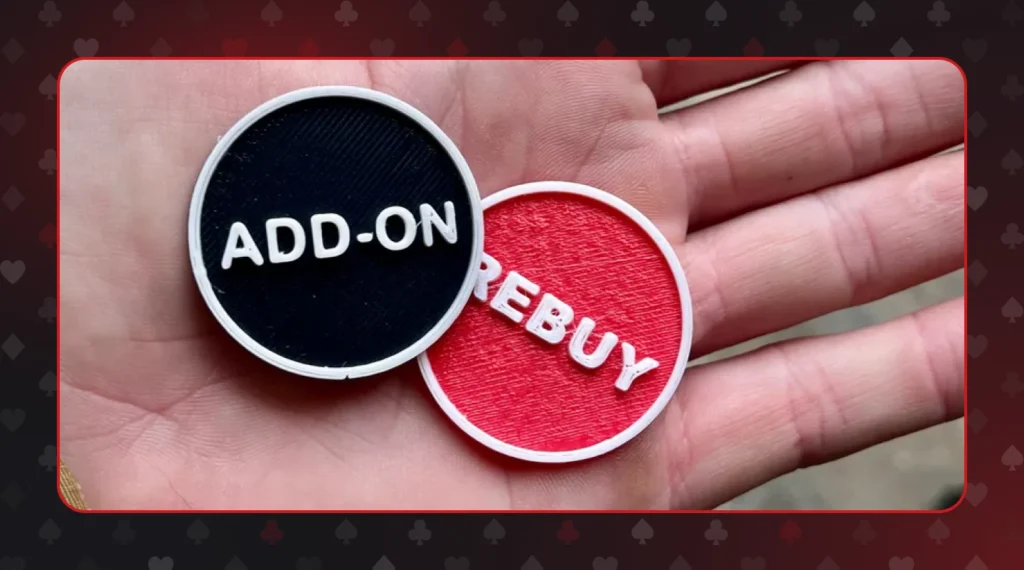
At the end of the rebuy period, tournaments often offer players one final chance to buy chips, known as the poker add-on. This option is typically available during the first break to every active player, regardless of how large or small their current chip stack might be. It serves as a final transition before the tournament shifts into its next, more restrictive phase.
An add-on can offer attractive value, particularly when the extra chips are inexpensive relative to the number of chips received. Tournament organizers often price this final purchase to provide more chips per dollar than the original entry fee. For example, in a hypothetical event, a $50 buy-in might grant 5,000 starting chips, while a $50 poker add-on might secure 10,000 chips.
However, whether it is worth buying depends on the tournament structure, your stack size, and the value of those chips at that stage of the event. If you are nursing a very short stack, the poker add-on can be particularly valuable because it gives you more chips and additional room to maneuver. It gives you a better chance to stay competitive as the blinds increase.
If you've already got a massive chip lead, though, the mathematical value of those extra chips is slightly different. According to the Independent Chip Model (ICM) - a mathematical framework used by professionals to calculate equity - adding a small percentage of chips to an already massive stack does not linearly increase your expected cash value. Nevertheless, many players still take the add-on simply to ensure they have the absolute maximum ammunition possible.
Adapting Your Tournament Strategy
In tournament poker, your chip stack affects how much flexibility you have in future hands and how much pressure you can apply to opponents. In a tourney where you know you have a second chance, a safety net during the early stages of the event fundamentally alters table dynamics. Players are generally more willing to call bets with speculative hands, knowing they can simply re-enter if they miss their draw.
Your tournament strategy during these early blind levels should adapt to this looser, more aggressive environment. You cannot always rely on standard bluffing tactics to force opponents out of pots, as the fear of elimination is temporarily suspended. Instead, focus on extracting maximum value with your strong made hands, which is generally a more reliable approach.
Premium hands can gain additional value during a loose rebuy period, but your bet sizing should still reflect the table dynamics, stack sizes, and the action in front of you. While it is tempting to simply overbet the pot with pocket Aces, a skilled player will still evaluate the board texture and the specific tendencies of the opponent. The goal is to build a large stack that can be used as leverage later, without needlessly risking chips when the board favors your opponent's range.
Transitioning to the Freezeout Stage
Once the rebuy or re-entry period closes, the tournament usually moves into a more conventional freezeout-style phase. The high-variance gambling that characterized the first few hours typically slows down significantly. Players suddenly realize that their safety net is gone, and every subsequent decision carries potential tournament-ending consequences.
You need to adjust your own play to match. Opponents who were recklessly splashing chips around earlier will often tighten their starting-hand requirements and play much more defensively. Recognizing this shift lets you adjust your tournament strategy, potentially opening opportunities to steal blinds and attack players who are now overly protective of their remaining stack.
Cash-Game Strategy and Stack Management
Cash games play by a different set of rules than tournaments. In a cash game, you won't find a registration period, escalating blind levels, or a cap on how many times you can replenish your chips - chips are just worth cash, all the time.
For many players, keeping a full stack helps because it maximizes what they can win when they have an advantage. If you are playing against weaker opponents, having a stack topped up to the table maximum ensures that you can extract their entire stack when you hit a strong hand. A successful cash-game strategy often revolves around deep-stacked play, which allows for complex post-flop maneuvering and multi-street bluffs.
However, the right stack size depends on your bankroll, skill level, table dynamics, and preferred strategy. Not every player wants or needs to sit with 100 big blinds. Some professionals prefer buying in for smaller amounts to manipulate the Stack-to-Pot Ratio (SPR) or to lower their immediate variance against highly aggressive regulars.
A shorter stack reduces your post-flop flexibility and can make certain lines less effective, but short-stack play involves more than simply moving all-in or folding. Even with a reduced stack, players must understand pot odds, positional awareness, and effective re-steal opportunities. Many well-known training sites teach short-stack poker as a dedicated strategy, since it has its own skill set.
The Psychology of Chasing Losses
Beyond the math, the psychology of second-chance mechanics matters too. Poker is a skill game heavily influenced by short-term variance, which can trigger intense emotional responses. The option to rebuy immediately can make it harder for some players to stay disciplined after a bad beat.
Players call this chasing losses - firing multiple bullets while playing worse than usual, just to win their money back fast. When a player suffers a frustrating elimination, the immediate urge is often to register again and force the action to win their money back quickly. Poker players call this "tilt", and it causes even good players to abandon logical strategy.
Recognizing when an opponent may be playing emotionally can help you make better decisions against them. If a player appears to be tilting after a re-entry, you may find more profitable spots to call their aggressive bets when you hold strong value hands. Staying emotionally grounded while your opponents lose their composure is one of the most profitable skills you can develop in a re-entry tournament.
Sustainable Poker Bankroll Management
None of the tactics above will make you money long-term without financial discipline. Your bankroll is the dedicated funds you use exclusively for playing poker, completely separate from your living expenses. Protect it first, whether you're in a local cash game or a massive international event.
Some players use a 100-buy-in rule as a conservative benchmark for tournament bankroll management, but no universal number exists. Because Multi-Table Tournaments (MTTs) can involve substantial variance, even successful players can face long downswings. A large cushion prevents these natural statistical fluctuations from depleting your funds.
The appropriate bankroll depends on factors such as field size, format, win rate, and risk tolerance. A professional playing massive online fields may choose to maintain a substantially larger bankroll because of the additional variance. When dealing with a re-entry tournament, you must account for the fact that a single event might require you to fire 2 or 3 bullets, and adjust your poker bankroll management calculations accordingly.
Long losing streaks are normal, even for highly successful tournament players. Variance dictates that you will sometimes go weeks or months without a significant cash, no matter how well you play. Maintaining strict financial discipline and refusing to play above your predetermined limits is the only way to survive these periods.
Final Thoughts
Freezeout, rebuy, or re-entry - the format changes the math before a single card is dealt. Check the structure sheet, know your bullet limit going in, and you'll never be the player scrambling to figure out the rules mid-tournament.
Whether you prefer the historic purity of a freezeout or the high-octane action of a re-entry tournament, the players who last are the ones who match their strategy to the rules actually in front of them - not the ones they assumed.
About the Editor

Gyöngyi P. Tóth is Somuchpoker's Content Writer and Poker Stories Specialist, writing Side Pot features, WSOP storylines, and the site's Poker in Pop Culture and Legends of Poker series. She was introduced to poker 20 years ago through live tournament play, and what has kept her interest since is the psychology and human behavior behind the game as much as the cards themselves.
Related News
 StrategyOnline PokeriGaming
Mystery Bounty Poker Tournaments Explained: Rules, Strategy & Big Prizes (2026)
Learn how mystery bounty poker tournaments work, why players chase massive jackpot envelopes, and the best strategy adjustments to increase your EV in 2026.
 Strategy
Poker for Beginners: How to Learn Online Poker from Streams
Discover how to turn poker streams into your best study tool! Learn online poker basics like preflop action, pot odds, and bet sizing with this beginner guide.
 StrategyOnline PokeriGaming
Poker Psychology: The Ultimate Guide to Master the Mental Game
Transform your results with this comprehensive guide to poker psychology. Learn to master emotional control, eliminate tilt, build confidence, and more.
![[Poker Basics] Target Stack and Timed Tournaments: The Complete Strategy Guide](/_next/image?url=https%3A%2F%2Fimages.ctfassets.net%2Fo0c4x84rxbjm%2F6AlscPiq8eFWhuKT0DNpu5%2Fe5e2e24abc7323cb5f48f69fabeec2f9%2Ftarget_timed_featured.webp&w=3840&q=75) Strategy
Strategy[Poker Basics] Target Stack and Timed Tournaments: The Complete Strategy Guide
Learn how target stack poker and timed poker tournaments work, with practical strategy tips for both formats.
 Side PotStrategyStories
Why Keeping Your Phone at the Poker Table Could Actually Save You Money
Think hiding your phone at the poker table is smart? Discover how keeping it handy can prevent you from playing trash hands and improve your win rate.
 StrategyOnline PokerLive Poker
The Ultimate Guide to Late Registration in Poker Tournaments: Strategy, Math, and ICM Benefits
Master late registration in poker tournaments. Discover how ICM equity boosts, shallow stack strategy, and max late regging can dramatically increase your ROI.