

Poker Psychology Part 5 - Decision Quality: How to Build Bulletproof Thinking Routines That Improve Every Choice You Make

There’s something almost magical about watching a great poker player think. Not the Hollywood version with intense staredowns, but the real thing. The calculation. The “deep breath” before putting chips in. The aura of someone who can get two-outed for a massive pot yet seems as oblivious to what just happened as they would seem reading a grocery list.
Some might call this "natural ability." Some try to mythologize it as a gift. But beneath the folklore lies something much more mundane: exceptional decision making as a byproduct of daily routines, poker psychology, and habitual tendencies that produce a pattern repeatable hand after hand.
Poker is quick. It's emotional. It's chaotic. Yet if you can outperform the decision making of your opponents across the felt, you come out on top. Not today. Not tomorrow. But statistically, over a large enough sample size, you'll come out on top. That's why poker is one of the most honest games ever created by humankind.
In this article, we're going to learn why decision quality trumps hand results, how your psychology works against you, how the top players approach the game, and how to create foolproof thinking patterns that enhance your decisions in poker and, of course, anywhere else.
What Decision Quality Really Means (and Why It’s Not About Winning the Hand)
Let me start with something surprisingly comforting: You can play a hand perfectly and still lose. World Series of Poker champion Annie Duke, who also worked with the Wharton School on decision science, explains that poker rewards “correct decisions”, not “immediate outcomes.”
If you call with the correct pot odds but your opponent hits a miracle river card, the result doesn’t say anything about your process. It says something about variance.
According to an analysis of Duke’s work, humans are wired to judge the quality of a decision after we see the result. This is called outcome bias, and it’s a nasty little mental trick. If your bluff gets snapped off, your brain screams, “Bad choice!” even if the bluff was mathematically perfect.
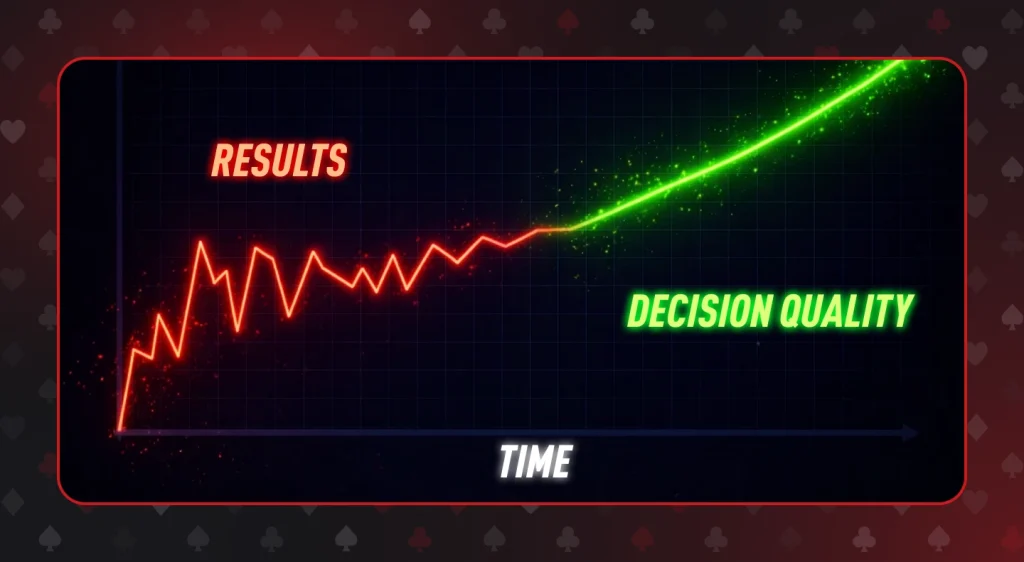
Poker forces you to separate the two. The process matters. The result is noise. This distinction becomes even clearer when you look at research from the Journal of Expertise. A 2020 research study on how expertise operates in poker declared it basically a “micro-laboratory for decision-making under uncertainty,” highlighting that poker players routinely face imperfect information, emotional challenge, riskiness, and time constraints, a rather unforgiving combination for the human brain.
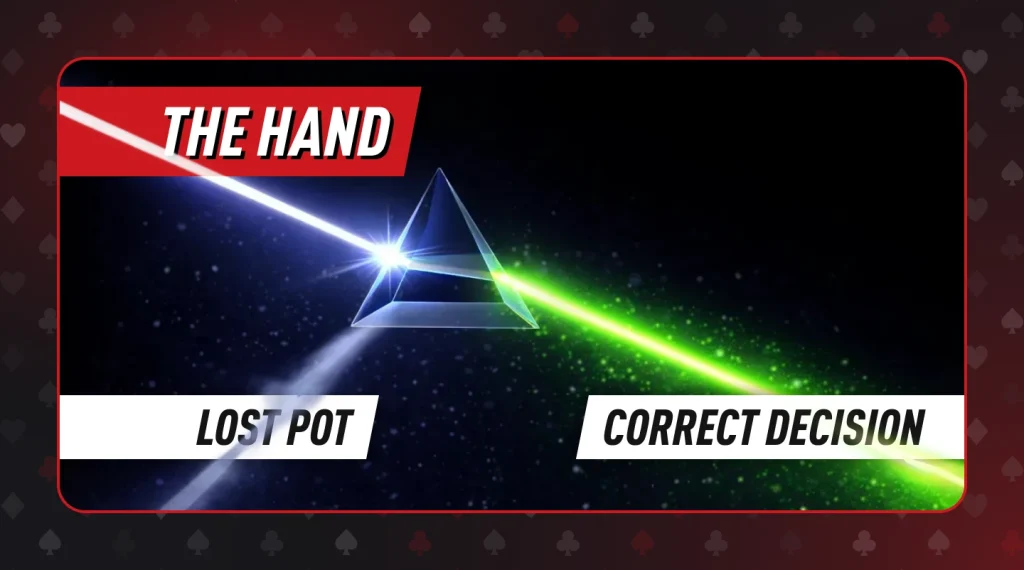
Yet experts consistently outperform novices not because they win every pot, but because their average decision quality is higher. Before we go deeper, let me say something simple: this isn’t about being a genius. It’s about learning a way of thinking that protects you from randomness, a routine.
Why Our Brains Struggle With Poker
Poker pushes right up against several psychological weak points. The game is built on uncertainty, which humans historically hate. Our ancestors weren’t solving river bluffs, they were trying not to get eaten by predators. That wiring makes us emotional creatures, not probabilistic calculators.
We Overestimate Certainty
A Wired magazine deep dive into the psychology of poker reveals that people tend to "round up" their confidence levels. Even if they're only 60% confident in something, they'll act like they're 80% confident. Poker punishes this, and punishes fast.
We Chase Losses
An academic study on decision-making in poker compared human behaviour with that of artificial intelligence. The study showed something very interesting: while AI programs remain constant, humans are much more risk-seeking after a loss. It's that little voice in your head that whispers,
"I'll just get one pot back."
You know what I'm talking about. That same little voice that has people triple-barrel bluffing when they know they shouldn't.
Cognitive Shutdown
Casino psychology researchers note that tilt isn’t simply rage, it’s an emotional override of rational processing. When emotions spike, the brain’s prefrontal cortex, the part responsible for deliberate reasoning, essentially takes a nice little nap. That’s why bad beats feel worse than they statistically “should.” It’s not numbers. It’s biology.
We See Patterns That Aren’t There
Humans search for meaning in randomness. If you lose three flips of a coin in a row, your brain attempts to construct an explanation for what happened: “I’m running cold”, “My luck turned”, or “I’m due!” But the coin does not remember. Neither does the deck. The easiest way to avoid being stuck in these traps is to understand them psychologically. But understanding won't save you when adrenaline rushes blood to your brain. That's when it's vital to have established thinking routines in place.
How Expert Poker Players Think And Use Poker Psychology
So what exactly separates the top poker minds from everyone else?
Experts Process More Relevant Information
A 2011 study of players analyzed how novices, intermediates, and experts scan poker situations. Experts didn’t just think harder, they thought better. They looked at
Position
Opponent ranges
Stack sizes
Betting patterns
Board texture
Novices focused on their own cards.
They Don’t Let Emotions Drive Decisions
Professional players talk a lot about staying calm, but this isn’t Zen philosophy, it is rather pure science. Emotional regulation keeps the decision-making part of the brain online.
They Use Structured Routines
Mental game coach Jared Tendler, author of The Mental Game of Poker, emphasizes the importance of pre-session routines, in-game mental checkpoints, and post-session reviews.
He argues that poker players need planned thought sequences just like athletes use warm-ups or pilots use checklists. These routines create consistency, which is another way of saying they protect decision quality.
They Avoid Autopilot
One of the greatest leaks of an average player is "autopilot mode". If you're not actively engaging your brain, your winrate disappears. Pros remain intentional. While it's true that they can play on 12 tables simultaneously online, there are safeguards in place to prevent them from spacing out. Let's talk about those safeguards. Because this is where the real gold lies: the replicable processes that transform erratic human psychology into something more stable.
The 5-Part Bulletproof Thinking Routine for Better Poker Decisions
Think of this section as your weapon to fight your hardwired human brain that works against you when playing poker. Okay, they won't magically transform you into a high-stakes crusher, but they will exponentially increase your average decision-making quality over time. And keep in mind, it's decision quality, not results, that should guide you.
Pre-Session: Clear Your Mind
Let’s be honest: at least half of our bad choices are made because we’re already fatigued, annoyed, or distracted. A strong pre-session ritual effectively clears the mind. It doesn’t have to be fancy. A minute or two will do. An effective pre-session ritual includes:
Emotional assessment: Am I calm? Am I under pressure?
Stakes assessment: Am I properly bankrolled for this?
Tilt indicators: Does something that happened to me today still annoy me?
Purpose declaration: “Today, I care more about the quality of my decisions than winning.”
This last one might feel goofy at first, like you’re a sports movie character talking to yourself in a mirror, but it works. Jared Tendler notes that even a single breath before a first hand fosters better decision stability. Tiny decisions lead to life-changing consequences.
Mid-Hand: 20-Second Script for Any Decision
This is where it all changes. A simple, repeatable process for every hand you play. Take the 6 Step Bulletproof Decision Routine and see how it works for you at the table:
The Bulletproof Routine
One-breath pause
Assess your hand and position
Define your opponents' ranges
Factor stack sizes and pot odds
Plan future streets
Choose the highest EV action.
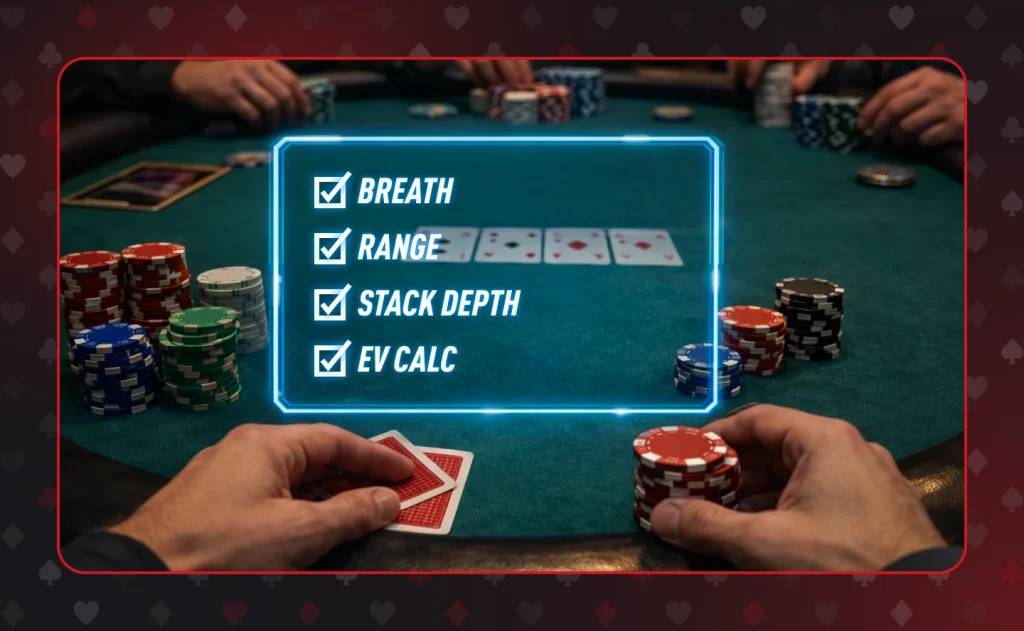
Sounds all so simple, right? Still, you should remember these steps, because most players just skip a couple of these after a few hours into a session, and start playing on autopilot.
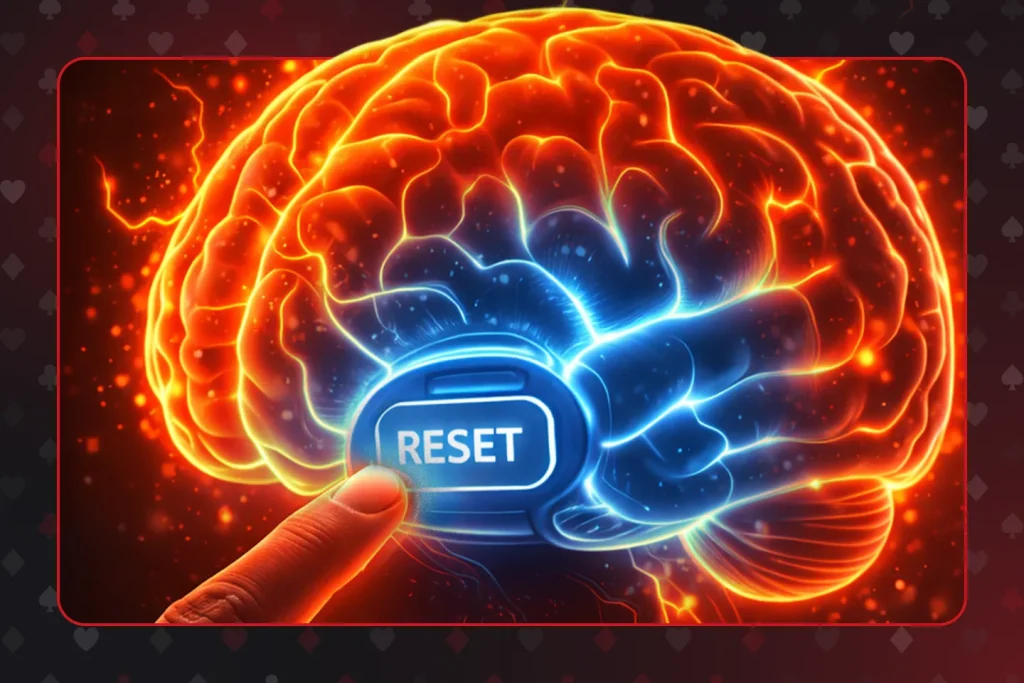
Mid-Session: Reset Before Tilt
Poker has these weird moments, right after a bad beat, or after stacking someone, when emotions flip the table over in your mind. Reset routines keep you safe. When you sense anger, irritation, revenge fantasy, desire for vengeance, tightness in the chest, or unexpected impatience, take a second to reset with the following:
Slide the chair back very slightly
Turn your head away from the table or computer
Let out a deep breath
Repeat in your head: "Process over outcome."
This gives your mind the equivalent of a “time out” to allow the prefrontal cortex to take back its control. Much of cognitive psychology supports the idea that even a millisecond of interruption can prevent an emotional cascade.
Post-Hand: Quick Reflection
You don’t need to analyze every hand mid-session. That’ll fry your brain. But a few quick reflections can keep you grounded. After you play a hand that is significant or intriguing, ask yourself:
"Did I stick to my routine?"
"What information can I pinpoint that I didn't get at the time?"
"Was my logic correct even if it feels bad now?"
According to the Journal of Expertise, experts learn more quickly because they monitor their processes instead of their results. You can, too, in as little time as 10 seconds after significant hands.
Post-Session: Evaluate & Note
When you close the laptop or walk away from the table, you’re not finished yet. Spend two minutes evaluating:
Decision quality rating (1–10)
One strength
One leak
A quick plan for next time
Humans learn through repetition and feedback loops. Simple routines like this create structure, and structure is the antidote to randomness.
A Real Poker Example
Let’s imagine a hand. You’re in the big blind with A♣Q♣ in a tournament. The cutoff raises. You call. Flop: Q♦7♣4♣. You check. They bet small. Most amateurs think one thing: “Top pair, good kicker!” And then they call.
Experts, on the other hand, think in systems. They take a pause. They look at the stack sizes, then assign a perceived range to their opponent.
They ask themselves what this bet size could mean on this board texture. They plan future streets, or if there should be any future streets at all, or they should just shove, like in this case, if the stacks are shallow enough.
They aren't guessing. They’re choosing. Even if they happen to lose a giant pot because a turn card pairs the board or completes a hidden straight, they’ll walk away calmly because they know that their thought process was flawless. That’s the freedom experts feel: they don’t cling to results because they trust their routines.
Real Life Benefits
Here’s the cool part: these routines don’t just help you at the table. They help you make better decisions in general. A business owner weighing a risky investment? A parent deciding whether their kid is ready for a phone? A person debating whether to leave a job? It’s all uncertainty. It’s all incomplete information. Poker players train for this, so yes, poker helps you become a better decision-maker. Even when you’re choosing between two mediocre products on Amazon at midnight, half-asleep, and questioning your life choices.
Decision Quality Is a Skill You Can Build
You don’t need to be a genius to think like a good poker player. You just need routines. Clear, repeatable, psychologically sound habits that help you stay balanced when things get loud, fast, or unpredictable. Poker rewards consistency, and the best way to become consistent is to use foolproof thinking poker routines. And if you put effort into the process, the outcomes will eventually follow. Not hand by hand, but across thousands of decisions.
About the Editor

Beus Zsoldos is Somuchpoker's Senior Copywriter and Player Stories Editor, covering WSOP color moments, player profiles and poker personalities for the site's Stories section. She has spent more than 20 years around the game, first as a player, then as a live tournament director and localization manager for a major online poker room, before moving into full time poker writing.
Related News
 StrategyOnline PokeriGaming
Mystery Bounty Poker Tournaments Explained: Rules, Strategy & Big Prizes (2026)
Learn how mystery bounty poker tournaments work, why players chase massive jackpot envelopes, and the best strategy adjustments to increase your EV in 2026.
 Strategy
Poker for Beginners: How to Learn Online Poker from Streams
Discover how to turn poker streams into your best study tool! Learn online poker basics like preflop action, pot odds, and bet sizing with this beginner guide.
 StrategyOnline PokeriGaming
Poker Psychology: The Ultimate Guide to Master the Mental Game
Transform your results with this comprehensive guide to poker psychology. Learn to master emotional control, eliminate tilt, build confidence, and more.
![[Poker Basics] Target Stack and Timed Tournaments: The Complete Strategy Guide](/_next/image?url=https%3A%2F%2Fimages.ctfassets.net%2Fo0c4x84rxbjm%2F6AlscPiq8eFWhuKT0DNpu5%2Fe5e2e24abc7323cb5f48f69fabeec2f9%2Ftarget_timed_featured.webp&w=3840&q=75) Strategy
Strategy[Poker Basics] Target Stack and Timed Tournaments: The Complete Strategy Guide
Learn how target stack poker and timed poker tournaments work, with practical strategy tips for both formats.
 StrategyOnline Poker
The Main Differences Between Poker Rebuy and Re-Entry Tournaments
Discover the main differences between a poker rebuy and a re-entry tournament. Learn how the rules, seat changes, and strategies affect your game.
 Side PotStrategyStories
Why Keeping Your Phone at the Poker Table Could Actually Save You Money
Think hiding your phone at the poker table is smart? Discover how keeping it handy can prevent you from playing trash hands and improve your win rate.