

Poker Psychology Part 3 - The Confidence Cycle: How to Build (and Rebuild) Self Trust in Your Poker Game


There’s a moment probably every poker player knows all too well: that strange, subtle flicker of doubt when you’re deep in a hand and suddenly you’re not sure whether you’re making a solid call or simply hoping luck will bail you out. That is the lack of poker confidence. It’s tiny, almost invisible from the outside, but inside your head, it feels deafening. Your heart races. Your focus shifts just a bit. The inner perspective that wasn't there yesterday suddenly says, “Are you certain?”
Poker confidence is such a weird thing to possess. One week you're at the top of the world, the next week, you're questioning your standard c-bet as if it's your only opportunity to stay alive. But many players don’t realize until years into the game that confidence isn’t something you magically “have” or “don’t have.” It’s a cycle, something that loops, evolves, strengthens, weakens, and rebuilds with your decisions.
And the heart of that cycle is self trust.
If you’ve ever felt yourself on tilt because you didn’t trust your read, or hesitated on a bluff you would’ve snapped off last month, or spiraled during a downswing, this article is for you. Let’s walk through what confidence really is in the context of poker, why it collapses, and how you can build a system for creating and rebuilding unwavering poker self trust.
Let’s talk honestly about the mental side of the game that nobody at the table sees, but everyone feels.
What Self Trust Actually Means in Poker
Self trust sounds poetic, but in poker it’s far more practical than mystical. It’s the belief, rooted in evidence, that you can rely on your process, even when the cards get ugly.
Notice I didn’t say “rely on winning.” That would be the biggest trap you could fall into. Winning is noisy; winning is fickle. Relying on outcomes for confidence is like relying on the weather before deciding whether you’re a good farmer. It’s backwards.
Poker self trust is the bedrock underneath the swings. It’s the sense that even when variance goes haywire, you still know how to steer the ship. And despite that randomness and weird feelings, it does not necessarily always feel good. Sometimes self trust is a non-emotional fold of the top two on a paired river, even if your gut hates you for it. Sometimes it's knowing that you'll make the correct shove, regardless of the outcome, knowing you still might bust the tournament. Sometimes it’s taking a thin value line because that’s what your process says, even if you’re tired, scared, or tilted.
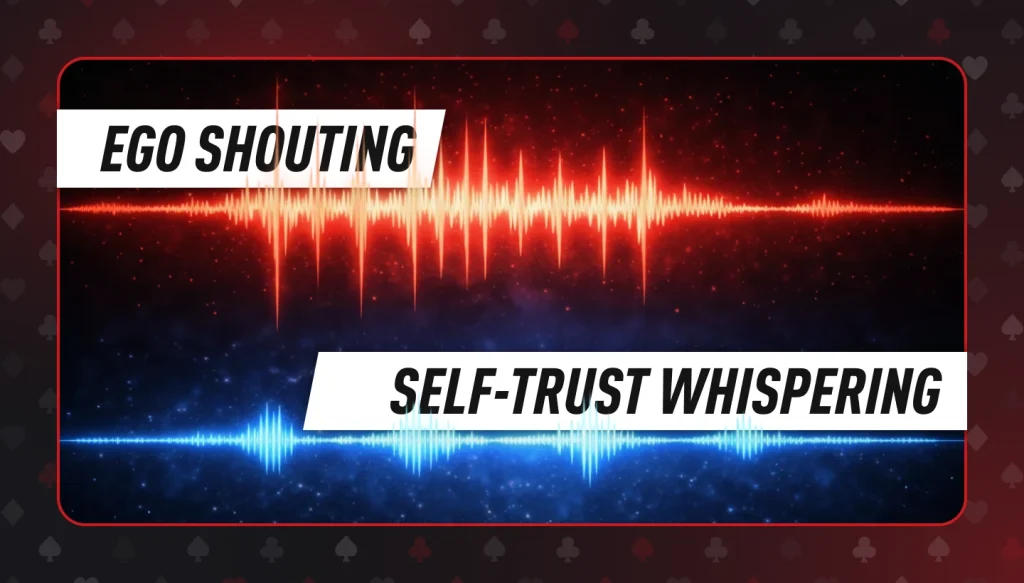
Confidence shouts. Self trust whispers. The players who rely on poker confidence alone tend to hit emotional potholes. They get overconfident, then underconfident, then panicky, then passive, then aggressive, then confused. But the ones who rely on self trust tend to stay steady. It’s not that they never wobble. They just wobble less.
Self trust is the internal muscle that stops your emotions from hijacking your logic. It keeps you grounded when the game starts feeling personal. And, probably the most underrated part: it helps you recognize your own progress, even if it’s been a rough month.
But if poker self trust is so important, why do so many players lose it so quickly?
Why Poker Players Lose Confidence
Confidence doesn't just suddenly collapse, it rather erodes, session by session, mistake by mistake. When you miss a value bet, botch a bluff, or get rivered three times within an hour.
And when that happens, you catch yourself hesitating on hands you used to snap-play. This is where things get messy.
Poker creates a very specific psychological trap: you can make correct decisions and get punished, or make terrible decisions and get rewarded. Over time, this distorts your internal compass if you’re not careful. It encourages emotional decision-making, not logical decision-making.
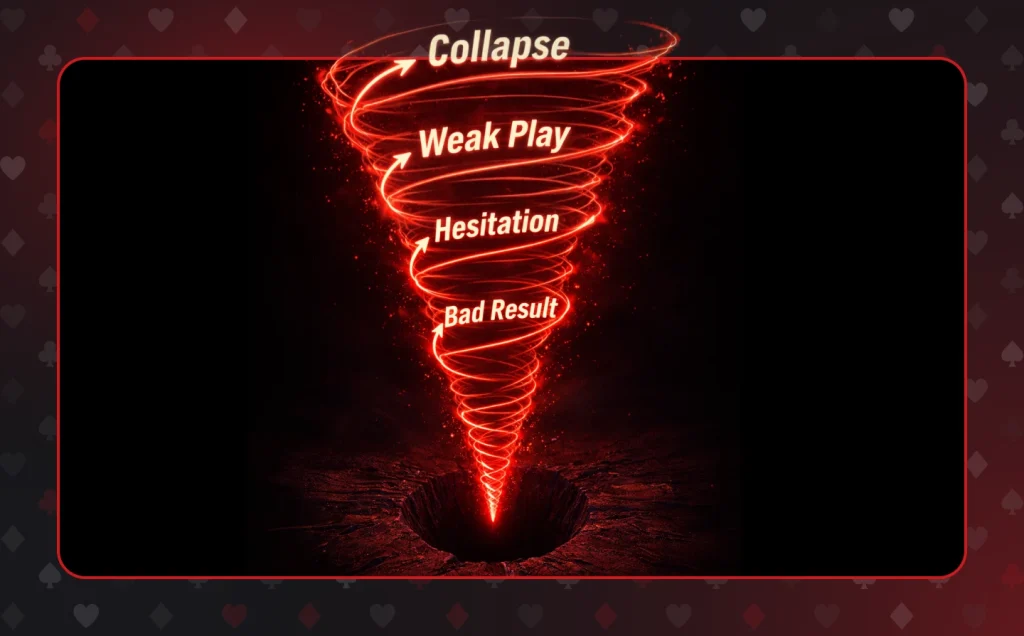
And this is usually how the “Confidence Spiral” starts:
Negative results hit.
Self-doubt creeps in.
You hesitate and second-guess yourself.
Your play weakens or becomes erratic.
Your results worsen.
The spiral tightens.
Poker players often assume that losing confidence is about losing money, but the truth is far more uncomfortable: it’s about losing faith in your own judgment.
When your internal compass loses its calibration, everything else becomes harder. You fold winning hands. You call in losing spots. You avoid thin value bets. You skip the bluffs you used to pull off. You start “playing scared” or “playing hopeful” instead of “playing poker.”
And the longer the spiral continues, the louder the doubt becomes.
But the great news, and it really is great, is that this spiral can be reversed. Rebuilt. Redirected. All through the Confidence Cycle.
The Confidence Cycle: A Process of Restoring Self Confidence
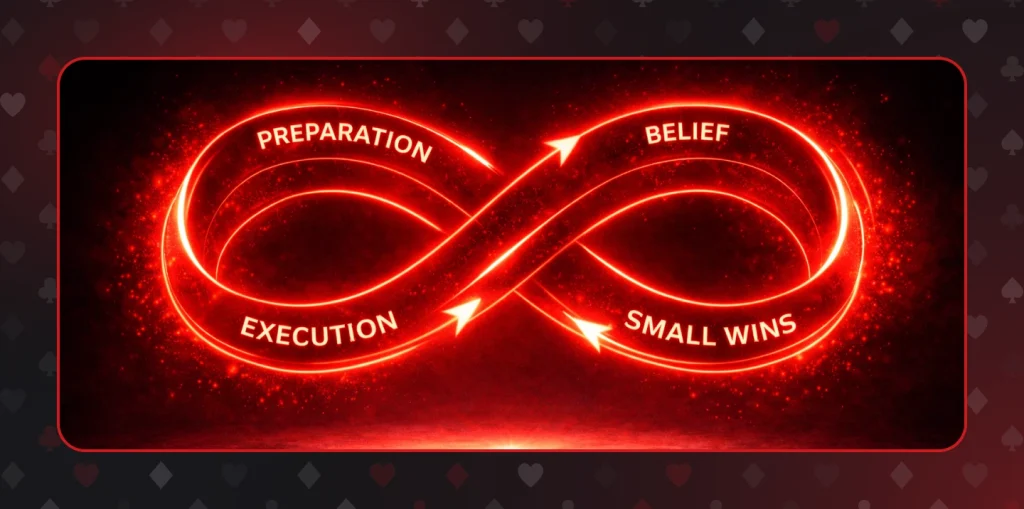
People like stories with beginnings and endings. Poker isn’t one of them. It’s a circle. Your poker confidence is not static but a never-ending restoration process that emerges from several actions that nurture one another.
This is what the cycle usually looks like:
1. Preparation & Study
Poker confidence begins long before you sit down at the table. It’s built on studying hands, reviewing decisions, running sims, talking through spots, and strengthening your understanding of situations.
Ironically, players often do less studying when they’re losing — when they need it most.
2. Small, Decision-Based Wins
The key term here is "decision-based." Not outcome-based. That is when you keep track of how many times you make the right decision, regardless of what happens. That's what drives you.
A correct fold bruises your ego but builds your self trust. A correct read that loses chips still raises your confidence.
3. Belief Formation (Self Trust)
Over time, you start to notice:
Your decisions are reasonable
Your rationale is sound
Your strategy isn't flawed
You're not "losing your touch."
Competence breeds confidence.
4. Execution On The Felt
This is the part where you start to notice the feedback loop. Your actions come more easily. You flow better without hesitation. You're less likely to be scared to bet thin, fold, or just stick to your plan.
5. Reflection
You analyze your session after you finish. You assess the quality of your decisions and make small changes if necessary. Try not to reprimand yourself, but rather just fine-tune your internal gauge.
6. Recalibration
Then you rinse and repeat.
Preparation → small wins → belief → execution → feedback → recalibration → preparation for more.
If you really internalize this cycle, you will have a remarkably better mental game over time.
Building Self Trust When Winning
It’s kind of funny that players usually think working on their poker confidence is only necessary when they’re losing. But surprisingly, some of the worst downswings start when someone is running hot! That's when overconfidence sneaks in. Decision quality drops. Sloppiness spreads like a virus.
Building poker self trust isn’t just about recovering, it’s about strengthening.
This is how you reinforce confidence while on a winning streak:
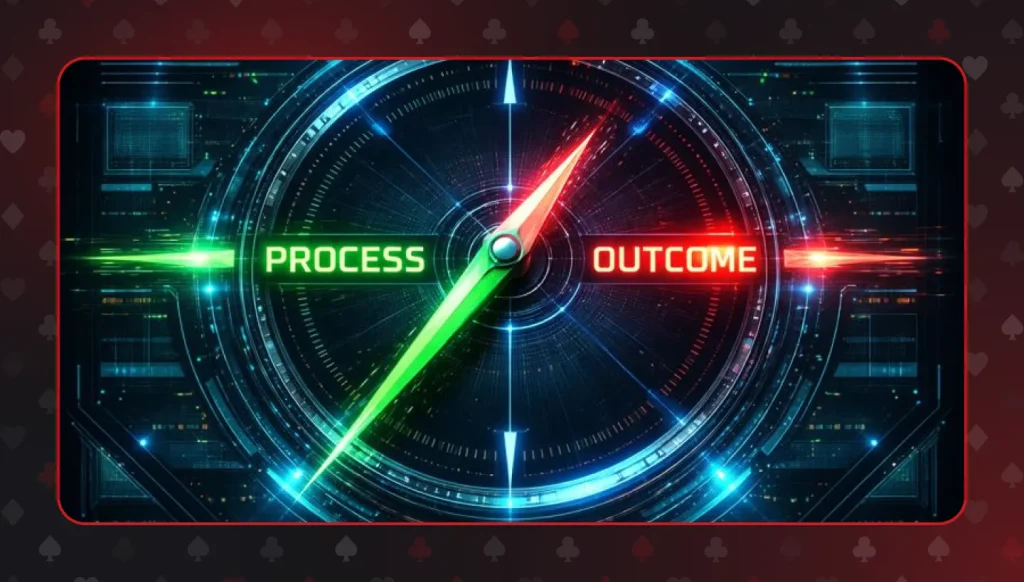
Maintain your focus on the process
Are you only patting yourself on the back for victories because of the cash? You're going to come crashing down one day. Celebrate:
Amazing hero folds
Perfect value bets
Timely triple barrels
Proper patience in marathon sessions
These things mean more than the biggest of wins.
Analyze at least one "I'm proud of this" hand per session
This establishes that your poker confidence comes from skill, not variance.
Keep mistakes honest
Winning streaks make players lazy. You ignore errors because the chips are stacking anyway. But this is where you plant the seeds of future downswings.
How to Rebuild Self-Trust After a Downswing
Let's clear the air and admit it: it is time to hit Reset.
Because eventually, even if you're the best player of them all, or if you're just starting your career, it will become a rough game, the cards will run out, and disappointment will set in.
That's when your confidence drops. You feel you lost your edge, but in reality, nothing changed in your brain over the past 48 hours.
Here's a tangible, real-life way to regain the balance:
Separate your identity from your result
You're not the terrible player you were over your last 1000 hands.
Poker doesn't care who you are. It cares how disciplined you've been.
Return to step one
Don't force your way through. That's how entire bankrolls are burnt. Return to the lab, get back to the fundamentals. Too often, players feel embarrassed by this, as if it's a failure to have to go back to ground zero, when in reality that's exactly what good players do.
Drop down in stakes if necessary
That's fine, and there is no shame in it. Recognize how it's easier for your brain not to connect a chip to your personal self-esteem. It will be easier to do in a smaller game.
Give yourself small, achievable bits of success
Think along the lines of:
"Make one correct tough fold."
"Take one thin value bet I usually would overlook."
"Stay calm for two hours."
Small personal wins can do wonders.
Journal three things per session
Journaling also does wonders. Jot down:
One hand you played you feel good about
Something you want to work on
A number from 1 to 10 to describe how you feel emotionally
No need for long prose, just honest bulletpoints.
Reassess emotional balance
Fear of poker is real, and acknowledging it is a win in itself. Breathing techniques, removing physical distractions, taking time off, sleeping enough – the more we can help to retrain the mind, the better we can get back to being us.
Long-Term Confidence Maintaining Habits
Now, let's take a meta approach, because confidence cannot be mended by a one-and-done fix. Rather, it is a long-term maintenance endeavor.
The following habits ensure your self-confidence remains intact:
Do A Weekly Review
Choose a day (Sunday morning? Late Thursday night?) where you can spare yourself 15 minutes to consider:
One thing you did wrong
One thing you changed
One thing you are proud of doing
One thing you want to learn
You'll be surprised how much confidence comes from consistency.
Recognize ego traps
Poker ego is usually flimsy. It tells you:
"This stake is beneath me"
"I deserve to win this session"
"I can't fold this. I won't look good doing that"
If you're considering making a decision because of your ego, then it's time to take a break.
Keep a small 'confidence bank'
Not for money, but for memories.
Document your great plays. When your poker confidence falters, go back and remember what you did right. It's comforting.
Stay in touch with other players
Other grinders are good for more than just poker talk, networking can also be good for mental support. When you hear someone else struggle, it legitimizes your struggle, helping you assess your situation and rebuild your confidence.
Your Daily Confidence Checklist
Here's a little checklist to turn to when the wheels feel a little loose:
Pre-Session
Review one range or one situation
Visualize making a confident decision
Set a small goal (e.g., "Don't rush in tough spots.")
Mid-Session
Be aware of tilt triggers
Take a deep breath after tough hands
Stay purposefully process-oriented
Post-Session
Journal about three decisions: one awesome, one okay, and one you need to review
Assess emotional regulation on a scale of 1 to 10
Acknowledge one thing you did really well
These are not hard and fast rules, just some habits to gently remind you how to get back in touch with yourself.
Confidence Isn’t a Feeling, It’s a Cycle
You don’t “find” confidence. You don’t “lose” it. You don’t “earn” it once and keep it forever. Every decision poker players make can take away from your poker self trust or add to it - it is on you, to not lose focus.
Confidence is a cycle: preparation, small wins, belief, execution, reflection, recalibration, repeat. When you understand that, poker stops feeling like a judgment of your character and starts feeling like a craft you’re constantly refining.
The next time doubt creeps in, remember that confidence isn’t built in the big moments, it’s built in the small ones. And those small moments are entirely within your control.
You know what? That’s a pretty comforting thought. For more poker psychology related content browse our article series. If you are ready to test your skills at the online felt, remember to use our bonus code SMPBONUS. To make it easier for you, we have a comprehensive list of online poker reviews and bonuses.
About the Editor

Beus Zsoldos is Somuchpoker's Senior Copywriter and Player Stories Editor, covering WSOP color moments, player profiles and poker personalities for the site's Stories section. She has spent more than 20 years around the game, first as a player, then as a live tournament director and localization manager for a major online poker room, before moving into full time poker writing.
Related News
 Online PokeriGaming
18,730 Players, One Millionaire: The One on CoinPoker
The One on CoinPoker drew 18,730 players and paid $1M to the winner - the biggest payout in CoinPoker history. Full final table results and stories.
 Online Poker
QQPK Bot Investigation: 724 Accounts Banned
QQPK confirms 724 account bans after a bot investigation flagged 2,587 suspicious accounts. More findings are expected on October 17.
 PromotionOnline Poker
WPT Global 2-For-1: $50K GTD PKO and Free $5.50 Tickets
WPT Global's nightly $50K GTD 2-For-1 PKO awards a free $5.50 ticket with qualifying cash entries. See the structure, rules and 7-day expiry.
 Online Poker
GGPoker Sets Record for Largest Online Poker Tournament with 420,084 Entries
GGPoker's $5 Ocean KO Opener attracted 420,084 entries to set a new record for the largest online poker tournament, surpassing PokerStars' 2015 benchmark.
 Online Poker
APT Online 2026 on Natural8: $40M GTD, 20 Trophies
APT Online 2026 is live on Natural8. $40M GTD, 20 trophy events, a $5M Main Event and $10K APTC seats for winners. Full schedule and promos inside.
 PromotionOnline Poker
Stake Showdown Returns on October 25 With $200,000 GTD and $0.50 Satellites
Stake Showdown returns October 25 with $200,000 GTD. Discover the $0.50 satellites, $1,000 buy-in, knockout rewards and full tournament details.