

Poker Psychology Part 9 - Peak Performance Poker: Flow States, Focus Training & Mental Stamina

It's a mesmerising, peculiar phenomenon when everything in poker goes… just right. You're one with the table, reading it without any particular effort, the cards feel like they are see-through, and you're confidently making all the right decisions, shocking even yourself. Poker psychology covers this topic, too; it's not just pure luck or magic.
Some refer to it as being "in the zone". Performance researchers talk about “flow” as the ultimate goal. For a poker player, that's most certainly true.
In this series, we have already discussed certain elements of it, but now we will bring it all together and learn how poker flow states, focus training, and mental stamina form the hidden triad that separates genuinely elite performers from casual players. Not just high-rollers or math wizards, but players who consistently sit down and operate at a higher cognitive level with stamina that lasts through long cash sessions and marathon tournaments.
We’ll bring together psychology, cognitive science, and the lived experience of players who know how brutal variance and decision fatigue can be. Let’s see what peak performance poker actually looks like!
What Peak Performance Is
Peak poker performance isn't just about having the correct ranges or analysing solver lines until your eyesight gets blurry. Those things help but mean little when your mental facilities blow up at the three-hour mark every single session. It's like driving a sports car: the car engine may be amazing, but without tyres that grip the pavement or a driver who doesn't fall asleep at the wheel, the engine won't do you much good.
Peak performance poker is achieved through three interconnected capacities:
Flow states for effortless, deep engagement
Focus training: for building attention muscles
Mental stamina: for high-level decision-making under pressure for extensive periods of time
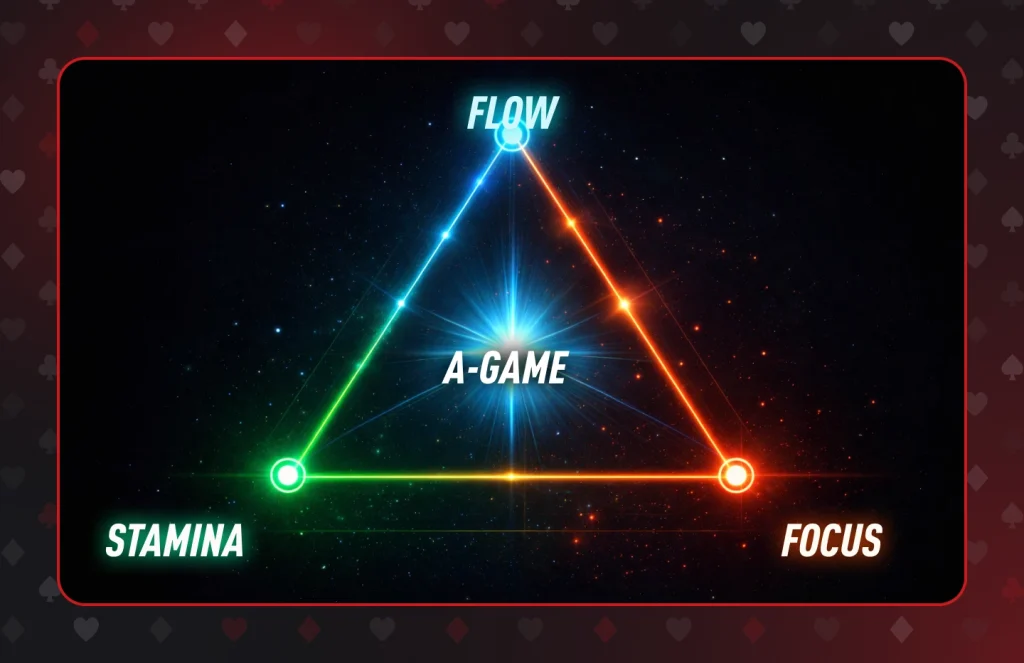
These skills transform already good players into very consistent winners, people who not only make the right decisions but also are emotionally stable, focused, and capable under extreme duress. Yet the ironic thing is that so many players attempt to learn their way to success rather than train the mind that needs training. It's all about the mind doing the work.
Flow States in Poker: That Elusive Zone Every Player Chases
If you’ve ever played a long session where everything slowed down, and your instincts sharpened, you’ve already tasted flow.
Psychologist Mihály Csíkszentmihályi described flow as a state marked by:
Total concentration
A sense of control
Distorted time
Clear goals
Loss of self-consciousness
Balance between challenge and skill
Poker, especially cash games and multi-hour tournaments, is the perfect environment for flow because the game constantly demands attention, adaptation, and creative problem-solving.
When a player enters the state of poker flow, they:
Process information faster
Know intuitively what to do in tough situations
Make fewer emotionally based decisions
Have better pattern recognition
Can go longer periods without making a mistake
This is a tremendous advantage, especially at mid- and high-stakes, where mistakes cost many big blinds. But the tricky thing about this state is that it doesn't just happen. You don't fall into flow like you accidentally find money in your long-forgotten winter jacket. You create it yourself.
Creating Flow
Three major ingredients tend to matter most when trying to create a state of poker flow:
The challenge must match your skill
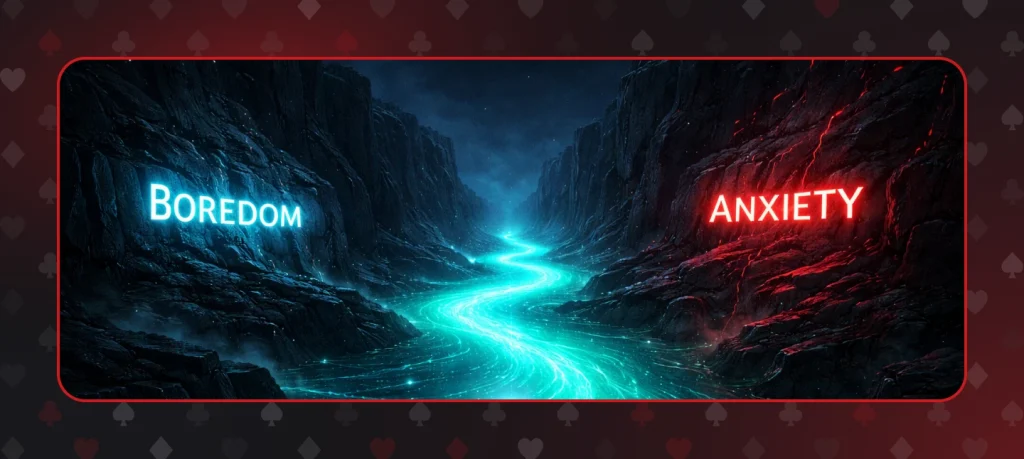
If it's too easy? You become uninterested. If it's too difficult? You get flustered or stuck. Especially since poker is constantly shifting, with new tables, different opponents, varying stack depths, so finding that optimal zone between challenge and skill is not a too straightforward task. Yet proper table selection and game awareness help you keep in that zone.
Distractions must be minimised
Your brain can’t enter flow state if it’s bouncing between checking your phone, talking on ten Discord servers, watching YouTube in the background, thinking about dinner, and responding to notifications. Humans don’t multitask well. Poker punishes people who think they can.

You need clear goals
Not “make money”. That's not a goal. Real goals look like this:
Focus on aggression based on positional awareness
Reflect on emotional spikes during the session
Play the same ranges for 3-bet pots
Track decisions rather than results
Goals prepare the mind for flow by creating structure. Poker flow doesn't turn you into a genius. It consistently turns you into the best version of yourself.
Focus Training: Building the Mental Muscles
If poker flow is the “peak,” focus is the foundation. Poker asks for a strange mix of attention: long-term stamina, short-term tactical awareness, emotional awareness, objectivity, the ability to reset after a bad hand, and so on. Most people think they’re focused because they’re staring at their cards. But that’s not focus, that’s just eyesight. Real focus is sustained cognitive attention. And it’s trainable.
Why Focus Crumbles During Long Sessions
You might relate to at least one of these:
The “stop caring” effect during the fifth hour
The impatient clicking
The urge to call down just because you want the hand to end
The mental fog where you barely remember the last ten hands
The sharp spike after losing a big pot
This isn’t a lack of motivation. It’s cognitive fatigue, your brain hitting its natural workload ceiling. Even athletes hit focus walls. But unlike physical fatigue, mental fatigue is sneaky. It doesn’t burn or ache, it just quietly erodes decision quality until you’re leaking EV without noticing.
How To Train Poker Focus
There are several methods high-performing players use, some simple, some more advanced. Usually, a combination works best.
Cognitive Warm-Ups (5–10 Minutes)
Just like athletes warm up their muscles, poker players should warm up their cognitive systems. This might include:
Solving 2–3 preflop range quizzes
Reviewing three hands you struggled with recently
Doing a two-minute breathing reset
Writing a small goal like: “I’ll respond instead of react”
These strategies help you control your feelings and get you into the right mindset for making decisions.
Mindfulness Training
It's not some woo-woo incense-burning, om-ing deal. It's a practical training of poker focus. Mindfulness helps players notice emotional impulses, focus on the present hand rather than outcomes, reset after variance swings, and reduce the frequency of tilt. Even five minutes a day helps. Apps like Headspace, Waking Up, and Calm are popular among poker players.
Minimise Stimulus Switching
Your poker focus dies every time you change a tab. Every time a notification dings. Every time you pick up your phone. Establish a "performance environment": turn off all your applications, silence your phone and if possible, turn on a blue-light filter. Your brain thrives on consistency. Allow it to find its equilibrium.
Track Your Focus
Just write down:
Focus score (1–10)
Mistakes you noticed
Emotional spikes
Length of session
You’ll start seeing patterns you were blind to before.
Mental Stamina: The Long Game
You can study solvers for 500 hours. You can analyse hands like a machine. But none of that matters if you can’t stay mentally sharp for the duration of a session. Mental stamina is the unsung force behind elite poker performance. It's not about "pushing through" or "not being a softie." Mental stamina is a dynamic mix of cognitive endurance and emotional regulation, physiological (blood sugar and hydration) and physical (posture) stability, stress resistance, and access to one's A-game.
Poker Is An Endurance Sport
A tournament day is often 10-12 hours long. Cash game players work at peak hours from 8 PM to 2 AM. The average online player gets 300 hands an hour. This means that no matter what you play, you're making thousands of choices, weighing thousands of variables, and you're psychologically sinking into the depths of variance. You're constantly adjusting, and if you can't mentally endure it, your performance drops long before your session is over.
Build Poker Stamina
This is where poker and sports overlap more than players realise. Let's see what the most effective ways are to train this aspect of your capabilities.
Brain Endurance Training (BET)
This mix of physical exertion and cognitive tasks helps build resistance to mental fatigue. It’s been used in sports psychology and can be adapted for poker. It looks like this, for example: you do a two-minute memory task, instantly followed by a short plank, then you repeat this scícle three times. I know, it sounds odd, but it really trains your brain to handle strain while thinking clearly.
Physical Exercise
You don't need to be a triathlete. But a certain level of physical conditioning is truly beneficial, because it increases blood flow to the brain, improves posture over time, stabilises blood sugar, and reduces stress. Even a twenty-minute walk is enough.
Nutrition & Hydration
What's the quickest way to drain your energy? Low blood sugar. Many tournament grinders forget to eat or neglect to eat for hours on end until a break comes around, then gorge on crazy amounts of chocolate, which sends blood sugar spiking and crashing. Try complex carbs, like oatmeal, nuts, and bananas instead. They are so much better for sustained energy release than major meals during a session. Also, don't forget to hydrate.
Emotional Regulation Exercise
You know how, when a huge pot shakes you, your mind goes all abuzz? That's emotional burnout. Give these a try:
Brief breathing resets
Leaving the table
Writing the feeling down ('frustrated', 'ashamed', 'annoyed'), for just calling it by name, sometimes helps reduce its power
Sometimes the easiest things work best.
A Peak Performance Poker Routine
Let’s make this practical by putting it all together. An effective poker performance routine turns knowledge into actual behavioural change.
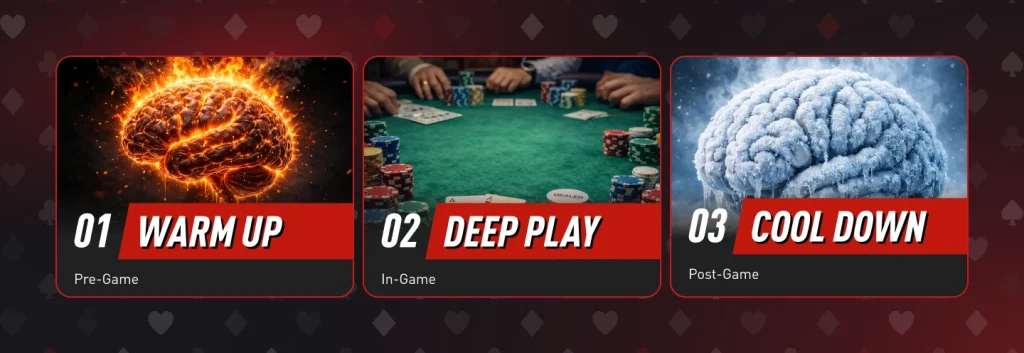
Before the Session
Review 2–3 hands
Set a clear goal (“Focus on patience”)
Do a quick breathing exercise
Eat something solid, but not heavy
Shut down distractions
Sit with good posture
Visualise making good decisions to prime your nervous system
During the Session
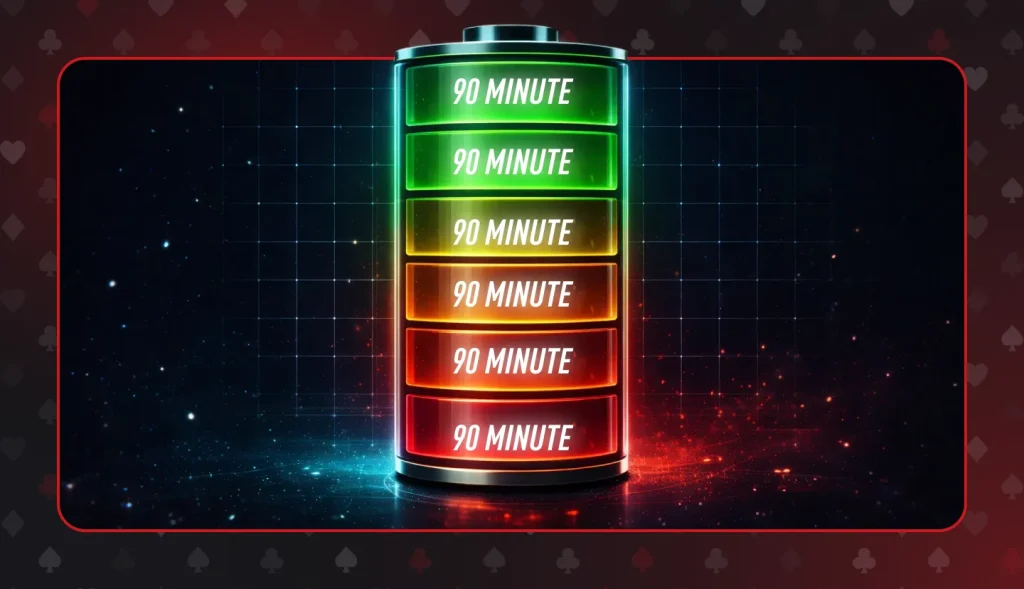
Play in 90-minute intervals
Take mini-breaks
Assess your emotions
Get up after big pots
Drink plenty of water
After the Session
Score your level of poker focus
Journal about one or two times you felt something
Choose three hands for later analysis
Cool down physically with a short walk or a stretch
This solidifies what you learn and minimises tilt from one session to the next.
How Elite Players Train Using Poker Psychology
Not every pro flexes with the mental component of their game, but rest assured, every single one of them trains their mental facilities. Jason Koon works out and meditates daily. Fedor Holz utilises mindfulness and small pauses mid-tournament. Daniel Negreanu has always advocated the benefits of diet, exercise and pre-game rituals. These days, most online crushers recommend using a mood tracker. It's nothing mystical, it's just performance psychology applied to an old game with new tools.
Building Your Own Peak Performance System
Understand this: it's better to be consistent than brilliant. Not everyone can, or should, learn every solver node or catch every live tell, but everyone can be better at holding focus, managing anxiety, maintaining concentration, and being in the moment. And that is the way to achieve your peak poker performance.
Flow, focus, and endurance are not necessarily transcendent elements to be harnessed by the enlightened. They're only the cornerstones to grounded, profitable decision-making. But don't overwhelm yourself. Take one new habit, develop your own system. You'll be amazed at how much more impressive your results will be once your mind finally gets the framework it craves to operate.
When you feel ready to utilise your newly learned skills at the poker table, take a look at the online poker sites we recommend, and don't forget to use the bonus code SMPBONUS when registering. If you train your mind using poker psychology, the results will show your progress. Good luck at the tables!
About the Editor

Beus Zsoldos is SoMuchPoker's Senior Copywriter and Player Stories Editor, covering WSOP color moments, player profiles and poker personalities for the site's Stories section. She has spent more than 20 years around the game, first as a player, then as a live tournament director and localization manager for a major online poker room, before moving into full time poker writing.
Related News
 PromotionOnline Poker
Stake Showdown Returns on October 25 With $200,000 GTD and $0.50 Satellites
Stake Showdown returns October 25 with $200,000 GTD. Discover the $0.50 satellites, $1,000 buy-in, knockout rewards and full tournament details.
 Online Poker
GGPoker Ocean KO - Jackpot Bounties Worth Up to 400x
GGPoker Ocean KO turns every knockout into a jackpot - bounty multipliers up to 400x and Legendary bounties to $1.5M. See how it works and play today.
 NewsOnline PokeriGaming
Road to Triton Cyprus: Win a $25,000 Seat at Titi Poker
Join the Road to Triton Cyprus at Titi Poker. Start free on Oct 6, climb the satellite ladder and win one of 3 guaranteed $25,000 tickets.
 NewsOnline PokeriGamingPromotion
GGPoker and Natural8 $18M October Giveaway
Win your share of $18M in the GGPoker and Natural8 giveaway this October. Cash drops, Halloween Party, leaderboards - plus a welcome bonus.
 NewsOnline PokeriGaming
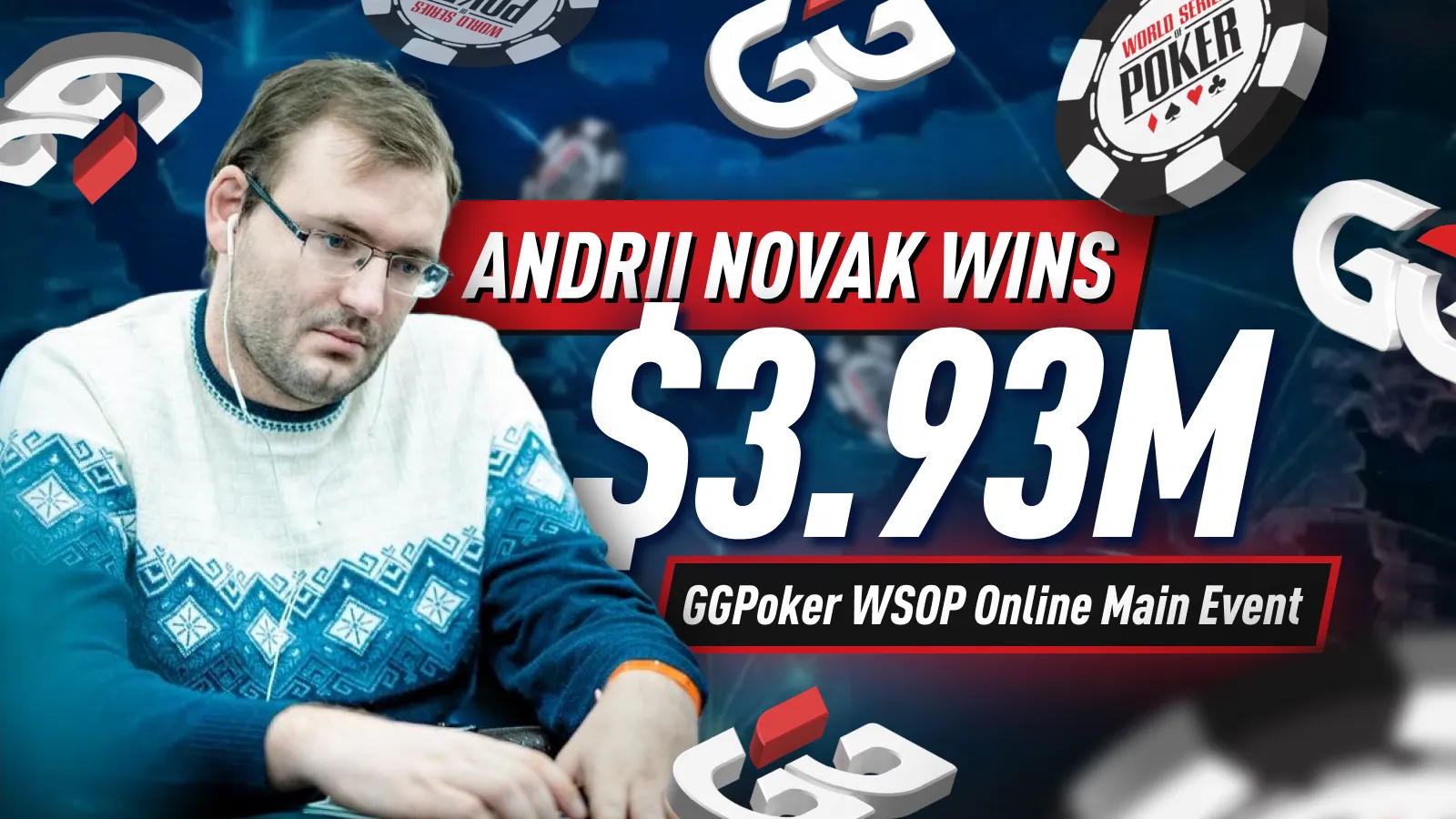
Andrii Novak Wins the GGPoker WSOP Online Main Event for $3.93M
Andrii Novak beats Simon Beckmann to win the 2026 GGPoker WSOP Online Main Event for $3.93M. Full final table results, payouts and stats.
 NewsOnline PokerLive PokeriGaming
QQPK Freeroll: Win a Poker Dream Malaysia Seat + $800
Win a MYR 3,200 Poker Dream Malaysia Main Event seat + $800 in the free Somuchpoker freeroll on QQPK. Sept 27 - sign up with code SMPBONUS.