

Hero Fold

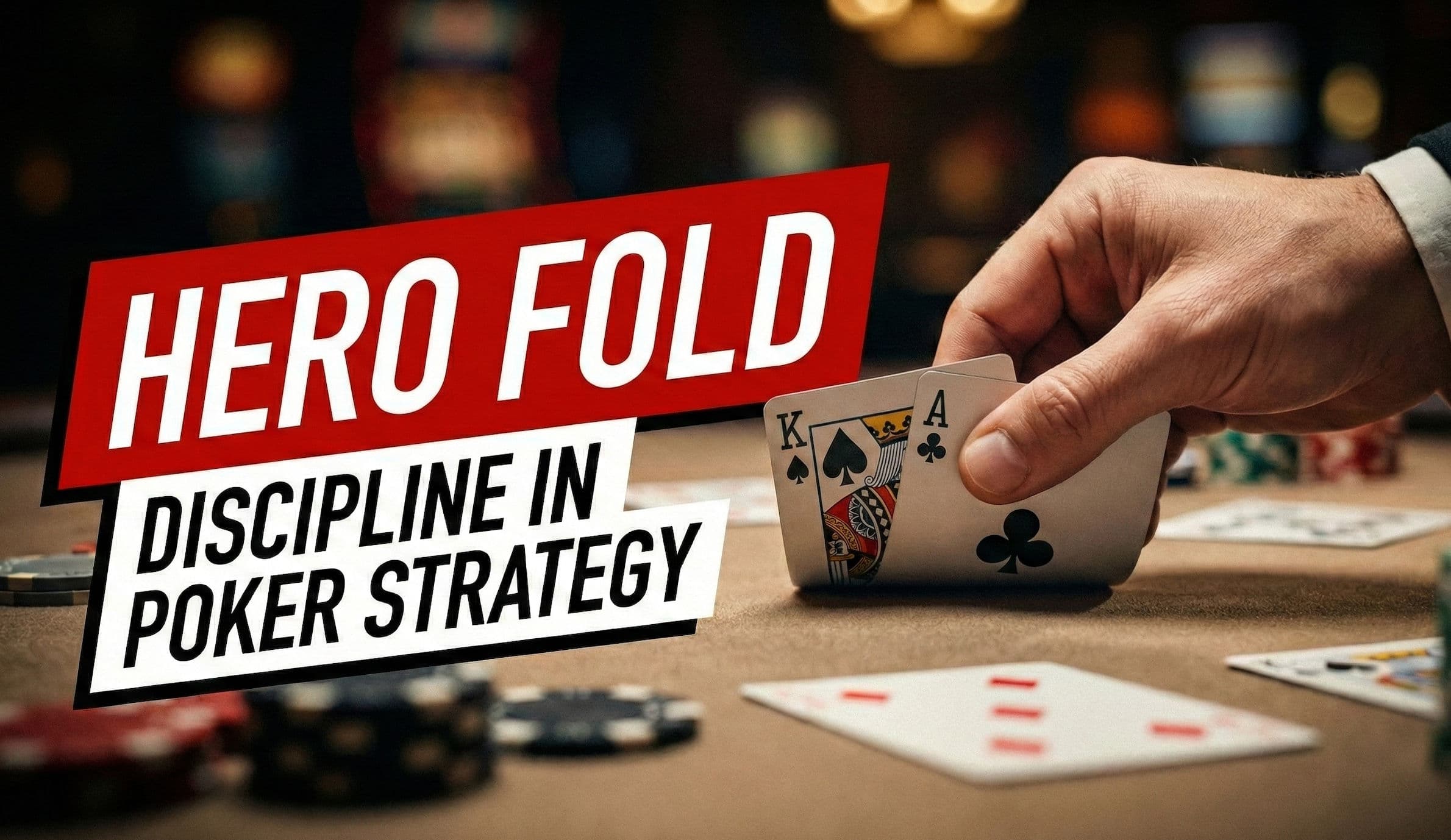
In the complex tapestry of poker strategy, few plays demand as much poker discipline and insight as the hero fold. This advanced maneuver transcends the conventional wisdom of playing strong hands aggressively, instead calling for a profound understanding of opponent tendencies and board dynamics. A hero fold is the act of consciously surrendering a hand that, by all standard measures, appears to be robust and worthy of continuation, yet doing so because an astute 'read' suggests your opponent holds an even more formidable, virtually unbeatable hand. It is a decision born of courage, not weakness, designed to protect your stack from significant losses against a perceived nutted holding.
This guide delves into the strategic rationale, psychological underpinnings, and practical application of the hero fold, equipping you with the knowledge to make these critical, often counter-intuitive, decisions at the poker table. Mastering the hero fold is a hallmark of an expert player, demonstrating superior analytical skills and an unwavering commitment to long-term poker bankroll preservation.
What Exactly Constitutes a Hero Fold in Poker?
A hero fold in poker signifies a deliberate choice to relinquish a seemingly powerful hand in the face of aggressive action that strongly signals a superior opponent holding. Imagine possessing a top pair with a premium kicker, a flopped set, or even a strong draw that hits, only to be confronted by betting lines that scream absolute strength.
Unlike a standard fold where your hand is simply not good enough, a hero fold in poker involves laying down a hand that is objectively strong, but likely second-best or worse against your opponent's perceived range. The 'heroic' element stems from overriding the natural instinct to call with a good hand, prioritizing chip preservation over the pursuit of a potentially lost cause.
The Psychology Behind a Hero Fold in Poker
Executing a hero fold in poker requires not only sharp analytical skills but also a robust psychological fortitude. It challenges the ego, as it means admitting defeat with a hand that often feels like it should win. This self-control is paramount, as the emotional pull to call with a strong hand can lead to catastrophic losses. True mastery lies in detaching from the immediate gratification of 'seeing the hand' and instead focusing on the long-term impact on your chip stack and overall tournament equity.
Identifying Opportunities for a Hero Fold
The decision to make a hero fold is rarely made in isolation. It's the culmination of observing multiple converging factors that create a compelling narrative for your opponent's strength.
Opponent's Betting Patterns and Tendencies
Consistent Aggression: An opponent who typically plays cautiously but suddenly exhibits an aggressive betting line (e.g., large bet sizing on multiple streets, an unexpected all-in).
Reliable Bluffer/Value Bettor: Knowing whether your opponent frequently bluffs or almost exclusively bets for value in similar spots is crucial. Hero folds are more often considered against players known for strong value betting.
Pattern Recognition: Identifying deviations from an opponent's typical playstyle, especially on critical streets like the turn or river.
Board Texture Analysis
Coordinated Boards: Boards that offer numerous possibilities for strong hands like straights, flushes, or full houses (e.g., a board with three cards of the same suit, or three connected cards). A seemingly strong hand like two pair can quickly become vulnerable on such boards.
Paired Boards: When the board pairs, a set in your hand can lose significant value if your opponent's range credibly includes higher sets or full houses.
Dynamic vs. Static Boards: Boards that change significantly with each street (dynamic) present more hero fold scenarios than static boards.
Leveraging Player Reads (Live and Online)
Live Tells: Physical tells in live poker (e.g., opponent suddenly becoming very still, rapid breathing, an unusually strong or weak bet placement) can provide critical information.
Online Timing Tells: In online poker, consistent timing patterns (e.g., immediate calls followed by a sudden long tank) can signal a bluff or a polarized range. For accurate reads, it is crucial to play on safe online poker sites like CoinPoker , where game integrity and secure software ensure that timing tells remain a reliable part of your poker strategy
Stack Dynamics and Implied Odds
High Stack-to-Pot Ratio (SPR): In situations where committing to a call means risking a significant portion of your stack, the cost of being wrong is much higher, making a hero fold a more prudent option.
Tournament Implications: In tournament play, preserving chips is often more critical than in cash games, especially near bubble stages or final tables.
Illustrative Poker Scenarios
Consider these expanded examples that highlight the thought process behind a hero fold:
Example 1: Top Pair/Kicker vs. Implied Nuts
You hold A♠K♠ on a K♦4♣Q♦10♦ board. You have top pair, top kicker, and the nut flush draw missed. Your opponent, a tight-aggressive player, has been passive pre-flop and on the flop, then suddenly fires a pot-sized bet on the turn, followed by an all-in on the river. Given the board texture and your opponent's tight image, their line strongly suggests a completed straight (J9, particularly J♦9♦ or similar) or a nut flush (any two diamonds that complete a flush with the board). Despite your strong hand, the confluence of your opponent's reliable betting pattern and the dangerous board texture makes a hero fold a sophisticated, stack-saving decision.
Example 2: Set vs. Hidden Straights/Flushes
You flop a set of 8s (8♣8♦) on a board of 8♠7♥6♦. This is typically a monster. You bet, and your opponent calls. The turn is the 5♥. Now the board reads 8♠7♥6♦5♥. Your opponent leads out with a massive bet, effectively putting you all-in. While your set is still very strong, the board has become extremely coordinated, bringing in numerous straights (9T, 49, 34) and a potential flush. If your opponent's pre-flop range and subsequent play suggest they are capable of holding a higher set, a straight, or even a straight flush, then even your flopped set might be a profitable hero fold.
When to Hero Fold: Key Strategies
Cultivating Trust in Your Reads: The foundation of a successful hero fold is confidence in your ability to accurately read your opponent. This skill is honed through countless hours of observation and critical analysis of betting patterns, timing, and player tendencies.
Deep Opponent Profiling: Maintain detailed mental (or actual) notes on opponents. Who bluffs often? Who only bets big with the nuts? Who is capable of audacious moves? This database of knowledge is invaluable.
Avoiding Pre-emptive Over-Folding: While hero folds are powerful, they must be used judiciously. Folding too often based on weak reads can lead to missed opportunities and exploitable tendencies. Balance is key; you must be willing to make hero calls when the situation dictates a bluff.
The Intrinsic Reward of Discipline: Since hero folds don't immediately translate to winning chips, the satisfaction comes from making a disciplined, well-reasoned decision that preserves your poker bankroll and avoids a costly mistake. This mental reward fuels better future decision-making.
Strategic Hand Concealment: Never reveal a hero fold. Showing your opponent that you folded a strong hand based on a read provides them invaluable information about your thought process, which they can exploit in later hands.
Distinguishing Hero Folds from Hero Calls
It's vital to differentiate a hero fold from a hero call, as they represent inverse strategic decisions. A hero fold involves laying down a strong hand because you believe your opponent has you beaten. Conversely, a hero call is made with a relatively weak hand because you strongly suspect your opponent is bluffing. Both require an advanced understanding of game theory, opponent psychology, advanced poker strategy, and situational awareness, but their outcomes – preserving chips versus winning chips from a bluff – are fundamentally different.
| Pros | Cons |
|---|---|
Successfully executing a hero fold prevents significant chip losses against stronger hands, crucial for long-term play and tournament survival. | If your read is incorrect, you might fold the best hand, relinquishing a pot you could have won. This can be costly over time. |
Making a disciplined hero fold showcases advanced poker understanding, demonstrating excellent opponent reading and emotional control. | Over-folding or making hero folds too frequently can make you susceptible to opponents bluffing you off good hands more often. |
Avoids the tilt and frustration of calling off a large portion of your stack with a second-best hand, maintaining mental clarity for future decisions. | The act of folding a strong hand can be mentally challenging and lead to regret if the opponent shows a weaker hand later, impacting confidence. |
Related Poker Terms
Best Online Poker Bonus Codes


About the Editor

Bence Mitykó is a Somuchpoker poker writer, covering poker news and strategy. He spent four years playing poker professionally, primarily focusing on Heads-Up Sit & Go games, experience that continues to shape his understanding of poker strategy, online poker dynamics, and the wider poker industry.


