Blackjack Insurance: A Player's Guide to this Side Bet

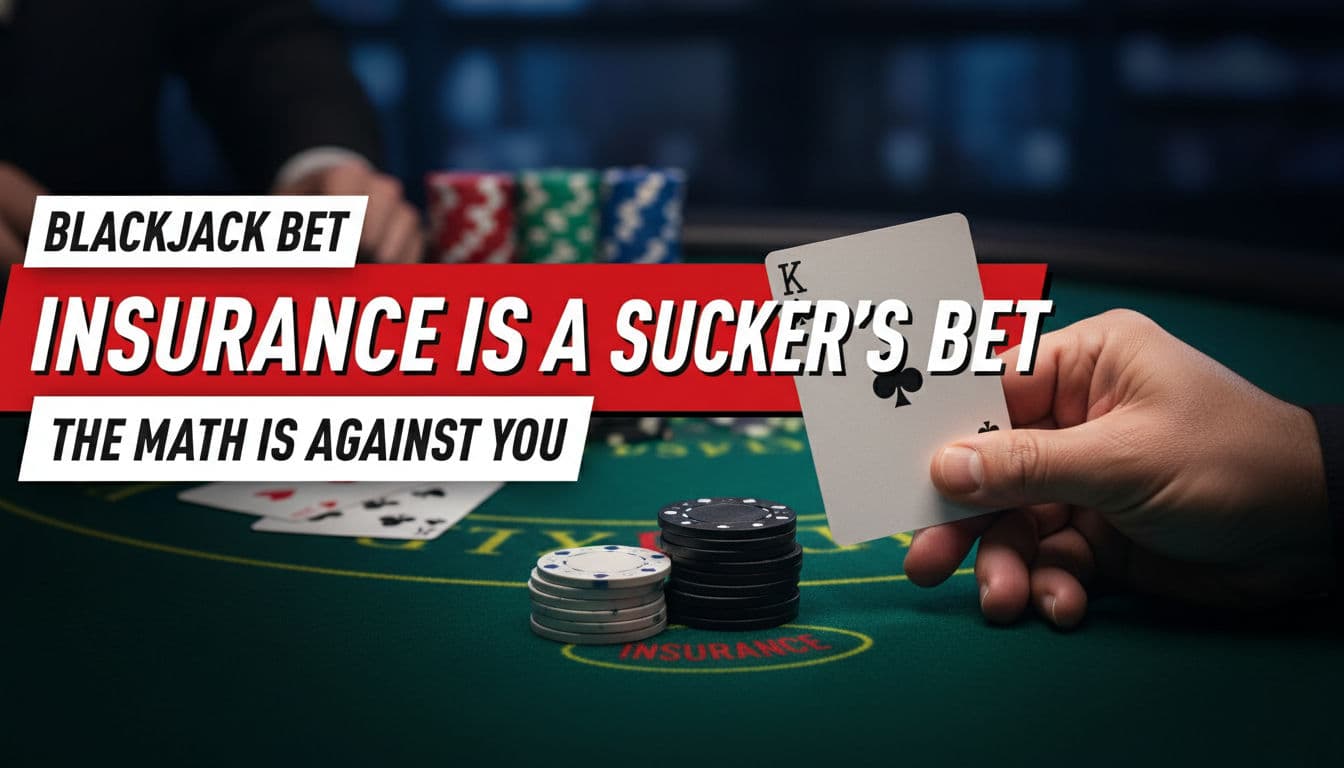
Blackjack insurance is a side bet offered to players when the dealer's face-up card is an Ace. While its name suggests a way to protect your hand, it's actually an independent wager on whether the dealer has a ten-value card in the hole, resulting in a blackjack. For the vast majority of players, this bet carries a significant house edge and is not a recommended long-term strategy.
What Exactly is Blackjack Insurance?
In the game of blackjack, you'll sometimes hear the dealer ask, "Insurance open?" This happens only when their visible card is an Ace. Taking blackjack insurance is a choice you make before the dealer checks their second card (the hole card). It's a side bet, meaning it's separate from your primary wager.
To take insurance, you must place an additional bet equal to half of your original stake. If the dealer reveals their hole card and it's a 10, Jack, Queen, or King, they have a blackjack. In this case, your insurance bet pays out at 2-to-1 odds. This payout effectively cancels out the loss of your original bet, allowing you to break even on the hand.
However, if the dealer's hole card is not a ten-value card, you lose the insurance bet, and the hand proceeds as usual. The insurance wager is settled before any further player actions.
When playing at an online casino, a pop-up window or a dedicated button will typically appear the moment an Ace is dealt to the dealer, giving you a limited time to decide whether to take the offer. While it might seem like a safety net, most strategic guides for online casino players advise against this bet, as the mathematical house edge on insurance is significantly higher than on the standard game, making it a losing proposition in the long term for those not tracking the deck.
How the Insurance Bet Works: A Practical Example
Let's walk through a common scenario to understand the mechanics:
You place an initial bet of $20.
You are dealt a King and a 9 for a strong total of 19.
The dealer's upcard is an Ace.
The dealer offers insurance. You decide to take it and place a $10 bet (half of your $20 wager) in the insurance area.
Now, two outcomes are possible:
Outcome A: The Dealer Has Blackjack. The dealer reveals a Queen as their hole card. You lose your initial $20 bet. However, your $10 insurance bet wins and pays $20 (at 2-to-1 odds). Your net result for the hand is $0 (breaking even).
Outcome B: The Dealer Does Not Have Blackjack. The dealer reveals a 6 as their hole card. You immediately lose your $10 insurance bet. The game continues, and you play out your hand of 19 against the dealer's hand.
The Math: Why Experts Call It a 'Sucker Bet'
The core of understanding what is blackjack insurance lies in its mathematics. The bet isn't about protecting your hand; it's a straight-up bet on the composition of the remaining deck. You are betting that the dealer's unseen card is a ten.
In a standard 52-card deck, there are 16 cards with a value of ten (10s, Jacks, Queens, Kings). There are 36 non-ten cards. Let's assume you're playing the first hand of a fresh shoe. You can see your two cards and the dealer's Ace. None of these are tens. This leaves 49 unknown cards, of which 16 are tens and 33 are not.
The odds of the dealer having a ten are 33 to 16, which is approximately 2.06 to 1 against. However, the insurance bet pays only 2-to-1. This disparity is where the casino gets its advantage.
"Over the long run, the insurance bet has a house edge of over 7% for players who don't count cards. It's statistically one of the worst wagers you can make at the table."
The 'Even Money' Trap
A particularly tempting version of the insurance bet occurs when you have a blackjack, and the dealer shows an Ace. The dealer will offer you "even money." This is just another way of phrasing the insurance bet. By accepting even money, you get paid 1-to-1 on your bet immediately, forfeiting the potential 3-to-2 blackjack payout. While it guarantees a win, you're giving up a higher expected value over time by making a poor insurance wager.
Optimal Strategy: Should You Ever Take Insurance?
For 99% of players, the answer is a clear and simple no. The house edge on the insurance side bet is too high to make it a profitable play. Basic strategy dictates that you should always decline insurance, regardless of the strength of your hand.
The Sole Exception: Expert Card Counters
The only time taking insurance becomes a strategically sound decision is for professional card counters. A card counter tracks the ratio of high-value cards to low-value cards remaining in the deck. If the count is very high, it means the deck is rich with ten-value cards. In this specific scenario, the odds can flip, making the 2-to-1 payout favorable for the player. However, this requires significant skill, practice, and concentration, and is not applicable to the average recreational player.
Player Type | Insurance Strategy | Reasoning |
|---|---|---|
Basic Strategy Player | Never take insurance | The bet has a negative expected value and a high house edge. |
Recreational Player | Never take insurance | It's a losing proposition over time that reduces overall winnings. |
Expert Card Counter | Take insurance when the true count is +3 or higher | The deck is rich enough in tens to make the 2:1 payout profitable. |
Ultimately, while insurance in blackjack might feel like a safe play, it's a costly one. By consistently avoiding this blackjack side bet, you are adhering to a solid strategy that will improve your results in the long run.
| Pros | Cons |
|---|---|
If the dealer has a blackjack, the 2-to-1 payout on the insurance bet cancels out the loss of your main wager, resulting in a push for the hand. | The insurance bet has one of the highest house advantages of any wager in blackjack, often exceeding 7% depending on the number of decks used. |
When you have a blackjack, taking the 'even money' option (a form of insurance) guarantees you a 1-to-1 payout, removing the risk of a push. | Because the payout odds (2-to-1) are lower than the true odds of the dealer having a ten, you will lose money over time by consistently making this bet. |
The wager has nothing to do with the strength of your own hand. It's a completely separate bet on the dealer's hole card, which often confuses players. |
Related Casino Terms
Best Online Casinos

Vave
4.6Welcome Bonus150% up to 1.5 BTCCashback BonusVariable- Welcome Bonus
- 150% up to 1.5 BTC
- FTD Bonus
- 150% up to 1.5 BTC
- Cashback Bonus
- Variable
- Extra Bonus
- Free Spins
- Platforms


- Browser Support
- Yes
- Mobile Support
- No
- Crypto Support
- Yes
- License
- Republic of Costa Rica
Game types
 No Blackjack
 Baccarat
 No Bingo
 No Craps & dice
 Crash games
 eSports betting
 Jackpot games
 No Keno
 Live games
 Roulette
 No Scratch cards
 Slots
Slots Sports betting
 No Video poker
Payment methods


LTC Casino
4.4Welcome Bonus250% First Deposit Bonus up to $750Cashback BonusNo Cashback- Welcome Bonus
- 250% First Deposit Bonus up to $750
- FTD Bonus
- 250% up to $750
- Cashback Bonus
- No Cashback
- Platforms
- Browser Support
- Yes
- Mobile Support
- No
- Crypto Support
- Yes
- License
- No License
Game types
BlackjackBaccaratNo BingoNo Craps & diceCrash gamesNo eSports bettingJackpot gamesNo KenoLive gamesRouletteNo Scratch cardsSlotsNo Sports bettingNo Video pokerPayment methods


Jack
4.6Welcome Bonus100 Free Spins + Risk-Free Sports BetCashback BonusUp to 30%- Welcome Bonus
- 100 Free Spins + Risk-Free Sports Bet
- Cashback Bonus
- Up to 30%
- Extra Bonus
- 100 Free Spins
- Platforms
- Browser Support
- Yes
- Mobile Support
- No
- Crypto Support
- Yes
- License
- Curaçao Gaming Control Board
Game types
BlackjackBaccaratNo BingoNo Craps & diceCrash gameseSports bettingJackpot gamesNo KenoLive gamesRouletteScratch cardsSlotsSports bettingNo Video pokerPayment methods


Duel
4.2Welcome Bonus50% Instant RakebackCashback BonusFix 50%- Welcome Bonus
- 50% Instant Rakeback
- Cashback Bonus
- Fix 50%
- Extra Bonus
- 100% RTP Games
- Platforms
- Browser Support
- Yes
- Mobile Support
- No
- Crypto Support
- Yes
- License
- License No. ALSI-202411026-FI1.
Game types
No BlackjackBaccaratBingoCraps & diceCrash gameseSports bettingJackpot gamesNo KenoLive gamesRouletteNo Scratch cardsSlotsSports bettingVideo pokerPayment methods

Stake US
4.6Welcome BonusFree 25 SC + 250K Gold Coins- Welcome Bonus
- Free 25 SC + 250K Gold Coins
- Extra Bonus
- 1 Stake Cash + 10,000 Gold Coins Free - Every Day
- Platforms
- Browser Support
- Yes
- Mobile Support
- No
- Crypto Support
- Yes
- License
- Sweepstakes (US Federal Law)
Game types
BlackjackBaccaratNo BingoCraps & diceCrash gamesNo eSports bettingNo Jackpot gamesNo KenoLive gamesRouletteScratch cardsSlotsNo Sports bettingNo Video pokerPayment methods

Shuffle US
4.7Welcome BonusFree 1 Shuffle Coin + 25,000 GC- Welcome Bonus
- Free 1 Shuffle Coin + 25,000 GC
- Extra Bonus
- Daily Log in Bonus
- Platforms
- Browser Support
- Yes
- Mobile Support
- No
- Crypto Support
- Yes
- License
- Sweepstakes Model — Munyon Canyon Ltd (BVI)
Game types
BlackjackBaccaratNo BingoNo Craps & diceCrash gamesNo eSports bettingNo Jackpot gamesNo KenoLive gamesRouletteNo Scratch cardsSlotsNo Sports bettingNo Video pokerPayment methods