

The Ultimate Guide to HORSE Poker: Rules, Strategy, and Mixed Game Mastery

If you want to transition from a casual card player to an all-round professional, HORSE poker is a great variant where you can prove your all-round skills. Long considered the test of a player’s overall card-playing ability, this mixed game format forces competitors out of their comfort zones, demanding extreme versatility, deep mathematical understanding, and flawless fundamental poker skills.
Whether you are preparing for a local mixed cash game or eyeing a World Series of Poker (WSOP) bracelet, understanding HORSE poker and its variants is essential.
Quick Answer
HORSE poker is a premier mixed game format consisting of five distinct poker variants played in a continuous rotation: Hold'em, Omaha Hi-Lo 8-or-Better, Razz, Seven Card Stud, and Seven Card Stud Hi-Lo 8-or-Better, played in a fixed limit betting structure.
What is HORSE Poker?
HORSE poker is a premier mixed game format consisting of five distinct poker variants played in a continuous rotation: Hold'em, Omaha Hi-Lo 8-or-Better, Razz, Seven Card Stud, and Seven Card Stud Hi-Lo 8-or-Better. Standard HORSE is played in a fixed limit betting structure; it tests a player's versatility across flop, stud, and split-pot games, making it harder for a player who specializes in only one game to dominate the full rotation.
Key Takeaways
Five-Game Rotation: The game order (H-O-R-S-E) typically changes after a set amount of time or after a full orbit of the table.
Fixed Limit: Unlike No-Limit Texas Hold'em, all variants in a standard HORSE rotation utilize a Fixed Limit betting structure, requiring excellent pot odds calculations.
Flop and Board Games: The rotation tests your skills in community card games (Hold'em, Omaha) and board games (Razz, Stud).
High, Low, and Split: Players must master high-hand games, lowball games (Razz), and split-pot formats (Omaha/8, Stud/8).
Memory is Crucial: Success in the "R-S-E" portion of the game relies heavily on tracking exposed (dead) cards folded by opponents.
Bankroll Management: Because of the limit structure, variance can be a slow bleed. Proper bankroll management and minimizing losses in your weakest game are critical to long-term profitability.
Brief History of HORSE Poker
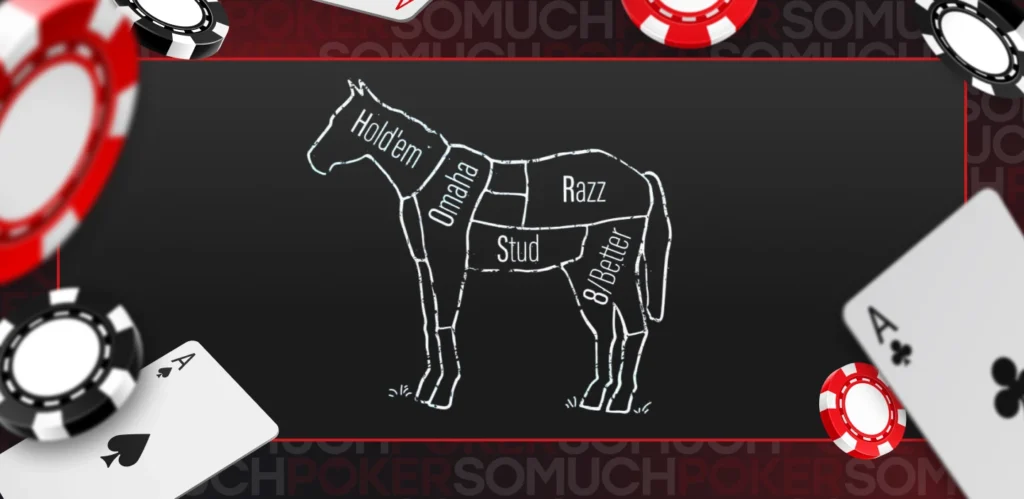
HORSE poker is a prominent mixed-game format where players compete in five different poker variations played in sequence. The acronym stands for Hold'em, Omaha Hi-Lo Eight or Better, Razz, Seven Card Stud, and Seven Card Stud Hi-Lo Eight or Better. It was designed to prevent single-game specialists from dominating the tables by requiring mastery across multiple distinct disciplines.
The origins of HORSE are said to trace back to high-stakes cash games in Las Vegas, where professionals sought a way to level the playing field against tourists and one-trick specialists. Today, it remains a staple of high stakes cash games and major tournament series worldwide.
How Does HORSE Poker Work?
The game begins with Texas Hold'em and rotates sequentially through Omaha/8, Razz, Stud, and Stud/8. The variant changes either after one full orbit of the dealer button or after a predetermined time limit. In most live HORSE cash games in casinos all variants are played with a Fixed Limit betting structure, using small and large bet sizes.
The Rotation Mechanics
When playing in a casino environment or online on platforms like PokerStars, the dealer (or software) will announce the game change.
In cash games: The game typically changes after one complete orbit.
In tournaments: The rotation schedule is set by the tournament rules and may change after a specified number of hands or at the end of a level.
Dealer Button vs. Stud Dealing
One of the most important logistical elements of HORSE poker rules involves the dealer button.
In Hold'em and Omaha/8, the dealer button determines the blinds and the order of play.
During Razz, Stud, and Stud/8, there are no blinds. Instead, all players post an ante. The dealer button doesn't define positional action; instead, the action is determined by the visible cards on the board (the door cards).
Crucial Rule: To ensure fairness, when the rotation shifts from Omaha/8 (a button game) to Razz (a stud game), the dealer button's position is "frozen". When the game rotates back to Hold'em, the button resumes its movement from where it left off, ensuring no player skips paying their blinds.
The Fixed Limit Betting Structure
Standard HORSE is played as a Fixed Limit game. At WSOP HORSE events, the betting structure is defined by the tournament rules. If you are playing a $10/$20 HORSE game:
The Small Bet is $10.
The Big Bet is $20.
In the early betting rounds (pre-flop and flop in Hold'em/Omaha; 3rd and 4th street in Stud games), all bets and raises must be in increments of $10.
In the later betting rounds (turn and river in Hold'em/Omaha; 5th, 6th, and 7th street in Stud games), all bets and raises must be in increments of $20.
Most casinos enforce a cap on raises, usually allowing a bet and three raises (a "cap") per betting round.
The Five Games of HORSE Poker Explained
To dominate at the tables, you must understand the rules, mechanics, and baseline strategies for all five variants.
H – Hold’em (Limit Texas Hold’em)
In the modern era, No-Limit Texas Hold'em is king, but HORSE utilizes Fixed Limit Hold'em (LHE).
The Mechanics:
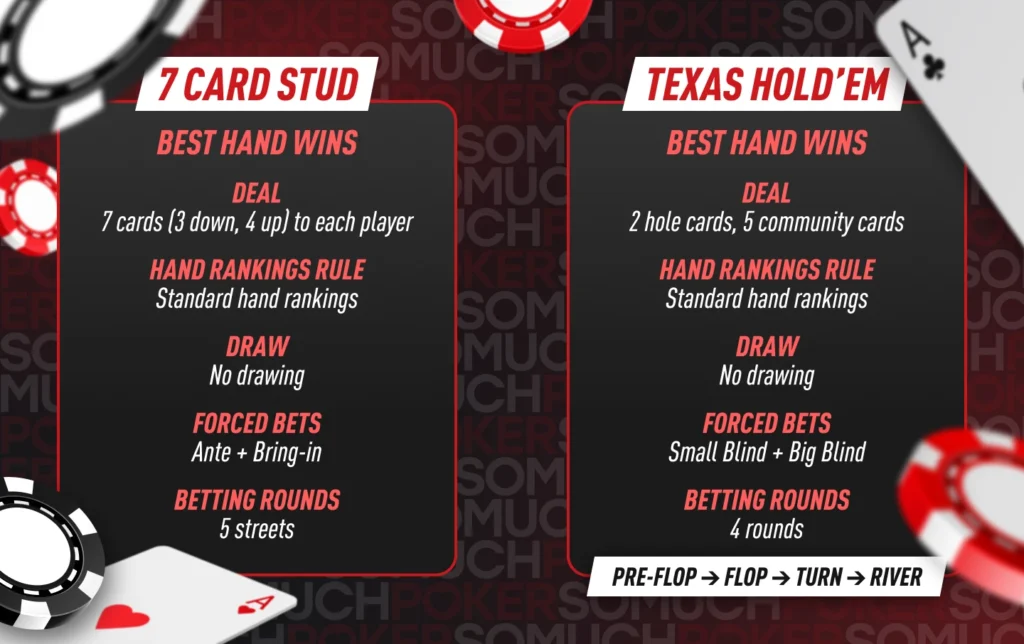
Players receive two hole cards. Five community cards are dealt face-up (flop, turn, river). The goal is to make the best five-card high hand.
Strategic Considerations:
Because you cannot push all-in to protect a hand, LHE is a game of marginal edges and relentless value betting. Most professional players play a tighter pre-flop range in LHE compared to No-Limit.
Top Pair has significant value: In LHE, one pair is often enough to win at showdown. You must aggressively bet your top-pair hands to charge opponents for their drawing odds.
Drawing Hands: Suited connectors go down in value because implied odds are severely restricted by the limit betting structure.
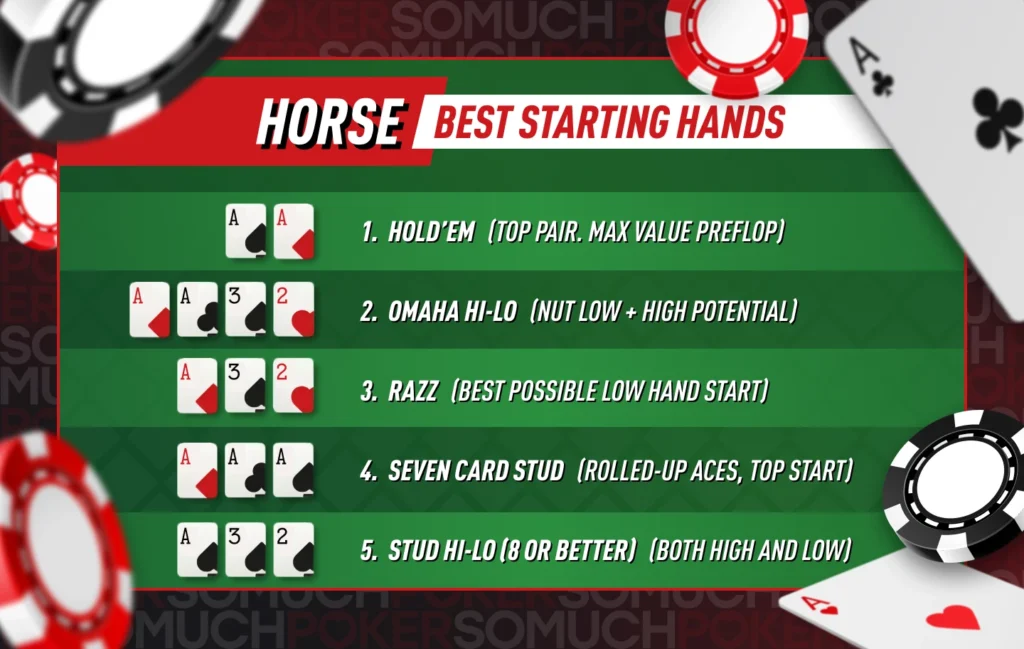
Best starting hand: Premium pairs (A-A, K-K) and big suited connectors.
Biggest beginner mistake: Overvaluing offsuit broadways (K-J, Q-T). In limit poker, you can't easily price out draws, so top pair with a weak kicker gets crushed.
O – Omaha Hi-Lo Eight or Better (Omaha/8)
Omaha/8 is a split-pot game that introduces the "Eight or Better" qualifier.
The Mechanics:
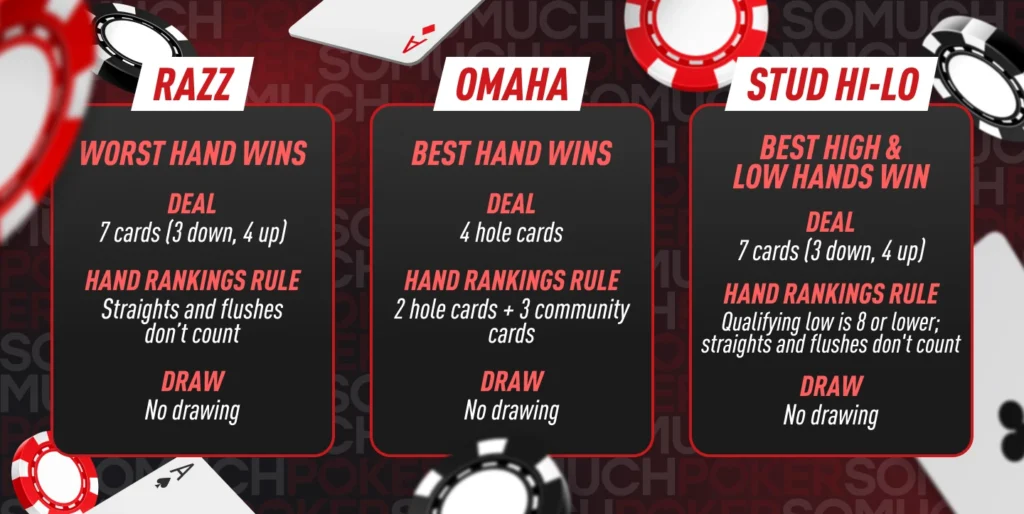
Players receive four hole cards. Five community cards are dealt. You must use exactly two hole cards and exactly three community cards to make your hand.
Hi Pot: Half the pot goes to the best traditional high hand.
Lo Pot: Half the pot goes to the best low hand, if it qualifies. To qualify for a low, a player must have five unpaired cards ranked 8 or lower. Aces are low. The best possible low hand is A-2-3-4-5 (the "wheel").
Strategic Considerations:
The golden rule of Omaha/8 is to play for the "scoop" – winning both the high and the low halves of the pot.
Quartering: If you tie for the low pot but lose the high pot, you only win 25% of the total pot. If you committed significant money, you will actually lose money on the hand. This is known as getting "quartered."
Counterfeiting: If you hold A-2 and the board contains 3-7-8, you have a strong low. If another 2 appears, your 2 is effectively counterfeited because the board now contains a 2, reducing the value of the 2 in your hand when forming the best five-card low.
Best starting hand: In general, it is A-A-2-3 double-suited. You want heavily coordinated hands that can win both high and low.
Biggest beginner mistake: Playing for only half the pot. Playing one-way high hands or middle cards (7, 8, 9) is a trap. Always aim to scoop the whole pot.
R – Razz (Seven Card Stud Low)
Razz often frustrates players, but mastering it provides a massive edge in mixed poker games.
The Mechanics:
There are no community cards. Players are dealt seven cards over five betting rounds (three face down, four face up). The goal is to make the lowest possible five-card hand. Straights and flushes do not count against you. Aces are always low.
Strategic Considerations:
Board Reading: You must pay intense attention to your opponents' upcards. If you need a 3, and several 3s are already exposed, your outs are "dead".
Stealing Antes: The player with the highest upcard (door card) on 3rd street must post a forced bet (the bring-in). If you have a low door card (like an Ace or a 2) and all players before you fold, raising to steal the antes is a standard, profitable play.
Hidden Strength: Your hand strength is disguised by your down cards. Having a bad board but good hole cards can be a trap for opponents.
Best starting hand: In general, three starting cards 5 or lower (e.g., A-2-3).
Biggest beginner mistake: Ignoring opponents' upcards. Do not stubbornly chase a low draw if an opponent is already showing a better visible board.
S – Seven Card Stud (High)
Before the poker boom, Seven Card Stud was the most popular poker variant in America.
The Mechanics:
Like Razz, players receive seven cards (three down, four up). However, the objective is to make the highest traditional five-card poker hand.
Strategic Considerations:
Live Cards: In variants with open cards, you always have to pay attention to information given away by the hands of your opponents. If I have three spades and am drawing to a flush, but I observe seven other spades folded by opponents on 3rd street, I'd better let that flush draw go. Failing to track folded cards can lead to serious strategic errors because it changes the number of live cards remaining in the deck.
Rolled Up: Starting with three-of-a-kind in your first three cards ("rolled up trips") is the best possible starting hand.
Action on 4th Street: If a player pairs their upcard on 4th street, they are given the option to make a double bet (the Big Bet size), signaling strength.
Best starting hand: "Rolled up" trips (three of a kind) or big pairs with strong kickers.
Biggest beginner mistake: Ignoring dead cards. Do not chase flushes or straights without counting how many of your needed cards are already showing on others' boards.
E – Seven Card Stud Hi-Lo Eight or Better (Stud/8)
The final variant combines the split-pot nature of Omaha/8 with the board-reading mechanics of Stud.
The Mechanics:
Played exactly like Seven Card Stud, but the pot is split between the best high hand and the best qualifying low hand (8 or lower).
Strategic Considerations:
Two-Way Hands: Starting with three low, suited cards (e.g., 3♥4♥5♥) is incredibly powerful, as it gives you a pathway to a low hand, a straight (high), and a flush (high).
Brick City: If you start with a strong low draw but your 4th- and 5th-street cards are face cards (Kings or Queens), you have "bricked". Skilled players know exactly when to fold these broken draws before putting more money into the pot.
Best starting hand: In general, low, two-way hands like A-2-3 suited.
Biggest beginner mistake: Pushing one-way high hands against strong low boards. Just like in Omaha, you risk losing half your chips or getting completely scooped.
Core HORSE Poker Strategy for Beginners and Pros
Excelling at HORSE requires more than just understanding the individual games. Many experienced mixed-game players recommend mastering the meta-game of the rotation itself.
1. Finding the Weakest Link
HORSE strategy is largely about identifying where opponents make the most costly mistakes and adjusting your play across the five games. Experienced players often notice that No-Limit Hold'em players struggle significantly with Stud and Razz.
Action Plan: Identify which game your opponent plays poorly. If a player chronically chases bad lows in Omaha/8, isolate them and value bet relentlessly when you hold the nuts.
2. Bankroll Management and Limit Grinding
Because HORSE is a Limit game, variance is lower than in No-Limit, but it can still be serious over long sessions. You are rarely going to double up in a single hand. Instead, you win by grinding out extra bets over thousands of hands.
Action Plan: A standard bankroll recommendation for Limit poker is 300 Big Bets. If you are playing $10/$20 HORSE, one commonly cited guideline is to weather the natural statistical downswings with around 300 big bets of $6,000.
3. Mastering the Transitions
The transitions between games cause the most confusion. Because the game changes frequently, players should confirm the current variant before each hand.
Action Plan: Always physically remind yourself which game you're playing. It sounds simple, but playing a Razz hand during a Stud round is a costly, embarrassing mistake that happens frequently in amateur games.
4. Defending the Bring-in
In the stud games (Razz, Stud, Stud/8), the bring-in is forced action.
Action Plan: Do not automatically defend your bring-in. If you have a terrible hand, simply fold and surrender the partial bet. Calling complete bets with dead draws out of stubbornness will drain your chips.
Common Mistakes in HORSE Poker
Avoiding errors is just as important as executing advanced strategies. Here are the most common pitfalls:
Overvaluing High Pairs in Split-Pot Games: Holding pocket Kings in Omaha/8 is usually a disaster waiting to happen. The board will often run out with three low cards, meaning someone will win the low half of the pot, and someone with an Ace will likely beat you for the high.
Failing to Count Dead Cards: In Stud games, if you aren't paying attention to the cards that are folded, you are playing blind.
Playing Too Loose in Hold'em: Because LHE lacks the fold equity of No-Limit, you cannot easily bluff opponents off top pair. If you play junk hands pre-flop, you will bleed chips post-flop.
Chasing Second-Best Lows: In Razz and Stud/8, drawing to a 9-low or a rough 8-low when your opponent is showing a 7-low on board is mathematical suicide.
Is HORSE Poker Worth Playing?
HORSE can be worth learning for players who want to develop skills across multiple poker variants. It improves your mathematical foundation, board reading, and positional awareness. Whether it is profitable depends heavily on the player pool, game selection, rake, limits, and your relative skill in each component game.
How to Practice HORSE Poker?
Becoming a really good HORSE player requires continuous practice and study. Take the time to study each individual variant, practice the transitions between games, and you will find yourself equipped with a level of poker knowledge shared by some of the world's best mixed-game players.
The Prestige of HORSE at the WSOP
When discussing HORSE poker, one must mention its profound impact on the global poker landscape, particularly at the World Series of Poker (WSOP).
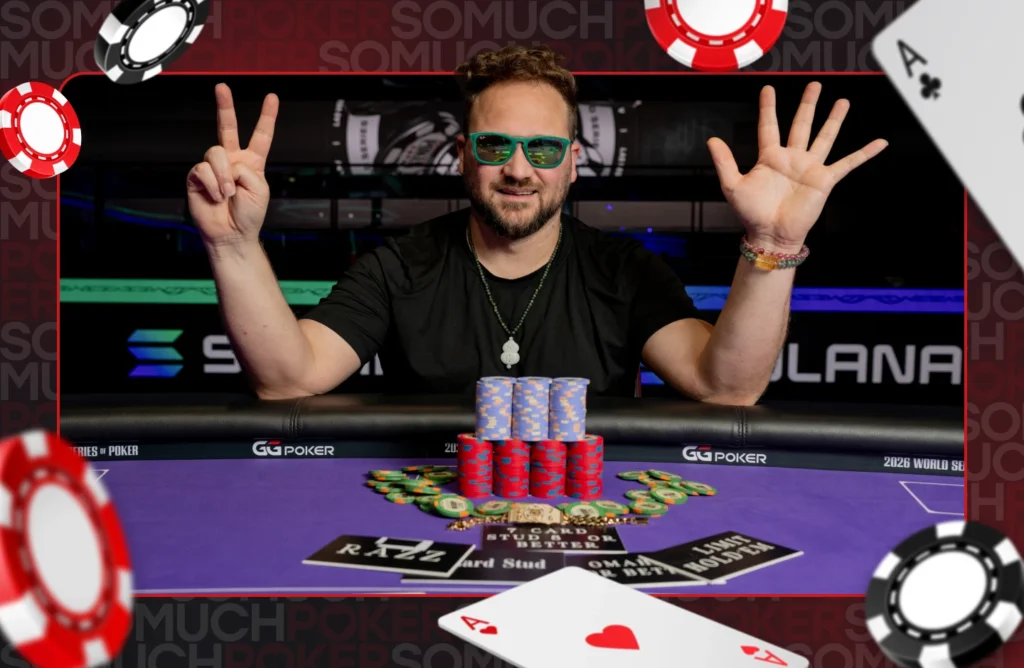
In 2006, the WSOP introduced the $50,000 HORSE World Championship. At the time, it was the largest buy-in event in WSOP history. The tournament was specifically created at the request of players who felt the event selection needed a high-roller championship event where they could compete for the best all-around player status.
The inaugural event was won by the legendary Chip Reese. Following his tragic passing, the trophy for this premier mixed-game event was named the David "Chip" Reese Memorial Trophy.
Key data of the very first WSOP $50,000 HORSE World Championship:
Information | Fact |
|---|---|
Year | 2006 |
Entries | 143 |
Buy-in | $50,000 |
Winner | David "Chip" Reese |
1st Prize | $1,716,000 |
The Poker Players Championship – built on the legacy of the $50,000 HORSE World Championship – has been held since 2010 and has incorporated additional games such as Pot Limit Omaha and No Limit Hold'em. In the event calendar, you can still find a high-roller version or a WSOP HORSE tournament with a $10,000 buy-in.
Expect to see HORSE and other mixed formats (like 8-Game Mix) continue to thrive as high-roller staples and prestige events in major online tournament series, on platforms such as GGPoker.
Final Thoughts
To sum up the basics and provide a rule of thumb: Discipline wins tournaments. Basic advice: fold your bad hands, protect your chips, and wait to strike when the rotation hits your strongest game.
HORSE poker is a challenging and highly rewarding format that separates all-round masters of the game from players who have an edge over the average Texas Hold'em player pool. By understanding the intricate rules of Hold'em, Omaha Hi-Lo, Razz, Seven Card Stud, and Stud Hi-Lo Eight or Better, you position yourself to exploit the weaknesses of players who rely solely on modern No-Limit strategies.
Learn Hold'em first
Then Omaha8
Practice Stud
Finally, combine all five games
The key lessons for mastering this format are rooted in discipline: practicing strict bankroll management to handle the limit structure, diligently tracking dead cards in the stud rounds, and avoiding the trap of chasing non-nut hands in split-pot variants. Embracing these practical takeaways will improve your decision-making, mixed-game skills, and overall table awareness.
Sources and Tips on How to Play HORSE Poker
To further your education on HORSE poker and verify the industry standards discussed in this guide, consult the following authoritative resources:
1. World Series of Poker (WSOP) Official 2026 Rulebook
Details tournament structures, bringing-in rules, and dealer button rotations for HORSE events.
2. HORSE Poker Games and Rules PokerStars
Simple explanation of mechanics, game rules, limit betting structures, and HORSE poker strategy.
3. Chip Reese shares some tips on how to play H.O.R.S.E.
| Pros | Cons |
|---|---|
Higher Win Rates: Softer player pools with fewer "GTO" (Game Theory Optimal) robots compared to NLHE. | Slower Pace: Fixed Limit and split pots mean hands take longer to resolve, resulting in fewer hands per hour. |
Action-Packed: Limit betting structures encourage more multi-way pots and action post-flop. | High Learning Curve: You must memorize starting hands, odds, and rules for five entirely different variants. |
Skill Development: Forces you to learn critical concepts like dead cards, quartering, and relative equity. | Difficult to Find: Outside of major online sites or massive live series like the WSOP, HORSE games can be hard to find in local casinos. |
Reduced Variance: You cannot lose your entire stack in a single cooler or bad beat due to the limit format. | Frustration Factor: Getting "scooped" on the river in split-pot games can be highly tilting for new players. |
About the Editor

Beus Zsoldos is Somuchpoker's Senior Copywriter and Player Stories Editor, covering WSOP color moments, player profiles and poker personalities for the site's Stories section. She has spent more than 20 years around the game, first as a player, then as a live tournament director and localization manager for a major online poker room, before moving into full time poker writing.


