

Razz Explained: The Complete Guide to Poker's Trickiest Lowball Game

Imagine you had the power to flip the whole world on its head. In your new world, people don’t grow older, but get younger every day. Trees don’t rise from the ground, but dangle like root-chandeliers from the sky. Rain doesn’t fall but floats back into the clouds.
Now imagine poker in this weird upside-down world. It would play totally backwards, right? That awful hand you would muck without a blink? Jackpot! The whole pecking order’s reversed. A busted mess of high cards? Perfection! Sounds made-up, right? But nah, it’s real. It lives in our world, and it is called 2-7 Single Draw. Or if you’re privy to the game: Deuce-to-Seven Lowball.
This backwards game then evolved into Badugi in Asia, but way before that happened, another variant of the lowball game gained popularity in the United States: Razz, where players receive not two, four, or five hole cards, but three, and one of them is dealt face-up!
Whether you’re an experienced poker player or a curious newcomer, Razz offers a thrilling twist on the classic lowball game, and strategic battles for everyone.
In our comprehensive guide, we aim to take you through Razz’s history, its rules, similarities and differences with other lowball variants, common pitfalls, and also provide you with basic and more advanced strategies to help you get started.
A Brief History of Razz
As we mentioned earlier, Razz is similar to its predecessor, 2-7 Single Draw, but only in that they are both lowball games where the lowest combination wins. Razz’s real predecessor is Seven-Card Stud, one of the oldest variants of poker, which was already widespread in gambling halls of the early 20th century, when players were just beginning to experiment with various lowball games.
By the middle of the century, Razz was frequently featured in high-stakes mixed games like H.O.R.S.E., which includes Texas Hold’em, Omaha Hi-Lo, Razz, Seven-Card Stud, and Eight-or-Better. Razz was included in the World Series of Poker (WSOP) for the first time in 1971, solidifying its status as a ‘serious’ poker game.

Since the rise of online poker, Razz has lost some of its appeal, but is still often played in high-roller cash games and tournaments. A couple of online poker platforms also offer Rass tables.
The Rules of Razz
Razz is a unique twist on seven-card stud, where the lowest five-card hand takes the pot. Instead of chasing big hands or flashy straights, you're aiming for the lowest combination of five unpaired cards out of the seven you're dealt. The game typically includes up to eight players and follows a fixed-limit betting structure.
It begins with every player putting in an ante. Then, each receives two cards face down, and one card face up, commonly referred to as the “door card.” The player showing the highest door card must post the bring-in, a small forced bet. However, that player can choose to "complete" the bet instead, bumping it up to the full first-round amount. From there, betting moves around the table in fixed steps, giving each player a chance to call, raise, or fold.
If two players happen to show the same door card rank, suit order breaks the tie – spades beat hearts, which beat diamonds, which beat clubs. That makes the king of spades the worst possible door card you can get. After each round of betting, players are dealt another face-up card, continuing until the sixth street. In every case, the player with the lowest visible hand goes first.
One important shift happens on fifth street: the betting limit doubles from what it was in earlier rounds. The seventh and final card is dealt face down, and the same player who led on sixth street kicks off the last betting round. While the dealer position rotates clockwise after every hand, it doesn’t affect gameplay strategy, since there’s no positional advantage as you'd see in other poker variants.
Razz Hand Rankings
To evaluate their own and their opponents' hands, players need to be familiar with the hand ranking hierarchy of the game.
Remember, everything is backwards compared to the classic poker hand rankings, but unlike other lowball games, straights and flushes do not matter in Razz!
The ideal Razz hand is 5-4-3-2-A, or the ‘wheel’.
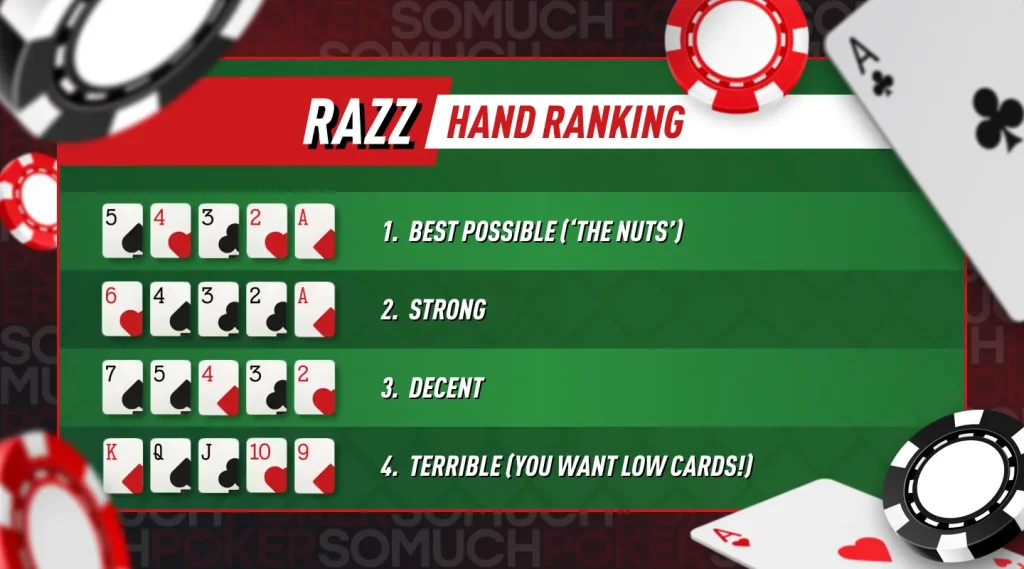
Here are the rankings for every possible combination, sorted from highest to lowest:
Hand Example | Strength |
|---|---|
5-4-3-2-A | Best possible (‘the nuts’) |
6-4-3-2-A | Strong |
7-5-4-3-2 | Decent |
K-Q-J-10-9 | Terrible (you want low cards!) |
Basic Strategies & Tips for Razz
Here are some essential strategies to help you get started with this unique poker variant:
Reading the Board Texture
You should pay attention to ‘dead cards’ that have been folded, especially low cards, because, for example, if multiple Aces and 2s are out, and you hold 3-4-5, your hand has just become much stronger.
Your opponent’s face-up cards also tell a story: if they show A-2-3, they are likely to have a very strong hand, but if they show K-qJ, they are probably bluffing.
If your opponent’s face-up cards pair, they are likely to be drawing dead, and you should bet them aggressively.
Profile Your Opponents
Pay careful attention to your opponents’ actions and assign them to player categories. You should play tighter against loose players, let them chase you, and punish them later. Against tight players, try stealing more antes and bring-ins with semi-bluffs. You should trap aggressive players with strong draws, then bet them big on later streets.
Betting Patterns & Deception
If you happen to get a perfect low card on the fourth street, for example, an Ace or a 2, you might slow-play it to induce a bluff from your opponents, which you can check-raise.
You should also try and bluff on boards that might be scary for your opponents. For example, if the board has many low cards, a well-timed bluff might force folds from those with marginal hands.
You should control the pot with your medium strength hands. For example, if you have something like 7-6-5-4, you should not overcommit to the pot, because your hand is vulnerable to a better low.
Common Mistakes to Avoid in Razz
There are countless pitfalls in poker. Be easy on yourself if you make a mistake – even experienced players make them from time to time, especially when they transition to Razz.
Identifying potential pitfalls reduces the risk of falling into them. Here are some mistakes you should look out for:
Overvaluing Marginal Low Draws
Staying in the game for too long with something like 8-7-6, hoping to improve, will cost you a lot in the long run. You should fold these marginal low draws unless your opponents show even weaker boards.
Ignoring Dead Cards
Make sure not to chase something like a 5-low when all Aces and 2s are out. Always track discarded cards and reassess your hand strength based on that information.
Playing Too Many Starting Hands
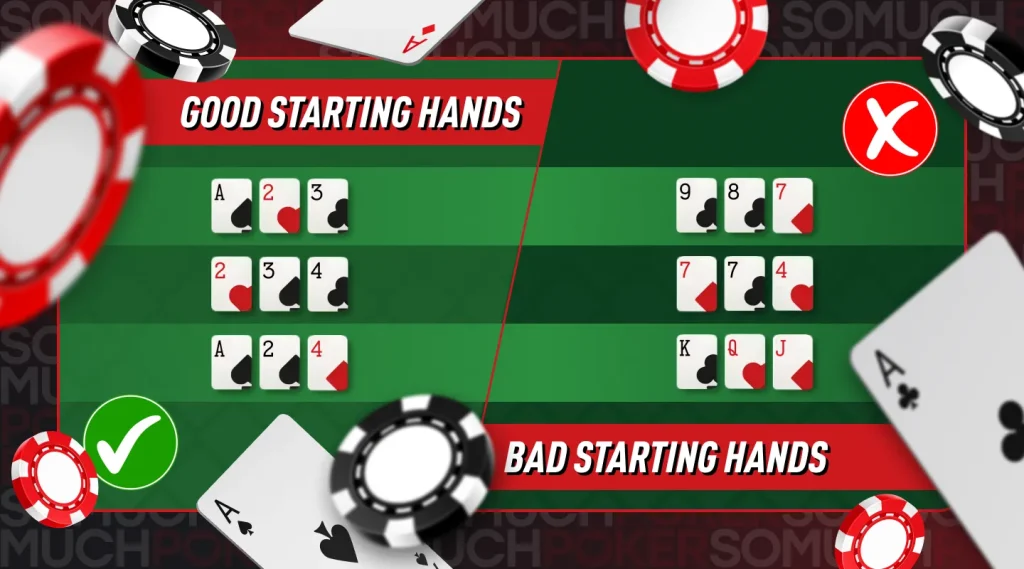
In the long run, some hands perform much better than others. You should take the time to carefully evaluate the strength of your cards before betting. For example, you should not play hands like 9-8-7 just because it is ‘lowish’. You should just stick to premium three-card lows like A-2-3, 2-3-4, and A-2-4.
Misreading Your Opponent’s Hand Strength
You should not assume a player showing A-2 has a lock. They could also be pairing or bricking. Don’t give up on your cards too soon!
Failing to Steal Antes
If you always limp with weak hands and do not put pressure on your opponents, more capable players will punish you all the time. If you have the lowest door card, you should consider raising to steal the antes.
Razz vs. Other Lowball Variants
Even though it is one of the trickiest, Razz poker is just one variant of lowball poker.
Here's how the game stacks up against other popular formats:
Feature | Razz | 2-7 Triple Draw | Omaha Hi-Lo | Badugi |
|---|---|---|---|---|
Hand Rankings | Worst 5-card hand (A-5 low) | Worst 5-card hand (straights/flushes count) | Best high & best low split pot | Worst 4-card hand (all different suits) |
Game Type | Stud (face-up cards) | Draw (replace cards) | Flop (community cards) | Draw (unique suits matter) |
Key Strategy | Reading opponents’ boards | Discarding & redrawing | Playing for both high & low | Balancing suits & ranks |
Complexity | Moderate | High (multiple draws) | Very High (split pots) | High (suit restrictions) |
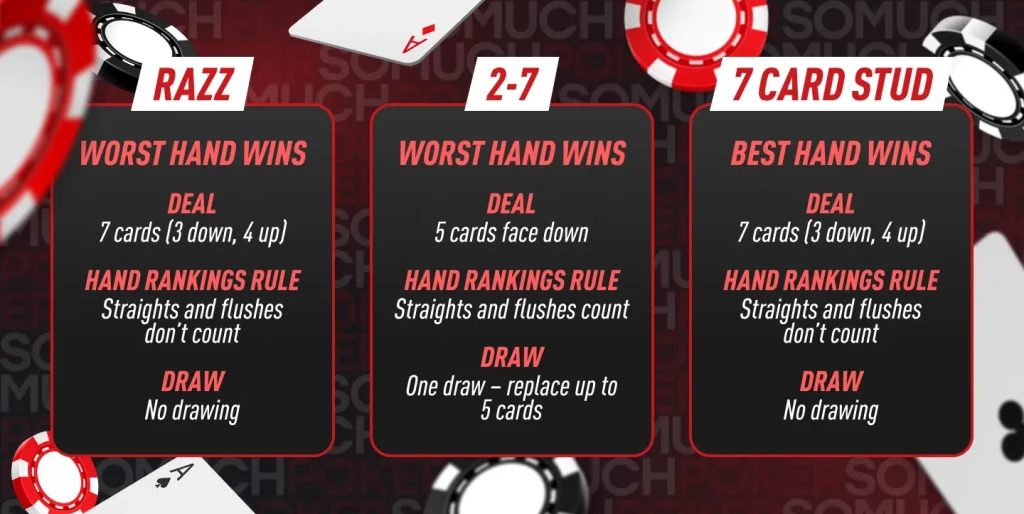
When deciding which game to play, you first decide whether you would like to play a game where you can draw or not. If you want to draw, play 2-7 Single Draw or 2-7 Triple Draw.
If you do not want to draw, the next thing you should decide is whether you want to play ‘pure’ lowball or not. If you want to play both for high and low hands, go with Omaha Hi-Lo.
If you only want to play for low hands, decide how much information you like to base your decisions on. If you want more information, go with Razz, because there are more cards face-up than in Badugi.
No matter which game you prefer, try sticking to just one for a certain period of time, because all these different rules can get mixed up in one’s head very easily, and that might cost you actual money at the tables.
How to Get Started with Razz
Want to start playing Razz poker, but don't know where to begin? Here are some tips to help you get ahead of the competition:
Learn the Basic Rules
Many players aren't even familiar with the Razz poker rules, so knowing exactly how the game is played can already give you an edge over them.
Take The Time to Study
Being disciplined about regular study sessions is what separates great players from mediocre ones. There are many free and paid courses on Razz online for players of every skill level.
Play Online
Playing online can improve your game fast because hands are played faster than in live poker, especially in Razz poker, and you can also play multiple tables at once. This means that you can gain much more experience playing a day online than you would if you spent a day in a casino!
What is more, many sites offer low-stakes tables where you can play without risking too much money.
Start with Low-Stakes Games
When you feel that you are ready to play with real money, start playing small stakes. When you have built enough confidence there, you can safely move up to the next stake.
Ready to test your skills? Join an online poker platform like Natural8 or WPT Global to practice and compete against players worldwide. Remember, every pro was once a beginner.
About the Editor

Beus Zsoldos is Somuchpoker's Senior Copywriter and Player Stories Editor, covering WSOP color moments, player profiles and poker personalities for the site's Stories section. She has spent more than 20 years around the game, first as a player, then as a live tournament director and localization manager for a major online poker room, before moving into full time poker writing.


