

Poker for Beginners: How Board Games, TCGs, and Video Game Experience Gives You an Edge

If you’ve ever grinded board games until sunrise, built decks in a TCG, or sweated through ranked matches in a competitive video game, I’ve got good news: poker isn’t unfamiliar territory. You already have the basics, so it will be easier to learn how to start playing poker.
Behind the cards and chips, the same skills are at work as in your favorite games: decision-making with incomplete information, resource management, reading opponents, and systematically fixing your mistakes.
In the first article of our series on poker for beginners, I’ll show you how to translate your existing “gamer habits” into real poker advantages. At the end, you’ll also get a beginner roadmap, so it’s not just excitement, it’s progress that helps you to take your first steps in the world of online poker.
Why Poker Is Easier to Learn If You’re Already “Game-Socialized”
Many people misunderstand poker. It’s not simply gambling; it’s a decision game where luck can look dramatic in the short run, but in the long run, the better system wins. If you’ve played more complex games before, you’ve probably already learned that:
the best move doesn’t always produce the best immediate result
the meta changes
and improvement requires patience, analysis, and repetition.
Those are poker superpowers.
Board Game Advantages in Poker: Logic, Planning, and People Skills
Modern board games (Eurogames, engine builders, deduction games) are full of patterns that also show up in poker.
Resource Management (Bankroll and Stack Management)
If you’ve played games where money/actions/resources are tight (e.g., Terraforming Mars, Brass, Puerto Rico), you know the mindset: it’s not about what you want to do, it’s about what the best investment is right now.
In poker, your bankroll (total funds) and your stack (chips at the table) are the same kind of resource. The key mindset: strong players don’t try to “win every pot.”
Example player: Daniel Negreanu. He’s known for subtle adjustments and for seeing the whole picture (stack sizes, dynamics, opponents), not just his own cards. He’s also one of the most recognizable names in poker, with multiple WSOP bracelets and a long-standing presence as a major face of the game.
Deduction and Tiny Clues (Range Thinking)
If you enjoyed games like Avalon / The Resistance / Codenames, you already understand how to make deductions from minimal information and how to live with uncertainty. You can ask: how to start playing poker based on those games? You'll be surprised.
Poker is the same thing, except instead of “who is the traitor?” the question becomes: what hands can my opponent have? That’s a range (a set of possible hands). As a beginner, you don’t need a “solver brain.” You just need to stop putting opponents on one exact hand and start considering multiple possibilities.
Example player: Phil Ivey. An icon of the “I see everything” style, famous for reading patterns and timing. He’s a multiple WSOP bracelet winner and also a member of the Poker Hall of Fame.
Negotiation / Psychology = Table Dynamics
If you’ve played Diplomacy or any “social” board game, you know the truth: rules matter, but people drive the game. Poker is the same:
who tilts
who gets scared
who wants to prove something
who can’t handle pressure
Noticing these things gives you a major edge against most player pools.
Example player: Maria Konnikova. She approaches poker with a strong psychological lens (behavior, decision-making, human patterns) and often highlights how table dynamics matter, who is nervous, who tries to dominate, who “breaks” after a bad hand, and how you should respond.
TCG (Magic, Hearthstone, Pokémon) Advantages in Poker: Ranges, Meta, Matchups
TCGs translate so well to poker that they almost feel like cheat codes. Do you want a shortcut to how to start playing poker? Just keep reading.
Deckbuilding (Preflop Ranges)
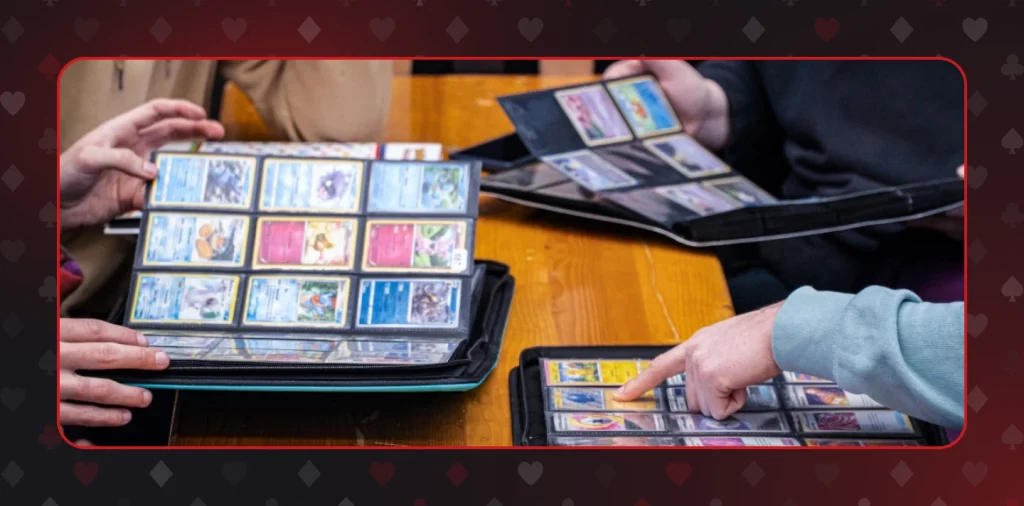
A deck is a pre-built system: what you can draw, what you’re prepared for, what your game plan is. In poker, you don’t have a deck, you have a range:
which hands you raise from each positionwhich hands you call with
which hands you 3-bet with
If you’re used to mana curves, ratios, and consistency, you’ll quickly understand why playing “random” hands is a leak.
Example player: Fedor Holz. A face of modern, structured thinking: game plans, studying, and building systems. He’s known for high roller tournaments and has won WSOP bracelets as well.
Reading the Meta = Table Selection + Adaptation
In TCGs, you’ve heard things like:
“everyone’s playing aggro right now”
“a new card dropped, the meta shifted”
“this matchup needs a different approach”
Poker has a meta too, it just happens at the table:
tight table: steal more
calling station: value bet more, bluff less
aggressive regulars: defend intelligently and choose your battles
If you played TCGs, this will feel natural: the best strategy isn’t “my favorite strategy,” it’s the one that beats the current field.
Example player: Doug Polk. Known for counter-strategy content and matchup-based adjustments, especially in heads-up no-limit hold’em. He’s also a multiple WSOP bracelet winner.
“Outs” Thinking = Pot Odds and Equity
In TCGs, you often count how many outs save you (which draws fix your situation). Poker is the same:
how likely you are to improve (equity)
how much you have to call (pot odds)
whether the call is worth it
This is one of the easiest skills to transfer directly. How to start playing poker is no longer a question; you already did it when you got into TCGs.
Example player: Chris Moneymaker. He is a classic example, because the 2003 WSOP Main Event boom showed many amateurs that fundamentals like pot odds and outs/equity calculation (or at least good estimation) can massively improve decisions, especially in draw-heavy spots.
Video Game Advantages in Poker: Ranked Grind, VOD Review, Tilt Control
Competitive games (LoL, CS2, Valorant, StarCraft, TFT, HS Battlegrounds) teach a lot of “pro mindset”.
Ladder Mentality (Volume + Improvement Cycles)
Poker has a grind, too. Improvement isn’t a single “enlightenment moment” it’s:
you play
you make mistakes
you review
you fix
you repeat
If you’ve done a VOD review or watched your own replays, a poker hand review won’t feel strange.
Example player: Lex Veldhuis. A streamer/online grinder who talks a lot about the mental game and the process. He’s also one of the best-known online poker streamers, primarily playing online MTTs, with a large Twitch audience for years.
Tilt as a Boss Fight (Where You’re the Final Boss)
Tilt is when emotions (anger, ego, impatience, hurt pride) take control, and you stop choosing the best decision; you choose the one that feels good right now. Examples: trying to win back losses (“I’ll show them”), calling too loose, bluffing in bad spots, or being unable to quit on time.
The key: everyone tilts. The difference is that stronger players:
notice the warning signs faster (rushing clicks, tension, “I have to call!” feelings)
have a pre-built protocol (5-minute break, close tables, breathe/water, end the session after a set loss)
In gaming, this is rage queue, re-queuing while tilted, and throwing matches in a row. Poker is the same, except every bad decision has a direct price tag. That’s why knowing when to stop matters.
Example player: Tom Dwan. Many noticed him because he could stay calm and creative under extreme pressure, rather than making panic-driven decisions. He’s a pro best known for high-stakes cash games and legendary televised poker sessions.
Matchups, Roles, Styles (Table and Opponent Types)
In a MOBA, your decisions change if you’re a scaling carry vs an early snowball comp, and everything depends on who you’re facing. Poker follows the same logic: you don’t have one strategy; you have a plan that adapts to the situation.
Deep stacks: position matters more, more maneuvering, more multi-street pressure (and more chances to make mistakes).
Short stacks: the game simplifies; preflop and all-in decisions dominate, and patience becomes gold.
Loose callers: bluff value goes down, value bet value goes up, less fancy play, more “I have it, pay me”.
Doing the same thing in every spot is one of the most expensive poker mistakes, because opponents adjust, and you fail to exploit what the table is giving you.
Example player: Phil Hellmuth. Famous for adapting to opponents and table types (especially in tournaments). He plays differently against wild loose fields vs disciplined regulars, and often “switches styles” on purpose when the dynamics change.
What Skills Will Actually Help You Most in Poker?
From Board Games
planning multiple turns ahead: think through turn/river, not just the flop
reading table behavior: timing tells, bet-sizing tells, live behavior patterns
From TCGs
outs and odds: equity and pot odds fundamentals
meta awareness: fast adaptation to table conditions
From Video Games
review system: a 15-minute post-session hand review routine
tilt control: stop-loss and break rules
A Beginner Poker Roadmap in 7 Steps
1) Choose Your Format: Online Cash or MTT?
Online cash: lots of repetition, fast learning
MTT: higher variance, but exciting “festival feeling”
As a beginner, the most important thing is to encounter many repeated situations to build confidence in poker basics.
2) Learn Hand Rankings and Basic Concepts
Obvious, but crucial. Don’t waste mental energy on poker basics while playing. Make these automatic:
position
pot odds
logic behind preflop raises
3) Build a Simple Preflop Rule Set (No Need for Perfect Ranges)
Three rules are enough to start:
tighter in early position
looser in late position
cautious from the blinds; often a 3-bet/fold approach
Goal: stop playing “randomly.”
4) Postflop: A One-Sentence Game Plan
On the flop, ask:
who has the range advantage?
who has position?
what’s my plan for the next two streets?
If you only do this, you’ll already be ahead of the average beginner.
5) Bankroll: Play Lower Than You Think You Should
Poker is a money game, but in the learning phase, the goals are:
play a lot, and achieve a full understanding of poker basics
make variance hurt less
6) Review: The Engine of Improvement
Twice per week, 30 minutes of review is enough at the start:
your 10 biggest losing hands
your 10 biggest winning hands
7) Build a Mental Protocol
Write down three rules:
when you leave the table
your daily maximum loss
what “tilt signs” look like for you
Common Beginner Mistakes (Especially If You’re a Gamer/TCG Player)
Too much creativity too early
When it comes to poker for beginners, strong fundamentals almost always beat fancy plays. Build ABC first, tricks later.Being results-oriented
In video games, you see the win/loss at the end. In poker, you can play well and still lose. Learn to separate decision quality from results.Moving up the stakes too fast
“Ranked mentality” is dangerous here, you don’t need to prove anything. Protecting your bankroll comes first. This is a good rule of thumb in poker basics.
How to Start Playing Poker - It Is Basically the Meeting Point of All Your Past Games
If you’ve played board games, TCGs, or competitive video games, you already have poker’s foundation:
systems thinking (board games/TCGs)
meta and adaptation (TCGs/video games)
review and mindset (video games)
deduction and people-reading (board games/live)
Your next step is simply to translate that knowledge into poker terms and build a simple routine you can stick to. This is the answer to the initial question: how to start playing poker. A solid beginner target: play small stakes, follow a preflop framework, and review consistently, because that’s the real secret to locking in any new habit and building strong poker basics.
About the Editor

Adam Biro is Somuchpoker's Content and Creative Quality Lead, writing the site's Legends of Poker series, including From TCG to the Top and Geek Women Legends at the Poker Table, along with strategy content for newer players. He brings a background as a trading card game developer and tester, plus close to twenty years in software testing and quality assurance, to how he analyzes poker strategy and player psychology.
Related News
 StrategyOnline PokeriGaming
Mystery Bounty Poker Tournaments Explained: Rules, Strategy & Big Prizes (2026)
Learn how mystery bounty poker tournaments work, why players chase massive jackpot envelopes, and the best strategy adjustments to increase your EV in 2026.
 Strategy
Poker for Beginners: How to Learn Online Poker from Streams
Discover how to turn poker streams into your best study tool! Learn online poker basics like preflop action, pot odds, and bet sizing with this beginner guide.
 StrategyOnline PokeriGaming
Poker Psychology: The Ultimate Guide to Master the Mental Game
Transform your results with this comprehensive guide to poker psychology. Learn to master emotional control, eliminate tilt, build confidence, and more.
![[Poker Basics] Target Stack and Timed Tournaments: The Complete Strategy Guide](/_next/image?url=https%3A%2F%2Fimages.ctfassets.net%2Fo0c4x84rxbjm%2F6AlscPiq8eFWhuKT0DNpu5%2Fe5e2e24abc7323cb5f48f69fabeec2f9%2Ftarget_timed_featured.webp&w=3840&q=75) Strategy
Strategy[Poker Basics] Target Stack and Timed Tournaments: The Complete Strategy Guide
Learn how target stack poker and timed poker tournaments work, with practical strategy tips for both formats.
 StrategyOnline Poker
The Main Differences Between Poker Rebuy and Re-Entry Tournaments
Discover the main differences between a poker rebuy and a re-entry tournament. Learn how the rules, seat changes, and strategies affect your game.
 Side PotStrategyStories
Why Keeping Your Phone at the Poker Table Could Actually Save You Money
Think hiding your phone at the poker table is smart? Discover how keeping it handy can prevent you from playing trash hands and improve your win rate.