

Chris Moneymaker Bubble Call at the 2026 WSOP Main Event -Exclusive ACR Poker Interview

In an exclusive ACR Poker interview - shared with Somuchpoker - Chriss Moneymaker, the 2003 WSOP Main Event champion, breaks down the J♥9♦ bubble hand that ended his 2026 WSOP Main Event.
You already know the headline. Chris Moneymaker called off his stack with jack-nine on the money bubble, ran into pocket aces, and busted the 2026 WSOP Main Event one spot short of a real cash. It sounds like a punchline.
It isn't. Moneymaker appeared in ESPN's 2026 WSOP Main Event coverage, and in this exclusive ACR Poker interview, he walks through every street of the hand - the reasoning is far smarter than the result. If you want to actually get better at bubble poker, this breakdown is worth ten minutes of your time.
Want to play on the same poker site where Moneymaker plays? Go to ACR Poker and get in the game.
The Chris Moneymaker Bubble Call in 30 Seconds
Here's why this matters: bubble hands look simple on TV and feel brutal at the table. The cameras only catch the river. The decision starts three streets earlier.
Moneymaker's Day 4 of the 2026 WSOP Main Event ended with a full house on the board, an active opponent, and a hard call.
The quick version:
Player: Chris Moneymaker, 2003 Main Event champion
Opponent: Antonio Vargas, holding A♥A♠
Moneymaker's hand: J♥9♦ - playing the board by the river
Final board: 7♠7♦7♣8♥8♠
Result: Eliminated on the bubble as one of three simultaneous busts
Payout: $10,000 - not the standard $15,000 min-cash
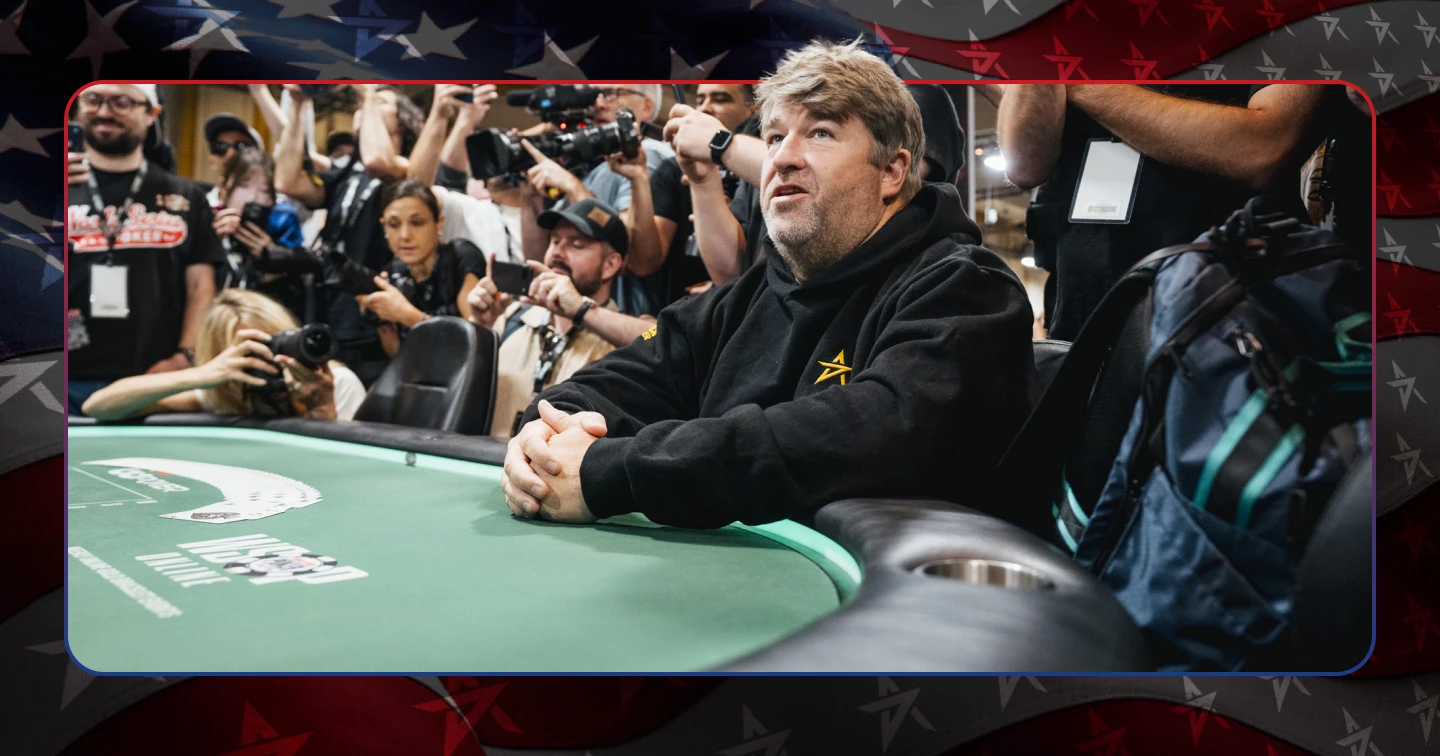
How Day 4 Set the Trap: Three Good Days, One Awkward Stack
He entered Day 4 of the 2026 Moneymaker WSOP Main Event with 221,000 chips. Blinds were 4,000/8,000 with an 8,000 big-blind ante. That's a shade under 28 big blinds - playable, but not comfortable.
Only seven eliminations stood between the remaining 1,389 players and the money. Most short and medium stacks had one goal: don't become the story everyone else celebrates.
"I felt like I had made a lot of good decisions and run very well. But when we sat down for Day 4, my stack was not in a great spot."
With 28 big blinds, you can't fold your way to safety and pretend the bubble takes care of itself. You still have to play hands. That's what set up everything that followed.
The Bubble Hand: Tale of the Tape
Before the streets, the numbers. These are the figures that shaped the moment.
Stat | Number | Why it mattered |
|---|---|---|
Main Event entries | 9,208 | The field had already shed more than 7,800 players. |
Day 4 starters | 1,389 | Only seven more eliminations reached the money. |
Paid positions | 1,382 | The standard minimum payout was $15,000. |
Buy-in | $10,000 | Reaching the money meant locking up a profit. |
Moneymaker's stack | 221,000 | About 27.6 big blinds to start Day 4. |
Blinds/ante | 4,000 / 8,000 / 8,000 | Every orbit cost 20,000 at a nine-handed table. |
Time to the stone bubble | ~15 minutes | The pressure arrived almost immediately. |
Moneymaker's payout | $10,000 | Three simultaneous busts split two $15,000 prizes. |
That last number is the strange one. Moneymaker busted on the bubble but didn't leave empty-handed. We'll come back to how that $10,000 happened.
The Opponent Was Half the Decision
Read this part slowly, because it's the whole point. Moneymaker wasn't trying to beat aces. He didn't know aces were there.
Antonio Vargas had been active and aggressive all session. That history shaped every range Moneymaker built - preflop and on every street after.
"He was very active. Against most players, I do not get to the same place. Against him, the decision was different." - Chris Moneymaker
"I was not putting him on aces. I was looking at the entire range I thought this particular player could take through the hand." - Chris Moneymaker
So when you evaluate the Chris Moneymaker bubble call, don't start with the aces. Start with the range Moneymaker actually saw: a wide, aggressive collection of hands that an active player could bet through a paired board.
Check out Chris Moneymaker's Vlog to see more of his poker journey.
The Full Hand, Street by Street
Here's every card and every bet. Follow the pot as it grows - it never felt huge until the river.
Street | Action | Board/cards | What changed |
|---|---|---|---|
Preflop | Moneymaker opens to 17,000 (hijack). Vargas 3-bets to 42,000. Moneymaker calls. | J♥9♦ vs A♥ {as} | Moneymaker calls against the top of the range - but the hand is hidden. |
Flop | Vargas bets 20,000. Moneymaker calls. | 8♥7♠7♦ | J-9 has a gutshot. Only a ten makes the straight. |
Turn | Vargas bets 45,000. Moneymaker calls. | 7♣ | The third seven gives everyone trip sevens off the board. |
River | Vargas jams ~100,000. Moneymaker calls. | 8♠ | Board reads 7-7-7-8-8. A full house sits on the felt. |
Showdown | Vargas shows aces. Moneymaker eliminated. | Sevens full of aces | Vargas had the exact top of the range. |
Preflop: J-9 Defends Against a Three-Bet
Moneymaker opened to 17,000 from the hijack - just over two big blinds. Vargas made it 42,000 with aces. Moneymaker called the extra 25,000 with J♥9♦.
Against a tight player, that's an easy fold. Against Vargas, it kept a connected hand in position versus a range that was three-betting far too wide.
"I opened from the hijack, he made it 42,000, and I decided to continue because of how active he had been. The exact same action from a tighter player would have meant something very different." - Chris Moneymaker
Flop: A Gutshot
The flop came 8♥7♠7♦. Vargas bet just 20,000 into roughly 96,000 - about a fifth of the pot. Moneymaker called.
J♥9♦ had a gutshot straight draw - only a ten completes 7-8-9-10-J.
That's four clean outs, not eight.
The tiny bet gave a low price, and a paired board rarely hits either player hard.
Turn: The Third Seven Rewrites the Hand
The 7♣ paired the board again. Now everyone held trip sevens. Vargas bet 45,000. Moneymaker called, leaving roughly 100,000 behind.
"The third seven changed the shape of the hand. There were fewer sevens available, the board was doing more of the work, and I still believed he could keep betting with hands that were applying pressure." - Chris Moneymaker
River: The Full House Was Already on the Table
The 8♠ completed the board: 7-7-7-8-8. Read that again. The community cards themselves made sevens full of eights. Vargas jammed for the rest.
"I was not calling because I thought jack-nine beat aces. I was calling because I thought enough of his range played the board." - Chris Moneymaker
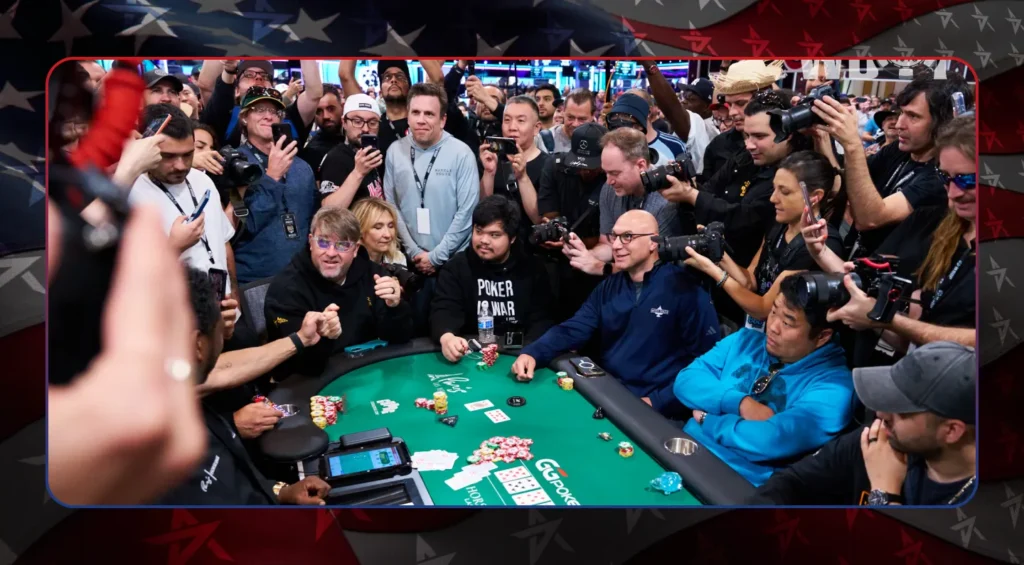
The bustout: Moneymaker's J♥9♦ playing the board against Antonio Vargas's A♥A♠ on 8♥7♠7♦7♣8♠
Want to run these spots yourself? Play the biggest online tournaments at ACR Poker - where Moneymaker grinds all year.
Why Call When You Can't Win the Whole Pot?
Because a chop still pays. That's the piece casual viewers miss.
Moneymaker's J-9 couldn't beat the board - but a huge chunk of Vargas's range couldn't either. Against those hands, both players use the same five cards and split the pot. Here's the map:
What Vargas could have | Best five cards | Result vs {jh} 9♦ |
|---|---|---|
Unpaired, no 7 or 8 | 7-7-7-8-8 (the board) | Chop |
Pocket pair 2-2 to 6-6 | The board still plays | Chop |
Pocket pair 9-9 to A-A | Sevens full of the pair | Moneymaker loses |
Any hand with a 7 | Four sevens | Moneymaker loses |
Any hand with an 8 | Eights full or better | Moneymaker loses |
By the river, the pot was around 226,000 before the shove. Add a ~100,000 jam and call, and you're playing for roughly 426,000. If Vargas was bluffing with a hand that plays the board, Moneymaker gets about half of that back. That's real money on the bubble.
The math only works if Vargas jams enough bluffs and chop hands versus his full houses and quads. His table image was the reason Moneymaker believed the bluffs were there. This time, they weren't.
How the Pot Grew One Small Bet at a Time
No single street felt like a life-or-death confrontation. Together, they built one.
Point in hand | Action | Approx. pot |
|---|---|---|
Before cards | Blinds + big-blind ante | 20,000 |
After preflop | 42,000 each, plus blinds/ante | 96,000 |
After flop call | 20,000 bet + 20,000 call | 136,000 |
After turn call | 45,000 bet + 45,000 call | 226,000 |
After river call | ~100,000 each | ~426,000 |
Pot figures are approximate - published reports round Moneymaker's stack and the river shove.
This is the lesson TV hides: the river call existed because of the preflop read, the small flop sizing, and the turn call. Remove any one step and the final choice changes.
A Bubble Nobody Could Ignore: Three Players, One Famous Name
Day 4 needed to lose only seven players before the money. It took about 15 minutes. The room barely had time to settle before hand-for-hand play hit.
Then three players busted at once: Moneymaker, Stoyan Madanzhiev and Zhaken Seitbekov. Two $15,000 payouts were available for the bubble finishers, so the three split the $30,000 and took $10,000 each. In one last piece of bubble theater, the three eliminated players flipped for an extra live-event package. Moneymaker didn't win that either.
Most bubble busts are remembered by the player and their friends. This one had a spotlight nobody else gets. In 2003, Moneymaker qualified online for $86, beat a field of 839, and won $2.5 million. That run convinced a generation that poker's biggest stage wasn't reserved for pros with private backing. An accountant from Tennessee could satellite in and win the whole thing.
Twenty-three years later, the man who started the poker boom stood at the exact line between cashing and leaving, surrounded by cameras. The irony wrote itself. But the interview doesn't sound like an excuse - it sounds like a pro explaining his process and accepting the result.
The $10,000 Payout Wasn't a Normal Min-Cash
The result confuses people, so here's the clean version. The standard minimum was $15,000. Moneymaker got $10,000 because three players busted in the same hand-for-hand sequence with only two paid seats open. Two $15,000 prizes became $30,000, split three ways.
"Three of us went out during the same hand-for-hand sequence. There were two $15,000 payouts available, so they split the $30,000 between the three of us, and we each got $10,000." - Chris Moneymaker
So he was technically a paid finisher, but without the full min-cash the survivors banked. Essentially, his buy-in came back - and nothing more. None of that was guaranteed when he faced the river shove, so it couldn't have factored into the call.
Could Moneymaker Have Folded Into the Money?
Probably. But it's not as simple as counting the seven eliminations that were needed.
He started Day 4 with almost 28 big blinds. He wasn't one of the players getting blinded all-in. A very conservative approach likely survives the few minutes it took to reach the money.
Here's the other side, though. Tournament poker value isn't created only by surviving to the next payout:
Chips won around the bubble become leverage for the rest of the day.
An active player attacks precisely because everyone else is trying not to bust.
Refusing to defend any playable hand becomes its own expensive strategy.
Balancing those two truths is the hard part. Once Moneymaker called preflop and continued twice, the river posed a much narrower question: did Vargas have enough bluffs that played the board? He understood the bubble pressure. He simply didn't believe it removed every bluff from this opponent's range.
Result vs Process: What You Should Actually Take Away
Once you see the aces, the call looks terrible. That's hindsight talking. The exposed cards don't prove Vargas would never jam a bluff on that board.
Moneymaker's last word isn't about bad luck, the cameras, or the strange payout. It's about the player across the table.
"He may be the only player I make that call against." - Chris Moneymaker
It doesn't make the call automatically right. It makes the reasoning clear - and that's what actually improves your game.
Ready to put these reads to work? Create your ACR Poker account in minutes and jump into today's tournaments.
About the Editor

Since early 2025, I've covered iGaming promotions, online poker platforms, and player stories for SomuchPoker. I discovered poker at 14 during the poker boom, and I've played cash games, online tournaments, and live events ever since.
Related News
 StoriesNews
The Rise of the Card Sharp: Inside 19th-Century Gambling Cheating
Explore how 19th-century card sharps used marked cards, false shuffles, second deals and collusion to cheat at Faro, poker and other popular gambling games.
 NewsLive Poker
Scheduled Maintenance: Live and Player Profiles Temporarily Offline
Somuchpoker is moving to a new server. Live and Player Profiles will be offline for a few days. Here is what to expect and when we are back.
 NewsOnline PokeriGaming
Road to Triton Cyprus: Win a $25,000 Seat at Titi Poker
Join the Road to Triton Cyprus at Titi Poker. Start free on Oct 6, climb the satellite ladder and win one of 3 guaranteed $25,000 tickets.
 NewsOnline PokeriGamingPromotion
GGPoker and Natural8 $18M October Giveaway
Win your share of $18M in the GGPoker and Natural8 giveaway this October. Cash drops, Halloween Party, leaderboards - plus a welcome bonus.
 NewsOnline PokeriGaming
Andrii Novak Wins the GGPoker WSOP Online Main Event for $3.93M
Andrii Novak beats Simon Beckmann to win the 2026 GGPoker WSOP Online Main Event for $3.93M. Full final table results, payouts and stats.
 iGamingNews
PokerStars B2B Network Opens Its Doors: A Game-Changer for Online Poker
The PokerStars B2B network is officially open. Discover how this new white-label platform and shared liquidity will change the online poker industry.