

The Cronus Structure Explained: Why Gods Of Poker Closes Registration So Early

Anyone dropping into a Gods of Poker event for the first time tends to notice one thing on the structure sheet almost immediately: registration closes after just two levels. On most major tours, late registration runs for the better part of a day. GOP's signature Cronus Structure does the opposite by design, and founder Lloyd Fontillas has a clear reason behind it.
The quotes below draw on an earlier interview with Fontillas from December last year, as well as a fresh sit-down with the founder during GOP Manila 2026, where he walked Somuchpoker through the thinking behind the structure in more detail.
What Is the Cronus Structure?

Named after the Greek god of time, the Cronus Structure is Fontillas' answer to what he sees as bloated modern tournament days. "Cronus is the god of time, and time is gold in poker," he said. "Players are tired of 14-hour days, late-reg abuse, and shallow late entries that ruin the flow of tournaments. So I redesigned everything."
In practice, that means most GOP events open with 120 big blinds, close registration after just two levels, and cap the latest possible entry at 30 big blinds.
Why Gods of Poker Has Only Two Levels of Late Registration
Fontillas traced the idea back to a high roller event he watched start with two tables and balloon to twelve by the time registration finally closed. "I watched players who showed up on time constantly get moved, while others wandered in seven or nine hours late. It just didn't feel right. So I rebuilt each of the structures from the ground up."
The philosophy, as he put it, comes down to three principles: "Respect the players' time. Respect the purity of competition. Make poker fun again." Speaking on the floor at GOP Manila, he expanded on the mechanics behind that stance, arguing that a tournament's bust-out rate has less to do with how fast the blinds climb and more to do with how many hands actually get dealt. "It's not about the progression of the level, it's how long they can actually play. This is why turbo flights or shorter levels become a crap shoot at the end - you're not dealing enough hands to actually bust players."
How the Levels Break Down
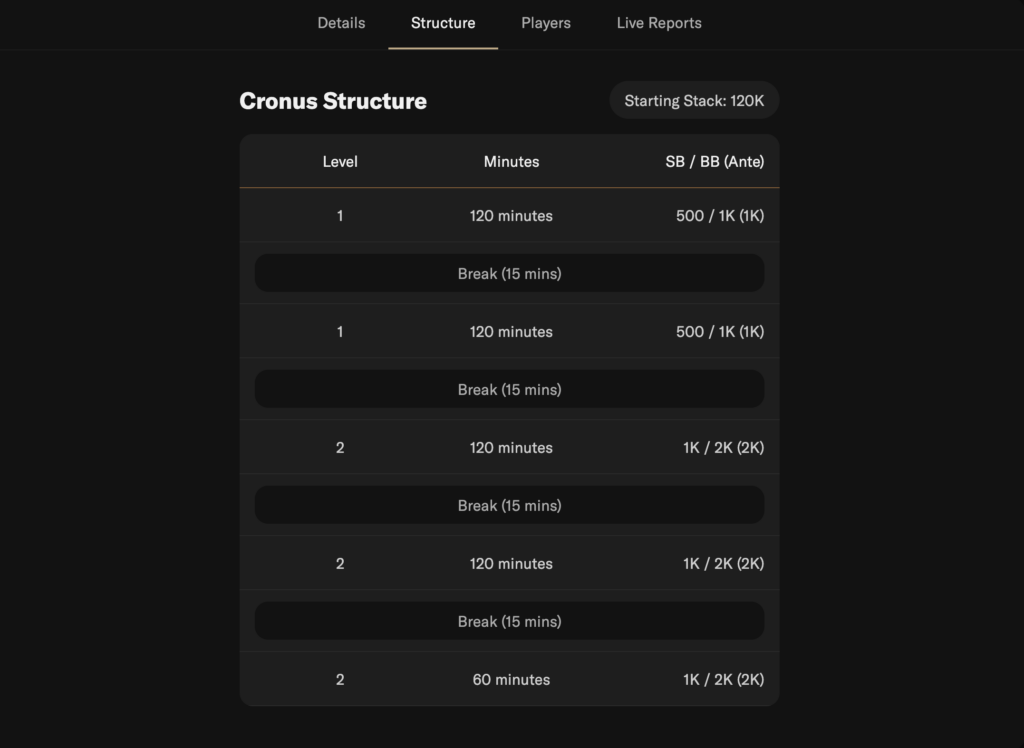
Every GOP Main Event flight follows the same shape: two long levels to open, then a jump into much shorter levels once registration closes. Flight A, for example, runs like this:
Level | Minutes | SB / BB (Ante) |
|---|---|---|
1 | 120 | 500 / 1,000 (1,000) |
Break (15 mins) | ||
2 | 120 | 1,000 / 2,000 (2,000) |
Break (15 mins) | ||
REG CLOSE. ENTER AT 30 BB | ||
3 | 40 | 2,000 / 4,000 (4,000) |
4 | 40 | 2,500 / 5,000 (5,000) |
5 | 40 | 3,000 / 6,000 (6,000) |
Break (15 mins) | ||
6 | 40 | 4,000 / 8,000 (8,000) |
7 | 40 | 5,000 / 10,000 (10,000) |
8 | 40 | 6,000 / 12,000 (12,000) |
Break (15 mins) | ||
9 | 40 | 8,000 / 16,000 (16,000) |
10 | 40 | 10,000 / 20,000 (20,000) |
11 | 40 | 10,000 / 25,000 (25,000) |
Break (15 mins) | ||
12 | 40 | 15,000 / 30,000 (30,000) |
13 | 40 | 20,000 / 40,000 (40,000) |
14 | 40 | 25,000 / 50,000 (50,000) |
Every other flight in the series follows the identical two-level opening and the identical blind progression from Level 3 onward - only the level length changes, getting shorter with each later flight to bring players to the money in roughly the same window regardless of start time.
Flight | Level Length (post-close) |
|---|---|
Flight A | 40 minutes |
Flight C | 35 minutes |
Flight D | 30 minutes |
Flight E | 20 minutes |
Flight B: The Two-Day Exception
Flight B breaks the mold. It's the only flight in the Main Event that spreads across two days, and the only one that plays down to the money on Day 2 rather than Day 1. Fontillas built it for a specific type of player.
"There's different types of players. There's pros that like to play longer levels - they feel there's more value for their money, that it's not more of a crap shoot. But there's also players who want instant gratification, who want to get to the money in a single day. Flight B is the only flight that takes two days, following that Chrono philosophy where you only get two levels of registration, but achieved over a longer format."
He also pointed to an unexpected source of feedback: cash game players making the jump to tournaments for the first time. "The transition from cash to tournament, when they played that four-hour Level 1 and Level 2, it kind of eased them in. They're not used to the blinds going up every 30 or 40 minutes, so they don't feel that pressure."
Flight B's spot in the schedule has also moved. At GOP's Incheon stop, it opened the Main Event as Flight A. In Manila, it was pushed to the middle of the schedule instead. "It just didn't look good enough to open the Main Event, because players were regging into Day 2 at 30 bigs - it looked weak as an opener. I wanted to get some players into the money first, for the hype of the whole thing."
Built Around a 12:30 Start
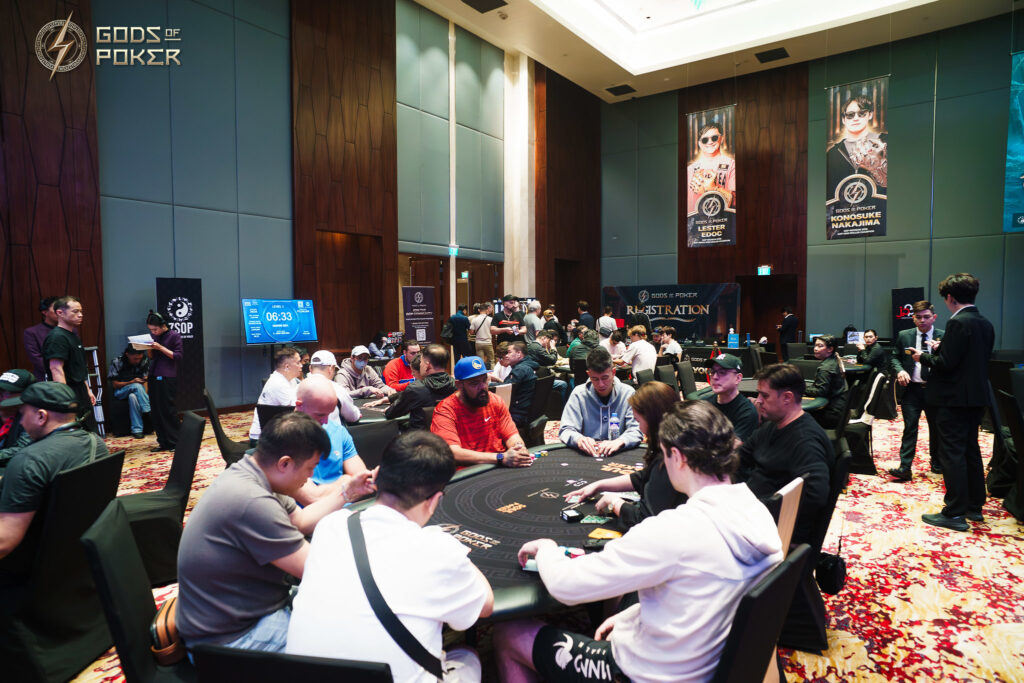
The structure's late morning start time is deliberate too. "I was taught growing up that lunchtime starts at 12:00. Why is everybody starting tournaments at 11:00 in the morning? The only reason is they're trying to extend registration to squeeze more re-entries out of players. But the market's telling us over 70% of players are entering in the last two levels before registration closes anyway. So why prolong it?"
Fontillas is candid that shorter registration windows cut into re-entry revenue, but says that's a trade-off he's made peace with. "If you want to make more money on re-entries, just add more events, more flights. That's what you actually want to do." For him, the bigger win is getting players home at a reasonable hour without sacrificing the depth of play that makes a Main Event feel like one. "By right, this is a better experience - I'm getting players to the money in a single day, with a structure that still respects the purity of the competition."
Images courtesy of Gods of Poker.
About the Editor

Callum Jury is Somuchpoker's Live Content and Social Media Specialist, reporting live from WSOP and Asia Pacific poker festivals including the APT and PokerStars LIVE series. Originally from the Lake District in the UK, he has covered the Southeast Asian poker circuit since 2025, combining day-by-day tournament reporting with the social and digital content that brings the action to fans.
Related News
 Live Poker
Asia Millions Unveils Ambitious Plans for 2027 Launch
Asia Millions plans its 2027 Vietnam debut with four festivals, including an April Circuit featuring VND 30 billion guaranteed across four headline events.
 Live PokerSummary
Inside the KPC Poker October Series: USD 13.4 Million, Two Main Event Champions and a Seven-Figure Score
The KPC Poker October Series paid out USD 13.4 million across 73 events in Jeju, led by Eric Tsai's USD 1,046,600 win and a Lithuanian double.
 TeaserLive Poker
Schedule Rundown of GOP Incheon 2026 II: The Labyrinth Trail
GOP Incheon 2026 II: The Labyrinth Trail runs October 30-November 8 at Paradise City, with 76 events, five Gauntlets and a KRW 600 million guaranteed Main Event.
 Live PokerRecap
TMT Championship Main Event Draws 1,418 Entries; TWD 5.763M Awaits Winner
The TMT Championship 2026 Main Event closes registration with 1,418 entries and a TWD 42.88 million prize pool, with 215 players advancing to Day 2.
 Live PokerRecap
Yao Cheng Wang Takes TMT Championship Main Event Lead; Kristof Segers Wins Super High Roller
Yao Cheng Wang leads the TMT Championship 2026 Main Event with 1,464,000 after four starting flights, while Kristof Segers wins the Super High Roller.
 Live PokerRecap
Malaysia Flies the Flag at WPF Asian Nation Cup 2026
The WPF Asian Nation Cup 2026 brought nine national teams together in Taipei for three days of poker competition, with Malaysia ultimately taking the title and eight TMT Championship Main Event seats. Taiwan finished runner-up on home soil, the Philippines claimed third after a close tiebreaker, and Lu Qi En and Hazel Tan led the individual categories.