

Bryn Kenney Sues GGPoker Parent Over 5% Stake and Millions in Commissions

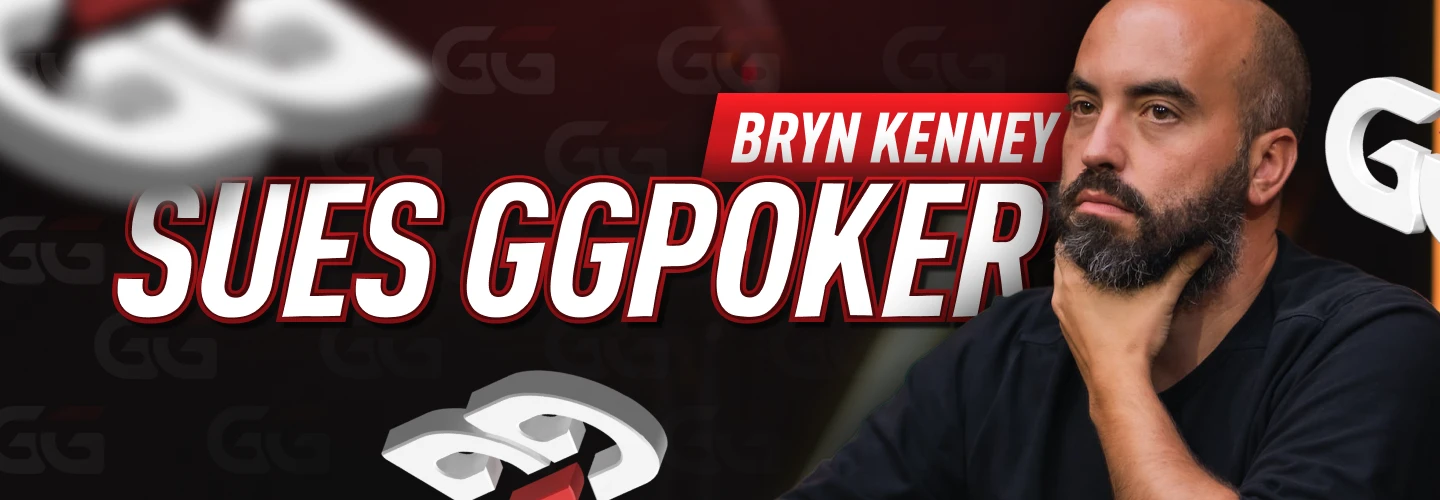
Poker's all-time live tournament earnings leader Bryn Kenney has filed a lawsuit against GGPoker's parent company and CEO Mansoo "Michael" Kim, claiming he was denied a promised 5% ownership stake and millions of dollars in commissions. The dispute has now escalated with an amended complaint that also details serious allegations involving player payments and the platform's security practices.
The lawsuit targets NSUS Group Inc., NSUS Limited, and Kim, with Kenney seeking damages he claims could run into the tens of millions of dollars.
Originally filed in Nevada in July 2026, the case has attracted significant attention across the poker industry following reports published in mid-October.
On October 14, Kenney filed a revised complaint, adding another chapter to the growing legal battle.
Kenney Files Amended Lawsuit Against GGPoker's Owners
According to federal court records, Kenney submitted his First Amended Complaint on October 14, 2026, requesting a jury trial.
The revised filing names three defendants:
Mansoo "Michael" Kim, GGPoker's CEO
NSUS Group Inc., the Canadian parent company
NSUS Limited, an Irish company affiliated with the poker operator
Global Gaming & Hospitality LLC, which appeared in the original lawsuit, is no longer listed among the defendants.
The case centers on two alleged agreements dating back to 2018, when GGPoker was still expanding its international player base.
Kenney claims he was promised recurring commissions and an ownership interest in exchange for helping grow the platform.
However, the financial disagreement is only part of the story. The complaint also raises allegations about unpaid player winnings and GGPoker's handling of cheating.
None of these allegations have been proven in court.
The Alleged 5% Ownership Deal That Started It All
Kenney's relationship with GGPoker began in March 2018, when he became one of the platform's first high-profile international ambassadors.
In fact, GGPoker's original announcement from March 13, 2018 is still available on its official website.
At the time, the operator celebrated Kenney's arrival with a $2,500 welcome freeroll, presenting the partnership as an important milestone in its expansion.
According to Kenney's lawsuit, his involvement soon grew far beyond the responsibilities of a typical sponsored professional.
He alleges that Kim offered him a 5% ownership stake in the business in August 2018, alongside commissions tied to the players and agents he recruited.
Kenney claims he subsequently helped attract thousands of players, establish agent networks, and develop GGPoker's high-stakes tournament offerings.
He also alleges that he spent years performing operational responsibilities that went well beyond promoting the brand.
Despite those contributions, Kenney claims the promised equity was never formally transferred or recognized.
The former ambassador left GGPoker's sponsorship program in 2020, although his alleged business relationship with the operator continued beyond that point.
Millions in Commissions Allegedly Withheld
The dispute also concerns the lucrative commission arrangement Kenney says he negotiated with GGPoker.
According to the complaint, he earned approximately $5 million in commissions during 2019 through the players and agents he brought to the platform.
However, Kenney alleges that the company subsequently began reducing his earnings through several practices, including:
Removing recruited players from his affiliate tracking network.
Applying deductions he had not authorized.
Reducing previously agreed commission rates.
Approaching agents within his network and transferring accounts to company control.
Kenney claims that by 2025, his annual commission income had fallen by more than $3 million compared with the earlier arrangement.
He believes the unpaid commissions and disputed ownership interest have resulted in financial losses totaling tens of millions of dollars.
Alongside damages, Kenney is requesting a court-ordered accounting of the disputed payments.
Such an accounting could become important if the case advances, as it would help establish what commissions were generated, how they were calculated, and whether any additional payments remain outstanding.
Kenney Claims He Paid $1 Million to Cover Player Winnings
One of the most striking allegations concerns money allegedly owed to players.
Kenney claims he personally guaranteed the funds of high-stakes players he recruited to GGPoker.
In one instance, he alleges that Kim failed to pay out $6 million in winnings owed to players, prompting Kenney to contribute $1 million of his own money to help cover the shortfall.
The circumstances surrounding the alleged payments have not been independently established, and the complaint does not represent a judicial finding that player winnings were improperly withheld.
Nevertheless, the allegation introduces a potentially significant player-facing dimension to what initially appeared to be a dispute over a former ambassador's compensation.
Cheating and Platform Security Allegations
The lawsuit also raises concerns about GGPoker's anti-cheating measures.
Kenney claims that Kim assured him the platform had adequate security systems and teams in place to protect players.
He subsequently alleges that Kim knew about systematic cheating but failed to address it appropriately.
Kenney further claims that responsibility for some of those integrity problems was later shifted onto him.
The complaint also reportedly alleges that GGPoker targeted players in the United States, including Nevada residents, and allowed some users transacting in cryptocurrency to access the platform without a VPN.
These claims remain unproven. No court ruling has established that the alleged misconduct occurred.
Why GGPoker's $500 Million WSOP Deal Matters
The timing of the dispute is particularly notable given GGPoker's transformation into a global poker powerhouse.
In October 2024, NSUS Group completed its acquisition of the World Series of Poker brand from Caesars Entertainment for $500 million.
As we reported at the time, the transaction included $250 million in cash and a further $250 million promissory note.
Kenney alleges that his contributions to GGPoker's growth helped put the company in a position to pursue such a major acquisition.
He also claims that his disputed ownership interest was not recognized or accounted for during the transaction.
However, there is an important distinction between the two figures.
The $500 million purchase price represents the value paid for the WSOP brand and related assets, not the valuation of NSUS Group or GGPoker itself.
Consequently, it would be inaccurate to calculate Kenney's alleged 5% interest directly from the WSOP acquisition price.
Determining the value of any ownership interest would require establishing what was actually promised, which business entity the stake concerned, and how that interest should be valued.
GGPoker CEO Challenges the Fraud Allegations
Kim has already taken legal action to challenge part of Kenney's case.
On September 23, his attorneys filed a motion seeking dismissal of the fraud claim against him.
Kim's legal team argues that the fraud allegations rely on an insufficiently specific assurance and improperly attribute statements made by other parties to him.
This represents an important distinction: filing a motion to dismiss a claim does not mean the court has accepted or rejected the underlying allegations.
The lawsuit remains unresolved, and the evidence supporting the competing positions has not yet been fully examined in court.
An October 9 court order scheduled a hearing on Kim's motion for November 12, 2026, before US District Judge Jennifer A. Dorsey.
The same order set October 26 as the deadline for Kim's reply.
However, the subsequent amended complaint could affect how the court handles the earlier motion and its associated schedule.
As of October 20, the publicly available records reviewed for this article do not establish that the dispute has been resolved.
Why the Bryn Kenney Lawsuit Matters for the Poker Industry
Beyond the potentially substantial financial claims, the case highlights the changing nature of relationships between professional poker players and online operators.
Kenney's alleged arrangement was considerably broader than a conventional ambassador contract.
Rather than receiving compensation simply for promoting GGPoker, he claims he played an operational role in building its player network and tournament ecosystem.
Such arrangements can combine sponsorship payments, affiliate-style commissions, and even promises of ownership.
As an operator grows, the distinction between those forms of compensation becomes increasingly important.
For players, the additional allegations concerning winnings and game integrity are potentially more significant, although they remain unsubstantiated.
For the industry, the central question is whether the agreements Kenney describes existed in the terms he alleges and whether the defendants failed to honor them.
The upcoming proceedings may provide further clarity, particularly if the court allows the dispute to move into the discovery phase, where relevant business records could become part of the litigation.
For now, Kenney's claims remain allegations, and the court has not determined liability on the part of Kim, NSUS Group, or NSUS Limited.
SoMuchPoker will continue monitoring the proceedings as further developments emerge.
About the Editor

Related News
 iGamingOnline Poker
Natural8 Free $15 APT Online Ticket - Claim Yours
New to Natural8? Sign up with code SMPBONUS, verify before 1 November and get a free $15 APT Online ticket for the $40M GTD series.
 iGamingOnline Poker
GGPoker Security Update Bans Third-Party Poker Tools
The GGPoker security update bans third-party poker tools, adds new client security features, and introduces detection for suspicious win rates.
 iGamingOnline Poker
Phenom Poker Launches Bellagio Mix Inspired by Bobby’s Room
Explore Phenom Poker’s Bellagio Mix, a 13-game rotation inspired by Bobby’s Room, featuring classic mixed games and two new capped pot-limit variants.
 Online PokeriGaming
Natural8 Streamer Mode: 100% Cashback, Privacy & How to Apply
Learn how Natural8 Streamer Mode works, how to apply, who can qualify, and how streamers can earn 100% cashback on streamed poker games.
 Online PokeriGaming
18,730 Players, One Millionaire: The One on CoinPoker
The One on CoinPoker drew 18,730 players and paid $1M to the winner - the biggest payout in CoinPoker history. Full final table results and stories.
 Online Poker
QQPK Bot Investigation: 893 Bans, $300K Compensation Fund
QQPK reports 893 account bans and a $300K compensation fund after uncovering a collusion scheme. Read the latest investigation findings.