

Shootout

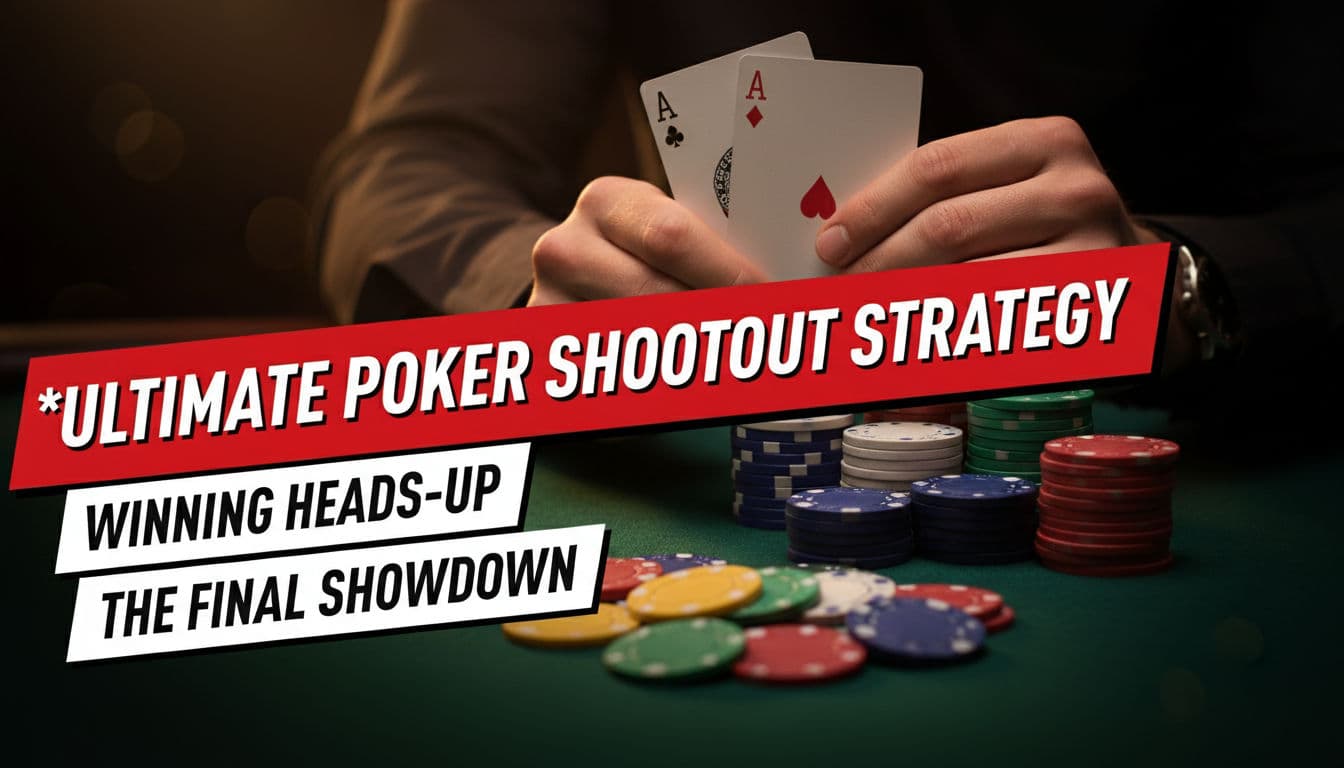
The world of poker tournaments offers a diverse array of formats, each demanding specific skills and strategic adjustments. Among these, the shootout tournament stands out as a unique and often preferred structure, particularly by those who thrive on dynamic gameplay and intense heads-up challenges. Unlike conventional multi-table tournaments (MTTs) where players are continuously consolidated as others are eliminated, the shootout maintains a distinct, progressive elimination system where each table must produce a single victor before advancing to the next stage.
This analytical guide delves into the intricate mechanics of poker shootout tournaments, from their foundational structure to the advanced strategic nuances required for success. We will explore the variations such as double and triple shootouts, and critically examine why this format consistently attracts and rewards the most adaptable and skilled players in the poker arena.
Understanding the Poker Shootout Tournament Structure
At its core, a poker shootout tournament operates on a principle of individual table elimination. The defining characteristic is that players remain fixed at their initial tables until only one player remains standing. This sole survivor then advances to a subsequent table, composed entirely of winners from other initial tables. This contrasts sharply with standard MTTs where tables "break" and players are moved to balance remaining tables, meaning you could play against many different opponents throughout the event.
The journey through a shootout is less about outlasting a continuous pool of diverse opponents and more about conquering a series of self-contained, high-stakes battles. Each victory at a table is a prerequisite for progression, fundamentally altering the strategic landscape.
The Progressive Elimination: Single, Double, and Triple Shootouts
The complexity and scale of a shootout tournament often determine its multi-round structure, commonly categorized into single, double, and triple shootouts.
Single Shootout: The Fundamental Form
In a basic single shootout, players are seated at multiple tables . Each table plays independently until a single winner emerges. These table winners then converge to form a final table, where they compete for the tournament's overall prize pool. This is the simplest manifestation of the shootout concept, providing a clear progression path.
Double Shootout: Escalating the Challenge
For tournaments with a larger field of participants, a double shootout introduces an additional layer of competition. Here, all initial table winners do not immediately proceed to a final table. Instead, they are reseated at new tables for a second "shootout" round. Each of these second-round tables then plays down to a single winner, and these winners subsequently form the grand final table. This structure necessitates winning two distinct tables to reach the championship stage.
Triple Shootout: The Ultimate Test of Endurance and Skill
Designed for even more expansive player fields, the triple shootout demands three successive table victories. Players first conquer their initial table, then advance to a second round of shootout tables. Winners from this second round move on to a third set of shootout tables. Finally, the triumphant players from the third round form the ultimate final table. This format can accommodate a significant number of players, potentially up to 81 (for 9-handed tables) or 100 (for 10-handed tables) initial entrants, showcasing its capacity for large-scale, yet intensely focused, competition.
Strategic Imperatives for Shootout Success
Winning a shootout tournament requires a distinct strategic approach, heavily influenced by the format's fixed-table structure and the inevitability of heads-up play.
Adapting to Dynamic Table Sizes
Unlike standard tournaments, where your strategy might shift gradually as players are eliminated from your table, a shootout demands rapid and significant adaptations. As the number of opponents at your table diminishes, the dynamics change drastically. What might be a sound strategy with 9 players will be completely inappropriate when only 3 remain, and especially when it transitions to heads-up (one-on-one) play. This necessitates a mastery of short-handed and heads-up poker, often requiring aggressive play and a deep understanding of opponent tendencies.
Aggression and Chip Accumulation
In a shootout, your sole objective at your current table is to win all the chips. There's no benefit to simply "surviving" with a small stack if you can't accumulate enough to eliminate others. This often encourages a more aggressive approach, particularly as the table shrinks. Building a significant chip lead early can put immense pressure on your opponents, making it easier to close out the table when short-handed.
Heads-Up Mastery is Non-Negotiable
Every single table in a shootout, regardless of the round, will eventually come down to a heads-up match. This makes proficiency in heads-up poker an absolutely critical skill. Players must be comfortable with high variance, bluffing, value betting, and making precise reads in a one-on-one scenario. Many players who excel in full-ring games struggle significantly when forced into heads-up play, highlighting why shootouts favor those with a complete skill set.
Since mastering the final one-on-one battle is vital for shootout success, you can practice your heads-up skills on CoinPoker , a platform where you can safely deposit using cryptocurrencies and access the short-handed action needed to refine your game.
Why Expert Players Gravitate Towards Shootouts
Many professional and highly skilled amateur players express a strong preference for the shootout format. This isn't merely a matter of taste; it's rooted in the perceived skill advantage the structure offers. The format rewards players who can consistently make optimal decisions across various table dynamics, who are adept at heads-up play, and who can adapt their strategy on the fly. Less experienced players, who might rely more on tight-passive play to ladder up in standard tournaments, often find shootouts challenging due to the constant pressure to eliminate opponents and the high-skill requirement of one-on-one poker.
In essence, the poker shootout tournament is a rigorous test of comprehensive poker skill, favoring aggression, adaptability, and an unyielding drive to win every battle on the path to overall victory.
| Pros | Cons |
|---|---|
Shootouts heavily favor players with strong strategic adaptability, excellent heads-up play, and the ability to thrive in varying table dynamics, making it a true test of overall poker prowess. | Success hinges on winning crucial heads-up battles at each stage. A single unlucky hand or mistake in a one-on-one scenario can lead to elimination, regardless of prior strong play. |
Players remain at their initial tables until a winner emerges, allowing for better reads and understanding of opponent tendencies over an extended period, unlike standard MTTs where tables break frequently. | Unlike standard MTTs where tight play can allow you to cash by outlasting others, shootouts demand active chip accumulation and elimination to progress, making passive strategies ineffective. |
The progression is straightforward: win your table, and you advance. This clear objective can simplify immediate strategic focus compared to managing stack size across a constantly changing field. | The necessity to shift gears from full-ring to short-handed and ultimately to heads-up play requires rapid and significant strategic adjustments, which can be challenging for less versatile players. |
Related Poker Terms
Best Online Poker Bonus Codes


About the Editor

Bence Mitykó is a Somuchpoker poker writer, covering poker news and strategy. He spent four years playing poker professionally, primarily focusing on Heads-Up Sit & Go games, experience that continues to shape his understanding of poker strategy, online poker dynamics, and the wider poker industry.


