

USA Legislation Part 3 - MSIGA Connecting US Online Poker Players


The Multi-State Internet Gaming Agreement, or MSIGA for short, is an official agreement among several US states that allows members to share and combine their online poker player pools.
The importance of the MSIGA stems from how online poker in the US is regulated. Each state is allowed to offer legal online poker, but only to players physically present within its borders.
Naturally, this creates significant limitations. For example, a site licensed in Michigan can only cater to players physically present in Michigan while playing. Someone in Pennsylvania, another state with regulated online poker, can only play with other people in Pennsylvania, but not with those in Michigan.
The Multi-State Internet Gaming Agreement represents a clever solution to this problem. It allows regulated states to agree to combine players into a single player pool.
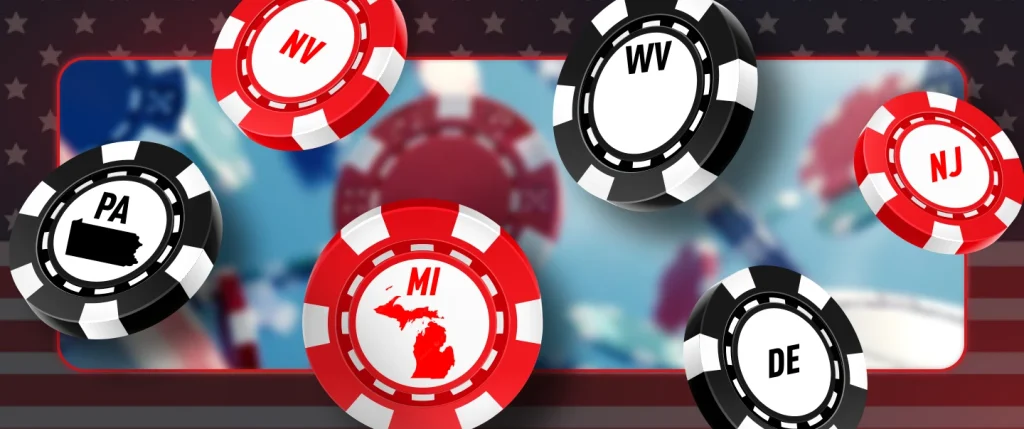
As of 2026, there are six member-states of the MSIGA: Nevada, Delaware, New Jersey, Michigan, Pennsylvania, and West Virginia. However, the road leading up to this point wasn’t without its challenges.
Brief History of the MSIGA
Origins of the MSIGA date back to the start of regulated online poker in the United States. Nevada, Delaware, and New Jersey were the first states to take advantage of new opportunities, launching online poker as early as 2013.
Two of these states, namely Nevada and Delaware, realized that it would be advantageous to combine their existing player pools. This was particularly important for Delaware, as the state’s small population made it difficult to create a sustainable poker ecosystem.
So, on February 25, 2014, Delaware and Nevada entered the Multi-State Internet Gaming Agreement. This was a historic moment for US online poker. At the time, there was considerable uncertainty about the legality of this decision, but these two states decided to roll the dice.
Simultaneously, the Multi-State Internet Gaming Association was founded. This body has a duty to oversee the operation of all member states. Although there were only two members at the outset, there was little doubt that new states would eventually join the MSIGA.
New Jersey was somewhat hesitant to follow suit. However, in October 2017, Governor Chris Christie signed the Multi-State Internet Gaming Agreement, and the Garden State became the third full member.
Legal Hurdles and the MSIGA Expansion
Like many other aspects of regulated online gambling in the United States, the MSIGA was repeatedly challenged and questioned by federal authorities.
The Department of Justice issued an interpretation stating that the agreement's principles were at odds with the provisions of the Wire Act. This old piece of legislation, passed in the 1960s, made it illegal to place real-money wagers across state lines using electronic devices.
Back then, the idea of online gambling and poker as we know them today wasn’t in anyone’s wildest dreams. The Wire Act was passed primarily to prevent illegal sports betting over the telephone, but the DoJ has frequently taken liberties in its interpretation to apply it to modern contexts.
This created a situation where, although there were new states regulating online poker, they were hesitant to join the MSIGA. While the three original members continued to operate a shared network, new states such as Michigan and Pennsylvania were waiting to see how things would play out.
The gambling world in the United States needed clarity, and that need extended beyond online poker. New Hampshire feared that this interpretation could affect the sale of its lottery tickets outside the state, so it took the DoJ to court in 2021. The court ruled in favor of the New Hampshire Lottery, stating that the Wire Act applied only to sports betting.
The next year, IGT, one of the largest casino game developers in the world, challenged the DoJ’s opinion as well. Once again, the verdict came in favorable, stating that the DoJ couldn’t apply the Wire Act to anything beyond sports betting.
While these court cases were initiated and won by parties with little interest in poker, they were major victories for online poker in the US. States in the holding pattern, as well as any new states passing online poker regulations, could freely join the MSIGA without fear of legal consequences.
New States Join the Multi-State Internet Gaming Agreement
After the 2022 court decisions, interest from new states in joining the MSIGA piqued. First, Michigan joined the agreement, becoming the fourth member in May 2022. The state already had all legal provisions in place to make this happen, but was waiting for the DoJ situation to untangle.
In 2023, the MSIGA got its fifth member in West Virginia. The small US state has had regulated online poker since 2019, but there were no live operators. They hoped that joining the cross-state border player pool would help rectify that situation.
As it turned out, this wasn’t the case, as West Virginians had to wait until 2025. This is when BetRivers Poker, a new force in the regulated US online poker market, decided to acquire a license and launch a poker site.
Pennsylvania, which remains the largest regulated state by population, joined the Multi-State Internet Gaming Agreement in April 2025. While it took some time, this was a major development for a growing US online poker network. The addition of the Pennsylvania player pool to the mix created significant opportunities for operators like WSOP Online and BetMGM Poker.
US States With Regulated Online Poker Still Not in the MSIGA
As of 2026, there are three US states with regulated online poker that are still not members of the Multi-State Internet Gaming Agreement. These are Rhode Island, Connecticut, and Maine.
Rhode Island passed its online poker bill in 2024 with language that allows the state to join the MSIGA without issue. However, this is a small state with no live poker operators, so they are yet to actually put their signature on the agreement.
It remains unclear whether Rhode Island is waiting to see interest from an actual operator before pulling the trigger, or if they plan to sign regardless. Either way, they are a very likely prospect to become the seventh member of the MSIGA.
The Connecticut situation is much different.
Although the state regulated online poker in 2021, no operators have gone live yet. There are multiple reasons for this situation, but one of them is the relatively small market size (around 3.5 million people). Joining the MSIGA could help resolve that issue.
The problem, however, is that the original language in the online poker regulation doesn’t allow for this possibility. So, unlike other states, Connecticut can’t simply join the MSIGA. Some important legal changes are required before this can happen.
To address this issue, a new bill was introduced in 2025. If passed, this bill would allow the state to join the Multi-State Internet Gaming Agreement, and we could finally see some operators launching in the state. The bill has made some progress through the legislative process, and there is a chance it will pass in the near future.
As for Maine, its recently passed legislation does not include MSIGA provisions, but it’s unclear whether this would actually be an obstacle to the state joining the agreement. Legal opinions on this matter seem to differ, so we’ll just have to wait and see.
Benefits of the MSIGA and Its Future
Licensed US poker sites have seen clear benefits from the Multi-State Internet Gaming Agreement. Larger player pools gave them more freedom to create larger tournament series, and they helped create more stable traffic across cash game tables.
One operator that took full advantage of the agreement is WSOP Online, which currently combines players from New Jersey, Nevada, Michigan, and Pennsylvania.
BetRivers Poker also has a four-state network, combining players from Pennsylvania, Michigan, Delaware, and West Virginia. Soon, they should be bringing their New Jersey platform into the fold, making them the first US poker site to span five states.
BetMGM Poker brings together players from Michigan, New Jersey, and Pennsylvania, while PokerStars has been somewhat slow to utilize these opportunities. As it stands, their combined platform brings together players from New Jersey and Michigan, while Pennsylvania remains segregated. This has changed with the launch of the new site, dubbed PokerStars Exclusively on FanDuel.
All in all, the MSIGA has been great for US online poker. It helped states and operators get around state-only provisions and enabled them to build sites with larger, more sustainable player pools. In many ways, this agreement is setting the foundations for a real US-wide poker network.
It’s hard to say what the future holds. Apart from Connecticut, which is a fairly small market, there are very few major developments. New York is the only state that could potentially launch online poker in the near future, and if it were to join the MSIGA, this would be a major development.
All signs indicate that once online poker is regulated, New York would be quick to join the agreement, which is good news.
Other than this, we’ll have to wait and see. It makes sense to assume that any new states launching online poker will ensure that their bills include multi-state provisions, giving them the freedom to join the MSIGA or, potentially, other multi-state compacts. All that US poker needs now is for more states to legalize online poker!
About the Editor

Ivan Potocki is Somuchpoker's Content Writer and Poker Strategy Specialist, writing strategy guides, online poker rankings and US regulation coverage for the site. He spent more than five years as a professional poker player before moving into writing, and brings a mathematical, data driven approach to breaking down poker and casino concepts.
Related News
 Online PokeriGamingStories
Bryn Kenney Sues GGPoker Parent Over 5% Stake and Millions in Commissions
Bryn Kenney sues GGPoker's parent over a 5% stake and unpaid commissions. A new filing also raises allegations involving player payments and security.
 iGamingOnline PokerPromotion
Natural8 Free $15 APT Online Ticket - Claim Yours
New to Natural8? Sign up with code SMPBONUS, verify before 1 November and get a free $15 APT Online ticket for the $40M GTD series.
 iGamingOnline Poker
GGPoker Security Update Bans Third-Party Poker Tools
The GGPoker security update bans third-party poker tools, adds new client security features, and introduces detection for suspicious win rates.
 iGamingOnline Poker
Phenom Poker Launches Bellagio Mix Inspired by Bobby’s Room
Explore Phenom Poker’s Bellagio Mix, a 13-game rotation inspired by Bobby’s Room, featuring classic mixed games and two new capped pot-limit variants.
 iGamingOnline CasinoStories
SteveWillDoIt Net Worth 2026: Gamdom Deal, Casino Streams and Biggest Wins
SteveWillDoIt net worth in 2026 - why it's $20M+, his $3.2M a month Gamdom claim, biggest slot wins and casino streams.
 Online PokeriGaming
Natural8 Streamer Mode: 100% Cashback, Privacy & How to Apply
Learn how Natural8 Streamer Mode works, how to apply, who can qualify, and how streamers can earn 100% cashback on streamed poker games.