

USA Legislation Part 1 - US States With Regulated Online Poker

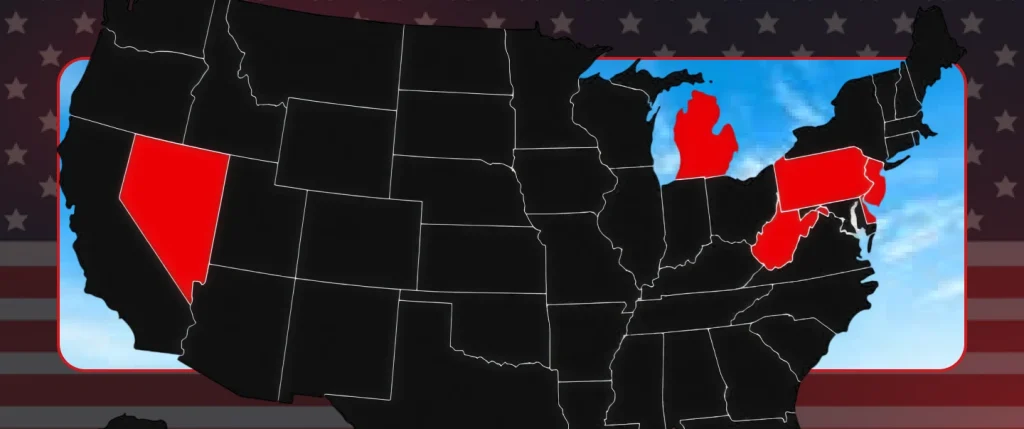
As of 2026, there are nine US states with regulated online poker. This means these states have passed laws and established specific regulatory bodies that allow operators to obtain licenses and offer legal online poker to their residents.
These nine US states where poker is regulated can be divided into two major groups: those with active licensed poker sites and those without any licensed poker operators.
The first group consists of six states, namely: Nevada, New Jersey, Michigan, Pennsylvania, Delaware, and, as of recently, West Virginia.
The other, smaller group of US states where online poker is regulated comprises Maine, Rhode Island, and Connecticut. Despite the regulation being in place for some time, no operators have applied for or received licenses to set up shop in these three states.
State | Regulated poker? | Active poker sites? | MSIGA member? | Licensed sites |
|---|---|---|---|---|
Delaware | Yes | Yes | Yes | BetRivers Poker |
Nevada | Yes | Yes | Yes | WSOP Online |
New Jersey | Yes | Yes | Yes | PokerStars, WSOP Online, BetMGM, Borgata |
Pennsylvania | Yes | Yes | Yes | PokerStars, WSOP Online, BetMGM, BetRivers |
Michigan | Yes | Yes | Yes | PokerStars, WSOP Online, BetMGM, BetRivers |
West Virginia | Yes | Yes | Yes | BetRivers |
Connecticut | Yes | No | No | N/A |
Rhode Island | Yes | No | Yes | N/A |
Maine | Yes | No | No | N/A |
US Online Poker Laws: The Basics
Before we dive into an overview of US states with legal online poker, it’s important to understand the legal fundamentals, which are the main reason for the country's limited growth in online poker.
In the US, online gambling (including online poker) is regulated at a state level. This means that each state must pass a specific set of laws defining this area, including licensing, regulatory agencies, taxation, gaming rules, and more.
Poker sites licensed in a particular state can only provide their services to players physically located within that particular state. So, someone living in California cannot log in and play on a Michigan poker site, unless they travel to Michigan.
US states with regulated online poker have been working together for some time to create larger, healthier player pools through agreements such as the Multi-State Internet Gaming Agreement (MSIGA). The MSIGA allows member states to combine their players into a single player pool, but all players can still only play on their respective state-licensed clients.
So, while the MSIGA helps create a healthier online poker ecosystem, it doesn’t benefit players in non-licensed states, who remain on the outside.
US States With Regulated Online Poker & Licensed Sites
As of 2026, there are six US states that offer legal, licensed, and regulated online poker and have actual live operators. All six are also members of the MSIGA, allowing operators to combine player pools across all states where they have a presence.
Delaware
Delaware was the first US state to regulate online poker. The regulation happened in 2012, with the first poker sites going live the next year. The Delaware Gaming Commission awarded three licenses to three local racinos, but all three were operating a poker room on the same platform provided by 888poker.
In 2014, after Nevada regulated online poker, Delaware entered into an agreement with Nevada to share player pools, laying the foundation for the MSIGA. In 2017, New Jersey joined in as well.
In 2023, Delaware residents were without online poker for a while. The deal with 888poker expired, and it was not renewed. This caused a blackout that ended in June 2025, when BetRivers Poker launched in the state.
As of right now, BetRivers Poker is the only site operating in Delaware, with a player pool that combines players from Michigan, Pennsylvania, and West Virginia.
Nevada
Nevada became the second US state with regulated online poker in late April 2013. However, it was the first state to offer legal online poker games, as the first sites went live shortly after, while the first operators in Delaware did not go live until November 2013.
Ultimate Poker was actually the first site to launch in the state, but it didn’t last long. WSOP Online went live in September of 2013, and, unlike competitors, the operator managed to weather all the storms. As of 2026, WSOP.com is the only regulated poker site operating in the state, licensed by the Nevada Gaming Commission.
As mentioned, Nevada has been a member of the MSIGA since 2014, and with WSOP having a presence in nearly all US states with legal online poker, the NV platform shares its player pool with Michigan, Pennsylvania, and New Jersey.
New Jersey
Online gambling, including online poker, was regulated in New Jersey early in 2013, with the first poker sites launching in November of the same year. The New Jersey Division of Gaming Enforcement (NJDGE) is the official body responsible for issuing licenses and overseeing the operations of licensed operators.
A few years later, in 2017, New Jersey joined the MSIGA, becoming the third member of the agreement, together with Nevada and Delaware.
As of 2026, there are four licensed poker sites operating in New Jersey: WSOP Online, BetMGM Poker, Borgata Poker, and PokerStars. PokerStars was rebranded as PokerStars exclusively on FanDuel, combining the two brands' strengths to create a new poker platform.
WSOP Online shares its player pool with Nevada, Pennsylvania, and Michigan, while PokerStars combines New Jersey and Michigan player pools. The new PokerStars x FanDuel app will also include players from Pennsylvania.
Pennsylvania
After the initial wave of regulation, there was a bit of a lull in US states passing online poker laws. The next major development came in October of 2017, when Pennsylvania passed a bill to regulate online gambling.
The job of issuing licenses and overseeing operators fell to the Pennsylvania Gaming Control Board (PGCB). Despite regulations and some online casinos launching in the state, it took a little while for the first poker site to launch.
This happened in 2019 when PokerStars acquired the license and went live. For a couple of years, they remained the sole operator before WSOP Online and BetMGM Poker joined them in 2021. Finally, in 2025, BetRivers Poker entered the state’s market as well.
In April 2025, Pennsylvania also joined the MSIGA, creating new opportunities for operators. WSOP took full advantage of this opportunity, bringing players from Nevada, New Jersey, and Michigan into the fold. BetMGM did the same, combining the PA pool with those in Michigan and New Jersey.
BetRivers Poker operates a network that combines players from PA, MI, WV, and DE.
PokerStars is the only site in the state that remained ring-fenced, but this might change in the near future, with the launch of the new PokerStars exclusively on the FanDuel platform. However, the main aim of the merger was to create shared liquidity for the licenses PokerStars already owns in the US. In addition, by combining the PokerStars player base with FanDuel’s massive community of sports bettors and casino fans, the new platform will feature much larger player pools.
Michigan
In 2019, Michigan became the fifth US state with legal online poker. However, online gaming didn’t actually go live in the state until 2021. The Michigan Gaming Control Board (MGCB) is the official body responsible for regulating iGaming.
PokerStars was the first operator to go live in the state, launching in January 2021. A couple of months later, BetMGM Poker followed suit, while WSOP Online entered the market in March 2022.
In 2025, BetRivers Poker also launched in Michigan, adding yet another option for all poker fans in the state.
In 2022, Michigan also joined the Multi-State Internet Gaming Agreement, allowing operators to combine their respective player pools across state lines.
West Virginia
West Virginia became the sixth US state with legal online poker, passing the required regulations in 2019. However, this was only on paper, as no operators were interested in entering the market because of its small size.
The fact that West Virginia joined the MSIGA in 2023, creating more favorable online poker conditions, did not change much. For the next couple of years, none of the major US poker operators demonstrated any real interest in obtaining a license.
Finally, in 2025, BetRivers Poker, a newly-launched site with an aggressive expansion strategy, became the first poker site to go live in the state. From the get-go, BetRivers combined its WV player pool with those in PA, MI, and DE.
As of 2026, BetRivers remains the only licensed poker site in the state, and there are no indications this might change in the near future.
US States With Legal Online Poker & No Active Licensed Operators
There are three more US states where online poker is regulated, but to date, no actual sites have gone live. These are Connecticut, Rhode Island, and Maine.
Connecticut Online Poker
In May 2021, Connecticut passed an online gambling bill that regulates sports betting, online casinos, and online poker. However, despite several years having passed since the regulation, there have been no developments in the online poker arena.
The legal situation in the state is somewhat complicated, as online gaming is solely in the hands of the two tribes, the Mashantucket Pequot and the Mohegan Tribe. So far, neither of these two tribes has shown too much interest in poker.
Liquidity remains the main issue as Connecticut is a small market that doesn’t appeal to major operators. Plus, the state is still not a member of the MSIGA, which means that only ring-fenced, state-level sites are possible.
It is possible we’ll see some movement in CT in 2026 and beyond, but there are no clear indicators as to whether and when this might happen.
Rhode Island
As of 2026, Rhode Island is one of the latest US states to join the ranks of regulated states. The legislation was passed in 2024, opening doors for potential operators to acquire licenses and set up shop in the state.
However, with a population of just over one million, Rhode Island is a very small market and not very attractive to major US poker sites. However, BetRivers has shown a willingness to take a gamble on smaller states, so there is some hope.
The state’s gaming bill also makes joining the MSIGA possible, which is an important element that could help.
Maine
In January 2026, Main became the ninth state with legal and regulated online poker, at least on paper. So far, no operators have shown interest or willingness to acquire a license and launch in the state.
Maine has a population of just 1.4 million, so it’s a very small market. Additionally, the current law has no provisions for the MSIGA, further reducing its appeal, even to operators willing to gamble on smaller states like BetRivers Poker.
The Future of Regulated US Online Poker
With six US states offering safe and regulated online poker and three more poised to welcome operators, the outlook for regulated online poker in the United States looks promising.
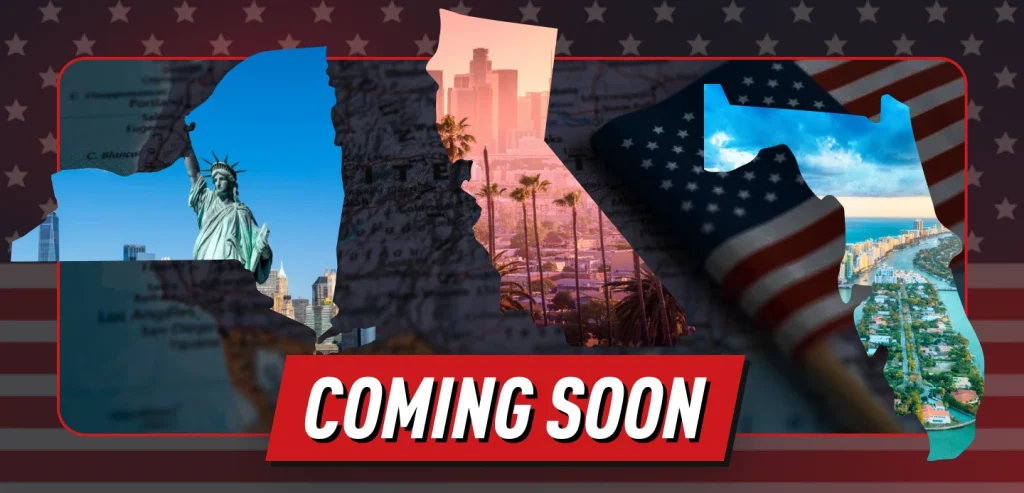
There is still a lot of work to be done, and several more key states, like California, Florida, and New York, could significantly tip the scales. These states have been toying with the idea of regulation for years, but we still have not seen any meaningful progress.
There have been positive signals in recent years, so there is hope that regulated online poker will continue to grow in the United States in 2026 and beyond. However, as we have seen, these things tend to move very slowly, so it’s best not to hold your breath.
However, players from the US can still play poker on offshore and crypto sites. For details, you can browse our complete collection of the best online poker options by US state.
About the Editor

Ivan Potocki is Somuchpoker's Content Writer and Poker Strategy Specialist, writing strategy guides, online poker rankings and US regulation coverage for the site. He spent more than five years as a professional poker player before moving into writing, and brings a mathematical, data driven approach to breaking down poker and casino concepts.
Related News
 iGamingOnline Poker
Natural8 Free $15 APT Online Ticket - Claim Yours
New to Natural8? Sign up with code SMPBONUS, verify before 1 November and get a free $15 APT Online ticket for the $40M GTD series.
 iGamingOnline Poker
GGPoker Security Update Bans Third-Party Poker Tools
The GGPoker security update bans third-party poker tools, adds new client security features, and introduces detection for suspicious win rates.
 iGamingOnline Poker
Phenom Poker Launches Bellagio Mix Inspired by Bobby’s Room
Explore Phenom Poker’s Bellagio Mix, a 13-game rotation inspired by Bobby’s Room, featuring classic mixed games and two new capped pot-limit variants.
 Online PokeriGaming
Natural8 Streamer Mode: 100% Cashback, Privacy & How to Apply
Learn how Natural8 Streamer Mode works, how to apply, who can qualify, and how streamers can earn 100% cashback on streamed poker games.
 Online PokeriGaming
18,730 Players, One Millionaire: The One on CoinPoker
The One on CoinPoker drew 18,730 players and paid $1M to the winner - the biggest payout in CoinPoker history. Full final table results and stories.
 Online Poker
QQPK Bot Investigation: 893 Bans, $300K Compensation Fund
QQPK reports 893 account bans and a $300K compensation fund after uncovering a collusion scheme. Read the latest investigation findings.