

How the New WSOP Main Event Shot Clock Changes the Game

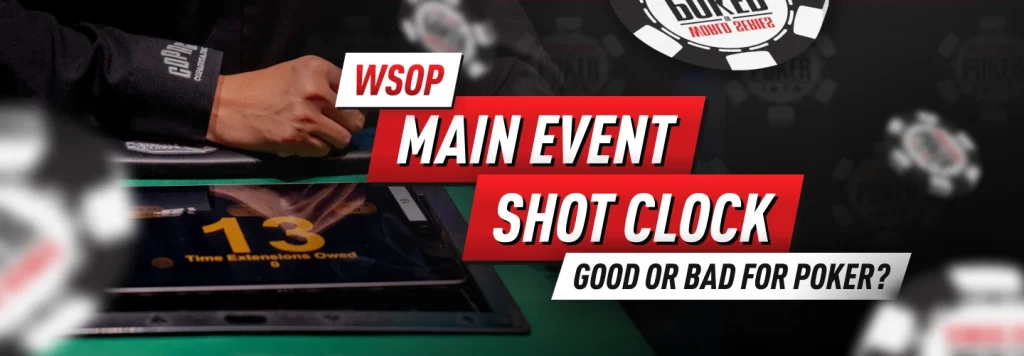
Have you heard about the massive changes happening at the 2026 World Series of Poker? For the first time in its 57-year history, the world's biggest tournament is speeding things up.
Tournament officials have officially introduced a WSOP Main Event shot clock late in the competition, on Day 7. This unprecedented decision has sparked a massive debate among professionals, recreational players, and fans alike. Let's break down what this means for your favorite game.
What is the WSOP Main Event Shot Clock?
If you enjoy watching high roller events on the PGT or World Poker Tour (WPT), you are probably familiar with an Action Clock. Now, this fast-paced concept is making its debut on poker's biggest and most prestigious stage.
The new WSOP Main Event shot clock gives competitors exactly 20 seconds to make a decision when facing a bet. If a player runs out of time without taking action, their hand is automatically ruled dead, or they are forced to check.
To keep things fair in massive pots, players are given special time-extension chips. Here is a quick breakdown of how these updated poker tournament rules actually work on Day 7:
Base Time: Players have a strict 20-second window to act on their hand.
Time Bank Chips: Each remaining player receives six time-extension chips at the start of the day.
Extra Time: Toss in an extension chip, and you get an extra 30 seconds to think about your next move.
Penalty: Failing to act before the timer hits zero results in an immediate forced check or a dead hand.
Why Change the Poker Tournament Rules Now?
You might be wondering why they are changing the rules so deep into the tournament. The primary reason for this drastic shift in poker tournament rules is to eliminate excessive stalling.
If you watch the ESPN+ livestreams, you already know that tanking in poker can drag the game to a halt. When players take five or ten minutes to make a routine fold, it creates a frustrating experience for the viewers at home.
The breaking point for organizers happened on Day 6. Pro player Loren Klein stalled for 15 minutes with only one single chip left in his stack. He was trying to survive long enough for another player to bust so he could secure a higher cash prize.
This extreme example of tanking in poker led to heavy criticism across social media. Klein eventually busted in 72nd place for $105,000, but the damage was done. The excessive delay forced tournament directors to finally step in and keep the game moving.
The Big Debate at the 2026 World Series of Poker
As you can imagine, not everyone in the poker community is thrilled about the new timing system. High-stakes professional Chris Brewer publicly called the decision "insanely unfair" to recreational players. He argues that amateurs are not used to timers and might panic under pressure when playing for life-changing money.
Legendary commentator and 2004 Main Event runner-up David Williams also criticized the move. He suggested that floor managers should simply penalize individual stallers rather than forcing a clock on the entire field.
Actually, Chris is right. This is a bad idea. The floor should just use their discretion in spots where someone is being egregious like Loren and numerous others yesterday. One chip back (or similar).. instant 30s clock. https://t.co/GJAkpXnEeH
— David Williams (@dwpoker) July 12, 2026
On the other hand, many respected pros fully support the change, including Allen Kessler, who argued that stalling the game might benefit the whole table and could be a reason not to call the clock on a tanking player.
Apparently a shot clock was added today to the @WSOP main event.
Anyone know the exact rules?
This was needed because no one will call clock on a huge pay jump.
The whole table benefits from one player tanking without a clock.
Good decision @shaundeeb https://t.co/iafiI8kpzv
— Allen Kessler (@AllenKessler) July 12, 2026
Bracelet winner Galen Hall is among those who believe a faster pace is much better for the 2026 World Series of Poker. Supporters argue that keeping the action flowing makes the game significantly more entertaining for the audience and fairer for players who act quickly.
What This Means for the August Nine Final Table
Whether you love the idea or hate it, the WSOP Main Event shot clock is here to stay for the remainder of the tournament. The field is rapidly narrowing down toward the highly anticipated "August Nine" final table at Paris Las Vegas.
When the final nine players take their seats, the pressure will be higher than ever. Final table action will be broadcast on ESPN2 on August 3-4, and will conclude on ESPN on August 5. The remaining contenders will have to think fast, manage their time chips wisely, and play their absolute best under the spotlight.
About the Editor

Beus Zsoldos is Somuchpoker's Senior Copywriter and Player Stories Editor, covering WSOP color moments, player profiles and poker personalities for the site's Stories section. She has spent more than 20 years around the game, first as a player, then as a live tournament director and localization manager for a major online poker room, before moving into full time poker writing.
Related News
 Side PotStories
Las Vegas Casino Photography Policy: Myth vs. Reality
Curious if taking photos in a casino is illegal? Discover the truth about the Las Vegas casino photography policy and how to safely snap your next selfie.
 Side PotLive PokerStories
The Ultimate Showdown: A Guide to the $250K WSOP Paradise Pro-Am
Get ready for the exciting $250,000 WSOP Paradise Pro-Am in the Bahamas! Learn the rules, schedule, and format of this 2026 gold bracelet event.
 Side PotStories
The Future of High Stakes: Inside the Deepstack Poker Show
Get ready for the new Deepstack poker show. Learn how advanced AI and poker heart rate monitoring will reveal the tension in high stakes poker.
 Side PotStoriesWSOP
WSOP 2026 - Moment of the Day - 15 June - Can you be quiet?
Martin Kabrhel and Martin Zamani shouting at each other, "Can you be quiet?" might be one of the worst nightmares of tournament personnel.
 WSOPSide PotStories
WSOP 2026 - Moment of the Day - 6 June - Family pot
Family pot of Kristen and Alex Foxen resulted in a sneak peak at the $25,000 event - Moment of the Day for 6 June WSOP 2026.
 Side PotStories
Rumours Confirmed: Caesars Entertainment Is Up for Sale!
The latest casino news shows that the massive $17.6 billion deal, as the Caesars Entertainment acquisition had been finalized, has drawn major attention.