

Daniel Negreanu Exposes a Wild 90s Poker Tournament Scam

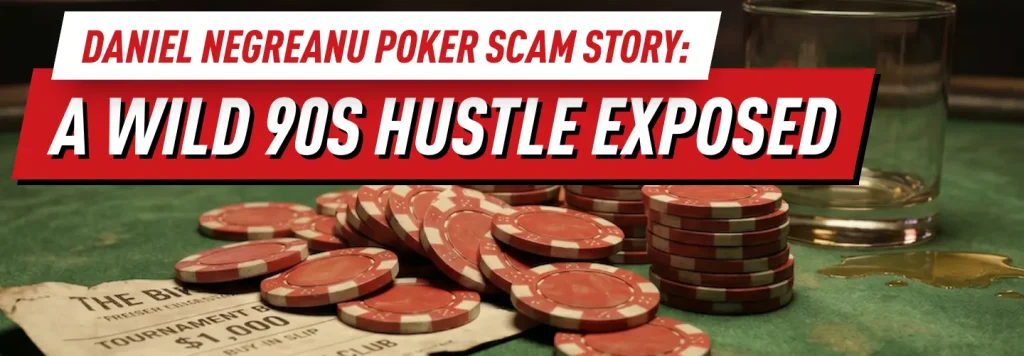
If you have been grinding the tables or firing up online tournaments for a while, you probably know that poker has a pretty wild history. Back in the day, before the era of live streams and high-tech casino security, the felt was a playground for some serious hustlers.
Recently, a mind-blowing Daniel Negreanu poker scam story made the rounds online, and it is an absolute must-hear. Speaking to his massive YouTube audience of nearly a million subscribers, "Kid Poker" himself shone a light on the darker side of the game.
If you are wondering how players pulled off poker tournament scams back in the day, this tale will blow your mind. Negreanu detailed an elaborate scheme from his early days playing at the Bicycle Club in the 1990s. It involved a ruthless combination of taking too many backers and secretly tossing away chips to other players.
The Mechanics of the Daniel Negreanu Poker Scam Tale
Back in the 90s, live poker was sometimes like the Wild West. In his video, Negreanu used a standard $1,000 buy-in tournament to explain exactly how this specific grift worked.
The entire hustle relied on a highly deceptive practice known as overselling poker action. For those new to casino terminology, "selling action" means a player gets investors to pay for part of their buy-in in exchange for a percentage of their future winnings. This is completely normal today.
But overselling poker action? That is a total trap. That is when you sell way more than 100% of yourself, essentially guaranteeing you will lose money if you actually win the tournament! Here you can watch the timestamped video:
Here is a step-by-step breakdown of how the scammer pulled off this elaborate con:
Step 1: The Hustle. The scammer aggressively works the casino floor before the event, selling pieces of his $1,000 buy-in. He manages to sell $2,500 worth of action to various unsuspecting backers.
Step 2: The Profit. He uses $1,000 to enter the tournament and quietly pockets the remaining $1,500 in pure, untraceable profit.
Step 3: The Fake-Out. He actually plays well at first! The goal is not to cash - because cashing means paying out his backers more than he won - but to build a massive chip stack.
Step 4: Trading Action. Once he has a mountain of chips, he approaches other players at his table and offers to swap percentages (for example, "I will trade 10% of my action for 10% of yours").
Step 5: The Dump. Finally, the scammer engages in chip dumping. He intentionally loses pots to the specific players he just swapped action with, secretly transferring his big stack to them.
A Masterclass in Chip Dumping and Deceit
To understand how brazen this is, let's take a closer look at chip dumping. This is a highly illegal table move in which a player deliberately makes terrible bets or folds winning hands to secretly give their chips to someone else.
By chip dumping, the scammer ensures his own tournament run ends early. His original backers get absolutely nothing, assuming he just suffered a bad beat. Meanwhile, the scammer walks away with $1,500 in stolen buy-ins, plus a 5% to 10% equity stake in the deep-stacked players he just boosted!
When it comes to poker tournament scams, it is hard to find one more layered and deceptive. The math was completely rigged against the original investors from the very start.
Why This Behavior is Borderline Sociopathic
To pull off such a multi-layered con requires a complete lack of empathy. Discussing the Daniel Negreanu poker scam revelation, the poker legend called the behavior flat-out wrong. He even described it as borderline "sociopathic."
"This is a scam, that's a scammer, that's someone who's really dishonest,"
- Negreanu told his viewers. He painted a picture of a guy drinking and plotting his next mark without a single ounce of guilt. Even though he found the sheer audacity of the hustle slightly amusing in hindsight, Negreanu was clear that he could never do something so cold-blooded.
Thankfully, poker tournament scams like this one are incredibly rare today. Modern casinos have sophisticated security cameras, strict rules against chip dumping, and highly trained dealers who would quickly spot this hustle.
Furthermore, overselling poker action is heavily monitored on modern, verified staking platforms, protecting honest backers from these shady math tricks. Next time you are swapping action with a buddy, just be glad you are playing poker in the modern era!
About the Editor

Beus Zsoldos is Somuchpoker's Senior Copywriter and Player Stories Editor, covering WSOP color moments, player profiles and poker personalities for the site's Stories section. She has spent more than 20 years around the game, first as a player, then as a live tournament director and localization manager for a major online poker room, before moving into full time poker writing.
Related News
 Side PotStories
Las Vegas Casino Photography Policy: Myth vs. Reality
Curious if taking photos in a casino is illegal? Discover the truth about the Las Vegas casino photography policy and how to safely snap your next selfie.
 Side PotLive PokerStories
The Ultimate Showdown: A Guide to the $250K WSOP Paradise Pro-Am
Get ready for the exciting $250,000 WSOP Paradise Pro-Am in the Bahamas! Learn the rules, schedule, and format of this 2026 gold bracelet event.
 Side PotStories
The Future of High Stakes: Inside the Deepstack Poker Show
Get ready for the new Deepstack poker show. Learn how advanced AI and poker heart rate monitoring will reveal the tension in high stakes poker.
 Side PotStoriesWSOP
WSOP 2026 - Moment of the Day - 15 June - Can you be quiet?
Martin Kabrhel and Martin Zamani shouting at each other, "Can you be quiet?" might be one of the worst nightmares of tournament personnel.
 WSOPSide PotStories
WSOP 2026 - Moment of the Day - 6 June - Family pot
Family pot of Kristen and Alex Foxen resulted in a sneak peak at the $25,000 event - Moment of the Day for 6 June WSOP 2026.
 Side PotStories
Rumours Confirmed: Caesars Entertainment Is Up for Sale!
The latest casino news shows that the massive $17.6 billion deal, as the Caesars Entertainment acquisition had been finalized, has drawn major attention.