

QuintAce Hand Review on WPT Global (Free Solver)


Most poker players lose money in the same three spots over and over without noticing. QuintAce Hand Review fixes that. It grades every meaningful decision you make on WPT Global, shows you what a solver would have done in your seat, and it is free for every player. No uploads, no hand histories to paste, no ranges to configure. You just play - and your session gets reviewed for you.
This guide walks you through exactly how QuintAce Hand Review works, what it covers, and how to use it to turn your leaks into wins. You can also try the hand replayer here later down in the article.
Join WPT Global and turn your leaks into wins
What Is QuintAce?
Before the WPT Global feature, a quick word on the engine behind it. QuintAce is a poker training platform built on a real solver - a deep reinforcement learning (DRL) engine that computes near real-time solutions for almost any spot in around half a second. Not pre-computed charts, not simplified approximations. Every strategy you see is grounded in live solver output across formats like NLHE and PLO.
On the full platform that engine powers Compete Mode (play against six AI opponent archetypes), Analysis Mode (review your hands and get leak-targeted drills), Range Explorer (build any spot and see solver ranges update live), Practice Mode, and a set of AI coaching personalities that show the same solve through a GTO or exploit lens.
Hand Review on WPT Global uses the same engine and targets your real-cash sessions. We will publish a full QuintAce platform guide soon - for now, here is what it does inside WPT Global.
What Is QuintAce Hand Review on WPT Global?
QuintAce Hand Review is a brand-new feature on WPT Global that puts solver-grade analysis of your own play directly into the app. It is built on the same deep reinforcement learning engine QuintAce develops for serious players - now handed to every WPT Global player at no cost.
Here is why that matters. Solver study used to mean expensive software, a steep learning curve, and hours of setup. QuintAce Hand Review removes it all. You finish a session, and the analysis is already done. Every rating, every recommended action, every solver-backed alternative comes from the same engine, working on the exact hands you just played.
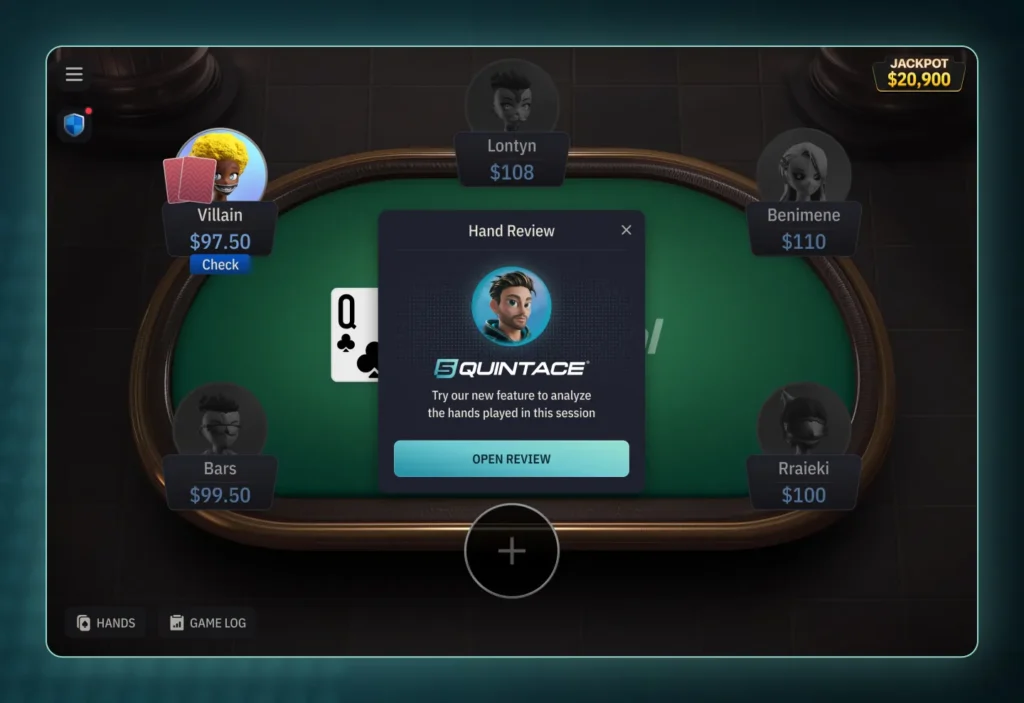
You reach it two ways. When you finish a session, a prompt appears right at the table inviting you to open the review and walk back through every hand. You can also open it any time from the new QuintAce Hand Review button in your Profile menu, marked NEW.
What lands in your account automatically
A rating on every meaningful decision you make - Solid, Close, or Lacking
An overview of your game across positions, streets, actions, and situations
The full action breakdown for each rated decision - every alternative, the solver's recommended frequency, and how each ranks by EV
You do not lift a finger to make any of this happen. Play your hands, and the review is generated for you.
Your Overview - Where You Find Your Leaks
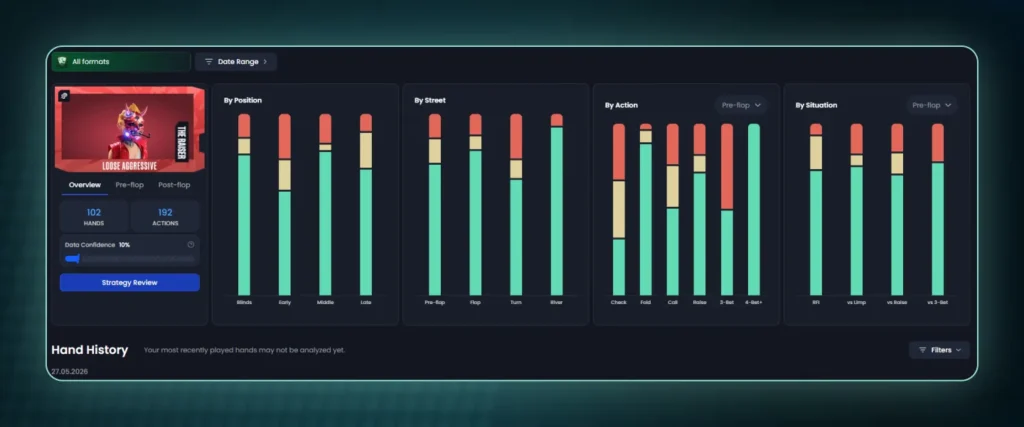
Open Hand Review, and the first thing you see is your overview. This is a read on your game built from every reviewed decision, organized around four lenses that show where you are strong and where you bleed chips.
Lens | What it breaks down | What it tells you |
|---|---|---|
By Position | Blinds, Early, Middle, Late | Where you play well and where you leak. A mostly-red "Early" bar is where you start studying. |
By Street | Pre-flop, Flop, Turn, River | The point in a hand where your decisions break down. Most players have one street that costs them. |
By Action | Fold, Check, Call, Bet, Raise, 3-bet, 4-bet+ | Whether your worst decisions are aggressive, passive, or tied to specific bet sizes. |
By Situation | RFI, vs Limp, vs Raise, vs 3-bet, plus post-flop spots | Which kinds of spots hurt you most? |
Each bar is stacked - green for Solid, yellow for Close, red for Lacking. Hover for the exact percentage. Alongside the lenses, the overview presents a player archetype that reflects your style, for example, "The Closer (Tight Aggressive)" or "The Caller (Loose Passive)."
You also get your Total Hands and Analyzed Actions counts, plus a Data Confidence indicator so you know how much to trust the read at your current sample size. Scope it to All Time or to shorter windows to compare recent sessions against your baseline.
The takeaway is simple. Your overview points you straight at your biggest leak. Fix that, and your win rate moves. Which Hands Get Reviewed?
Every hand you play. On WPT Global, Hand Review covers your entire session, with nothing skipped, in whatever cash game you were in. Your overview and ratings reflect everything you did at the table - not a curated highlight reel.
When you want to cut straight to the spots that matter, the filters do that job. More on those below.
How Your Decisions Are Scored
Every meaningful decision in every reviewed hand receives a rating: Solid, Close, or Lacking. The rating reflects how your action compares to the solver's recommended play for that exact spot.
Click into a hand from the feed, and you get the full hand played out, every player's action listed in order across each street. For opponents, you see position and action. For your own decisions, you also see the rating. Expand any of yours into the Action Overview - the drill-down where most of the learning happens.
The Action Overview: Review and Explore
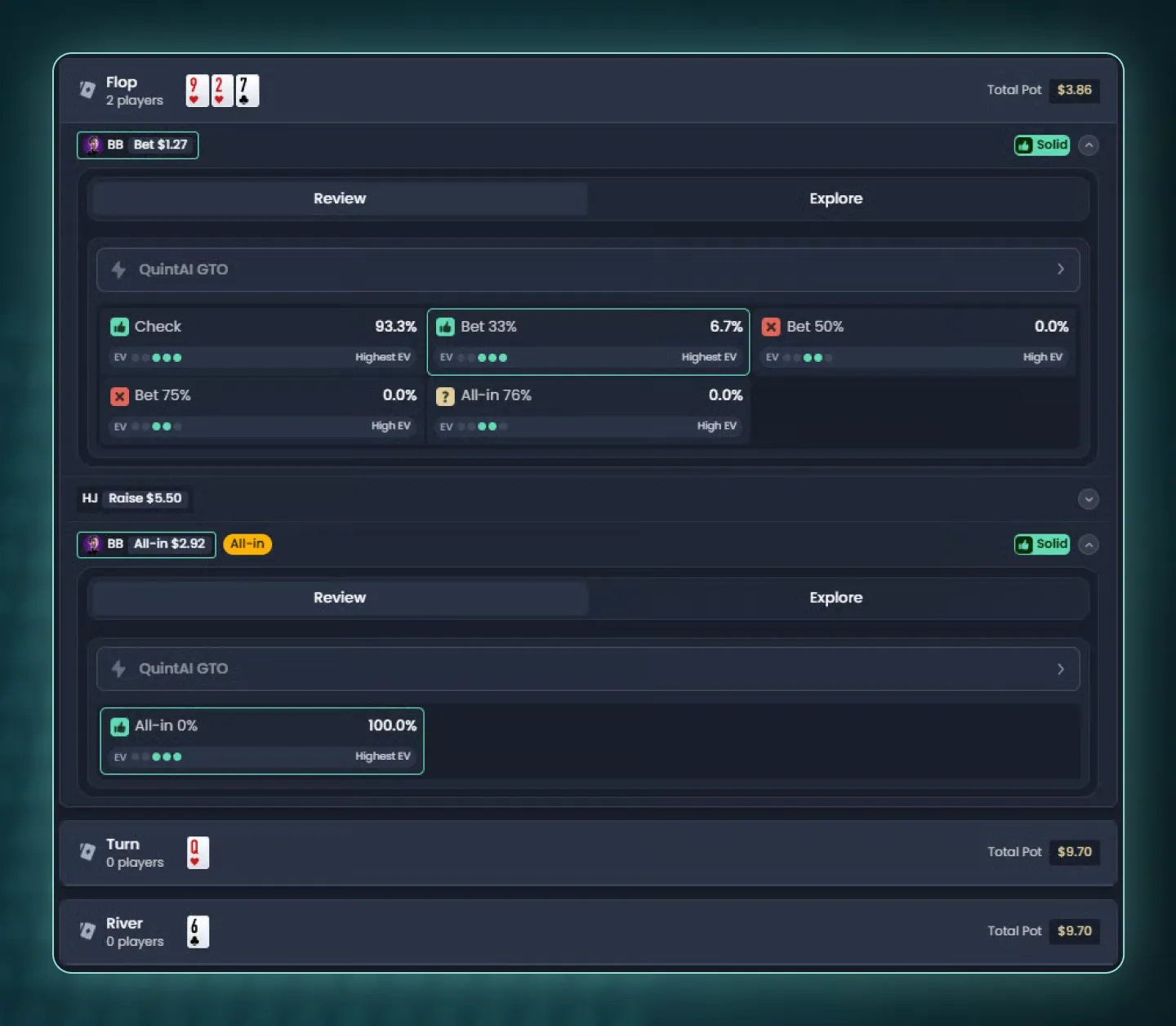
Expand a rated decision, and it opens on two tabs.
Review lays out every action you could have taken as a grid of cards. Each card shows:
The action itself - Fold, Check, Call, a bet size, a raise size, or all-in
The solver's recommended frequency for that action, for example, 93%, 7%, 0%
An EV ranking on a visual scale - Highest, High, Moderate, Low, or Lowest EV
A rating icon showing how that action would have scored
The action you actually took is highlighted with the rating you received. Every top-bucket play carries the green Solid tick, so you see at a glance whether your choice was one of the solver's preferred lines.
Take a real example. You are in the big blind with K♠K♥. After an early-position open and a call, you squeeze to just under 4x the open, and the decision grades as Solid. The solver does not force one size here - it spreads frequency across a smaller 2.8x, your 3.7x, a larger 10.1x, and even a 10.7x shove, and all four sit in the Highest EV bucket. Because your size is one of those top plays, it grades Solid. Folding and calling are both 0%.
Explore steps out of your own two cards and into the solver's entire strategy for the spot. You get the full range grid - every starting hand colored by what the solver does with it - plus a row of your exact suit combinations so you can pick the one you held and read its action mix underneath.
Explore is where the curious player asks "what is the solver doing with everything else here," not just "what should I have done." That is how you build real understanding, not just a list of corrections.
Frequency vs EV - what the numbers actually mean
Two numbers appear on every action card, and each answers a different question.
Data point | Question it answers | How to read it |
|---|---|---|
Frequency (%) | How often does the solver recommend this exact action | 100% is a pure, always-do-this play. A 70/30 mix means balancing two actions to disguise your range. |
EV ranking | How does this action's EV compare to the alternatives | Shown as a bucket, not a number. Two 0% actions can differ: Low EV is a small mistake; Lowest EV is a serious one. |
You do not need the math behind either. The rating, the frequency, and the EV ranking together tell you what you need: whether your action is recommended, how often it is right, and how bad the mistake is if it is not.
Filtering Your Hand History
Your overview aggregates across every hand. The feed itself slices down to exactly what you want to study, using the Filters panel:
Net Results - won or lost, in big blinds. Set a minimum, a maximum, or both to pull only the big pots.
Position - Blinds, Early, Middle, Late
Street - Pre-flop, Flop, Turn, River
Action and situation - dynamic. Choosing a street updates these to fit it, so you narrow to the exact spot you were in.
Rating - Solid, Close, Lacking
Combine them, and you drill straight to the spot you want. For example: Lost, 50 BB and up, Flop, Bet, Lacking - to see only the big flop pots you lost where your bet was the mistake. That is a targeted study, not scrolling.
Results vs Ratings - Why They Are Kept Apart
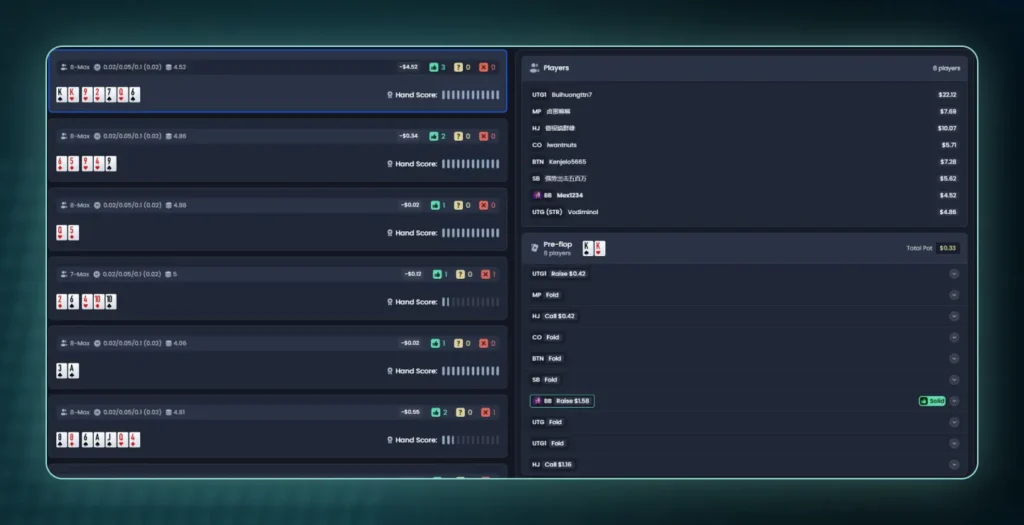
At the bottom of every hand is a Results panel. It is descriptive, not evaluative. It shows the chip outcome for every player, with your row highlighted.
Whether you played well lives in the Solid, Close, and Lacking ratings - not the result. Win a hand with a bad call, and that decision still rates as lacking. Lose one with a correct fold, and it still rates Solid. You can play a spot perfectly and still lose the pot. That is exactly why the ratings and the result are separated. It trains you to judge your decisions, not your luck.
Real WPT Global Blunders QuintAce Catches
Ratings and buckets are easier to trust when you see them applied to real hands. Here are three actual preflop spots from WPT Global cash games - the kind QuintAce grades as lacking, and the kind quietly draining stacks every day. It is always easier to spot a mistake when it is not your own, so learn these the easy way.
Try the interactive hand replayer below. It is a real 4-bet spot from WPT Global cash - step through it yourself, then read what the solver says. This is the exact kind of analysis that makes WPT Global one of the best places online to grind cash games right now.
1. Chasing dead money with the wrong bluff
Dead money in the pot tempts players to go for the lot. In this hand - the one in the replayer at the top of this page - a player 4-bet jams a suited king as a bluff. The problem: a 4-bet jam needs blockers or value, and a suited king brings neither. Step through it in the replayer, and you can see the mistake unfold street by street.
Keep your 4-bet bluffs to a handful of combos that do real removal work - a hand like A5s blocks AA and AK and still keeps straight and flush equity when called. A suited king blocks nothing that matters. Remember how tight the value range is here too: AK and QQ+.
2. Trying to stack aces with suited connectors
Low-suited connectors look fun. They do not survive a 4-bet, and they definitely do not survive a 5-bet. At this depth a 5-bet almost never bluffs, so the range is AK and QQ+ and your hand is in dreadful shape.
Low-suited connectors do not belong in a 5-bet pot and rarely in a 4-bet pot either. The 4-bet is the natural place to let them go. This is exactly the kind of decision Hand Review flags as lacking while showing you the fold sitting in the Highest EV bucket.
3. The one we cannot explain
The straddle seat invites loose play. It does not authorize random play. Here, a player shoved all in for no clear reason. Your opponents showing no aggression does not mean you get to jam. And if you are going to jam anyway, at least pick a hand that performs better when it gets called.
Every one of these mistakes shows up instantly in your own review as a red Lacking rating, with the solver's preferred line sitting right next to it. See the full breakdown in QuintAce's Big Blunders on WPT Global: Preflop Edition, then check your own preflop spots and fix the leaks before they cost you again.
The Technology Behind It
QuintAce runs on a deep reinforcement learning (DRL) solver - the same class of system behind engines like AlphaGo. DRL produces solver-quality answers in seconds against the exact spot you played, with no pre-computed abstractions and no waiting.
That speed is what lets Hand Review run on every meaningful decision without bottlenecking. It also lets coverage extend across the off-tree formats WPT Global runs, where traditional CFR solvers stop working.
Paired with the solver is Quint coach. The solver gives you the math. Quint gives you the why, in plain English, adapted to your level, with follow-up questions welcome on any hand.
What Is Coming Next
The current feature is only phase one. Rolling out over the coming months:
Leak Review - surfaces the patterns costing you the most across hundreds of hands, not one hand at a time.
Decision Analysis - Quint explains a decision in plain English, walking you through what happened and why one action beat another.
Practice This Spot (Drills): pulls hands tied to a specific leak, so you can drill it until your rating mix improves.
Coach voices - named coaching personalities and WPT Global ambassadors adding reasoning on top of the solver verdict on the hands that matter most.
Weekly hand breakdowns - drawn from real WPT Global sessions, plus format-specific lessons on the games WPT Global runs.
In other words, the tool you get free today is going to keep getting sharper. Get in now and grow with it.
Claim Your WPT Global Welcome Bonus
New players get a 100% First Deposit Bonus up to $3,580 with our SMPBONUS code at the online home of the World Poker Tour. Your first deposit is matched dollar for dollar, giving you more room to put QuintAce Hand Review to work across more sessions.
Here is the smart play. Deposit, claim the bonus, and use your early sessions to build a real sample in Hand Review. You get the extra bankroll and a solver grading every decision you make with it.
About the Editor

Since early 2025, I've covered iGaming promotions, online poker platforms, and player stories for SomuchPoker. I discovered poker at 14 during the poker boom, and I've played cash games, online tournaments, and live events ever since.
Related News
 NewsLive Poker
Scheduled Maintenance: Live and Player Profiles Temporarily Offline
Somuchpoker is moving to a new server. Live and Player Profiles will be offline for a few days. Here is what to expect and when we are back.
 NewsOnline PokeriGaming
Road to Triton Cyprus: Win a $25,000 Seat at Titi Poker
Join the Road to Triton Cyprus at Titi Poker. Start free on Oct 6, climb the satellite ladder and win one of 3 guaranteed $25,000 tickets.
 NewsOnline PokeriGamingPromotion
GGPoker and Natural8 $18M October Giveaway
Win your share of $18M in the GGPoker and Natural8 giveaway this October. Cash drops, Halloween Party, leaderboards - plus a welcome bonus.
 NewsOnline PokeriGaming
Andrii Novak Wins the GGPoker WSOP Online Main Event for $3.93M
Andrii Novak beats Simon Beckmann to win the 2026 GGPoker WSOP Online Main Event for $3.93M. Full final table results, payouts and stats.
 iGamingNews
PokerStars B2B Network Opens Its Doors: A Game-Changer for Online Poker
The PokerStars B2B network is officially open. Discover how this new white-label platform and shared liquidity will change the online poker industry.
 NewsOnline PokerLive PokeriGaming
QQPK Freeroll: Win a Poker Dream Malaysia Seat + $800
Win a MYR 3,200 Poker Dream Malaysia Main Event seat + $800 in the free Somuchpoker freeroll on QQPK. Sept 27 - sign up with code SMPBONUS.