Noah Dummett Net Worth, Life & Shuffle.com Story

Affiliate Disclosure: To keep our content independent and free, Somuchpoker is supported by its readers. When you register at an online poker or online casino site through our links, we may earn a commission from the operator at no extra cost to you.

Noah Dummett net worth is the question most people land on this page to ask, but the real story behind it is more interesting than any single number.
He built Shuffle.com from a standing start into a platform processing around $2 billion in monthly wagers in under two years, without a gambling background, with a skeleton seed round, and in the direct shadow of FTX’s collapse.
If you play at Shuffle Casino or you’re just curious who’s behind one of the fastest-growing crypto casinos on the internet, this is the full story.


Who Is Noah Dummett? The Man Behind Shuffle Casino
Noah Dummett is the co-founder and CEO of Shuffle.com, a crypto casino and sportsbook. He grew up in Australia, taught himself to code at 14 to escape what he’s described as farm life, and left high school at 17 to work in tech. He later completed a Bachelor of Commerce in Finance at Curtin University.
Today he runs one of the most closely watched operations in the crypto gambling space. His stated goal is blunt: make Shuffle Casino the largest crypto casino in the world – doing in two or three years what it took Stake Casino seven.
| Detail | Info |
|---|---|
| Full name | Noah Dummett |
| Age | 25-26 (reported as 24 in mid-2024 industry coverage) |
| Nationality | Australian |
| Based in | Melbourne, Australia |
| Education | Bachelor of Commerce (Finance), Curtin University |
| Known for | Co-founder and CEO of Shuffle Casino |
| Estimated net worth | $100M-$300M (estimate based on Shuffle equity stake, no verified figure) |
| Other ventures | Kingside (co-founder), Munyon Canyon Limited (Shuffle.us operator) |
| Industry | Crypto gambling, crypto exchange operations |
| Social media | @noahdummett on X (17K+ followers) |
Early Life – From Farm to Code
Dummett grew up in a small Australian country town of around 4,000 people. By his own account, life there felt slow, and most of his peers were heading into farming.
Learning to code at 14 was his way out. He funded his first crypto purchases around 2013 with money scraped together from a job at a local fish-and-chip shop – an early sign of where his instincts were pointing. That self-taught technical foundation became the thread that ran through his entire career.
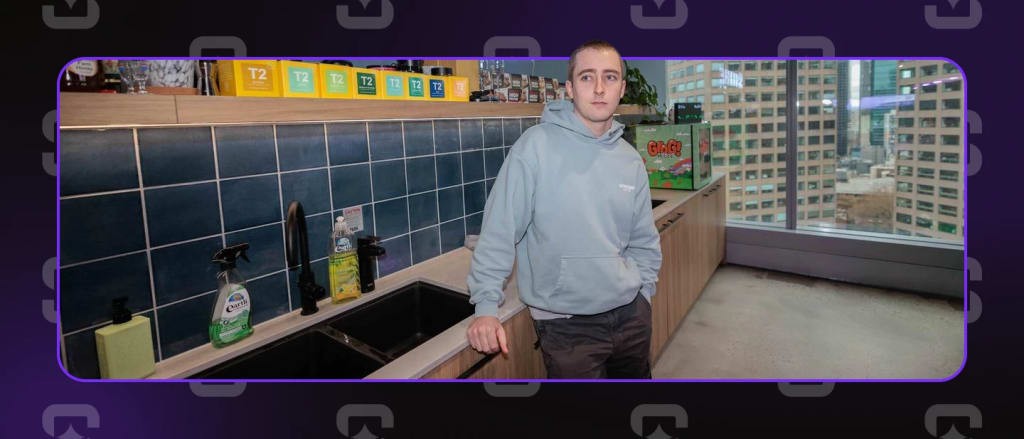
Industry coverage from mid-2024 listed Dummett’s age as 24 at the time, putting him at 25 or 26 today, depending on his birthday. He started his career in crypto in his late teens, which means by the time he was running operations at Alameda Research, he was still in his early twenties. The career-to-age ratio is unusual and worth flagging.
At 17, he left school and joined Intercom, the Irish-American tech company known for its customer messaging software. He later reflected on Intercom as a “fantastic team, company and culture” and credited it with being an ideal introduction to the tech world. He was still at Intercom when the company raised a $125M Series D round – a moment he described at the time as “crazy stuff” and a signal of what was building behind the scenes.
He left Intercom around 2017-2018 to pursue bigger opportunities in a fast-moving space he had been watching closely: crypto.
Career Timeline – Crypto Exchange Years
Dummett’s route through the crypto industry before Shuffle Casino covered some of the most significant names of that era – for better and worse.
BitMEX (2018-2019)
His first crypto role was in client support at BitMEX, the derivatives exchange that was one of the world’s largest at the time. It gave him ground-level exposure to how high-volume crypto trading platforms operated at scale.
Alameda Research and FTX (2019-2021)
He moved into a trading role at Alameda Research – Sam Bankman-Fried’s quantitative trading firm – and simultaneously held an OTC and operations position at FTX. These were two of the most powerful organizations in crypto at the peak of their influence.
Dummett has since described what that environment was actually like. Alameda and FTX ran out of the same room in Hong Kong – a tight group of around 20 people, working 16-hour days, seven days a week, living in apartments minutes from the office. He has called it electric, mission-driven, and a fast track to burnout. There were also, by his account, almost no operational guardrails. In his first couple of weeks handling OTC settlements, he accidentally sent $10 million to the wrong person. He managed to recover it – but noted that nothing in the system would have caught the error if he hadn’t flagged it himself.
That experience left a mark. The lack of process and oversight he saw inside the FTX ecosystem is something he has pointed to directly when explaining how he chose to build Shuffle Casino differently.
When FTX collapsed in November 2022, Dummett had already left – he departed in 2021, and by the time of the collapse, he was only two months away from launching Shuffle. He has said it took him about ten seconds to understand exactly what had gone wrong, pointing to the same missing processes and unwritten lines of credit he had seen firsthand. The FTX fallout killed many projects connected to that ecosystem. Shuffle was not one of them.
Leaving to Build
In 2021, Dummett stepped away from the exchange world. COVID border restrictions in Australia had made remote trading at Alameda impractical, and he turned his attention to a new idea. In March 2021, he published a detailed proposal on Medium for Sol Vegas: a fully decentralized, on-chain poker casino built on the Solana network. It laid out why a decentralized casino made sense, why Solana was the right infrastructure, and how a native token (CHIPS) would drive long-term value.
Then he did something more telling than writing the proposal – he killed it. After working through the concept, Dummett concluded that a fully decentralized poker platform simply could not work in practice.
Two problems were fatal. First, the ecosystem problem: online poker depends on casual players, and without KYC or central oversight, collusion and multi-tabling become trivial, which drives those casual players away fast. Second, the experience problem: blockchain was just too slow. Gamblers want to bet, get paid instantly, and bet again – and even on Solana, transaction failures and delays broke that flow. His blunt summary was that the on-chain experience is nowhere near a centralized service, and he wasn’t sure it ever would be.
That is the part of the story worth paying attention to. Plenty of founders have ideas. Far fewer have the discipline to abandon a polished concept once the logic no longer holds. And the lessons from why Sol Vegas failed – the need for KYC, central management, and instant payouts – are exactly the principles he built Shuffle on. The failed idea wasn’t wasted. It was the blueprint, in reverse.
Founding Shuffle.com
Shuffle Casino launched on 1 February 2023. Dummett co-founded it alongside Darcy Spangler, who led on product, and Harley Fresh, who brought a ready-built engineering team through Fisher8. The timing was not comfortable – FTX had just imploded, and crypto confidence was at a low point. Even so, Dummett raised approximately $1.1 million and launched anyway.
The company is registered in Willemstad, Curaçao, and operates under a Curaçao gaming license (Natural Nine B.V. – OGL/2024/1337/0628). Shuffle was incubated by Fisher8 Capital – a crypto-native proprietary trading and venture group whose team members had previously held roles at Alameda Research, BitMEX, Three Arrows Capital, and other major web3 firms.
That background is not incidental. It shaped the platform’s approach to tokenomics, trading infrastructure, and financial transparency from day one. Total external funding eventually reached $2.5 million, raised in a seed round in early 2024 from investors including Sunforge, Cipher Capital, and Parc Capital.
Play at Shuffle Casino – 200% up to $3,000 with Code SMPBONUS
If you want the full breakdown of that welcome offer – wagering terms, the maths, and how to claim it – see our Shuffle promo code page.
US players can’t access the crypto site, but there’s a separate sweepstakes version covered in our Shuffle US review, and the Shuffle US promo code page.


Play Shuffle US Casino with free Cash & 25,000 GC for Free
Growth That Surprised the Industry
Three months after its launch, a senior figure in the gambling industry told Dummett on a call that Shuffle had less than a 2% chance of still operating in 6-12 months. Dummett has since referenced this publicly, pointing out that Shuffle was already profitable and growing at the time.
By mid-2024 – roughly 15 months after launch – Shuffle was processing over $1 billion in monthly wagers. By 2025-2026, that figure had grown to around $2 billion per month, with the platform handling approximately 300 bets per second at peak. In February 2026, Shuffle was reported to be processing approximately three times the monthly volume of rival Rollbit.
Those are not small-operator numbers. Third-party estimates cited in industry coverage put Shuffle’s annualized net gaming revenue – what the platform keeps once player rebates and cashback are paid out – at $100 million or more. For context, that revenue figure was achieved with total external investment of $2.5 million. We break down the platform itself – games, bonuses, payouts, and licensing – in our full Shuffle Casino review.
The SHFL Token and Community Strategy
In March 2024, Shuffle launched its native token: SHFL. Dummett has been direct about why. In his view, building a loyal gambling community is genuinely difficult because the user base churns. A token creates a second layer of connection – a community of people who are invested in the platform beyond any single session.
“It’s like you can build this separate user base that is rallying behind you,” he told NEXT.io‘s Pierre Lindh. The tokenomics were designed with real-world economic mechanics in mind. Each week, Shuffle puts 30% of its SHFL-based gaming revenue toward purchasing tokens on the open market and taking them out of circulation for good – a deflationary design that, by early 2026, had already retired roughly 5% of the total supply. Another 15% of weekly net gaming revenue feeds the SHFL Lottery prize pool.
The lottery runs Powerball-style – five numbers from 1-55 plus a Powerball – with a provably fair draw on the Bitcoin blockchain every Friday at 07:00 UTC. Grand prize pools have surpassed $1.89 million, with a single $0.25 ticket famously hitting a $2.88 million jackpot.
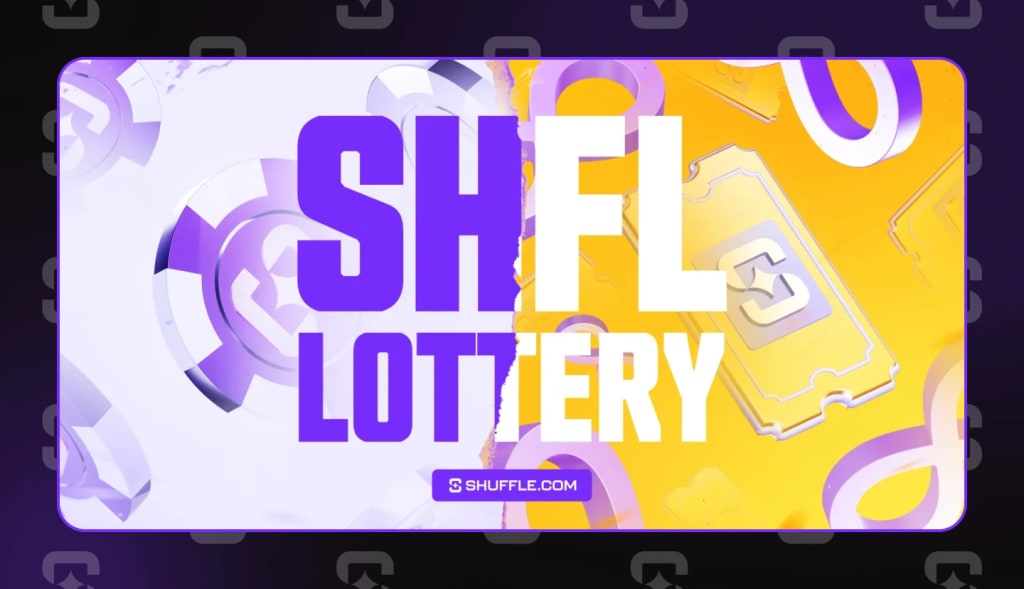
The first SHFL airdrop in March 2024 was a defining moment – Shuffle distributed roughly $50 million worth of tokens to early players, and the platform tripled in operational scale almost overnight as a result. A second, larger airdrop followed, and in March 2026 Shuffle rolled out its third official airdrop, keeping long-term holders engaged and the wider crypto community paying attention.
Looking further ahead, Shuffle has announced plans to launch a fully on-chain casino where 100% of net revenue would be directed to back the SHFL token ecosystem – a significant step up from the current model. That announcement has generated substantial interest among token holders. It has not launched yet, but it signals the direction Dummett is pushing the platform.
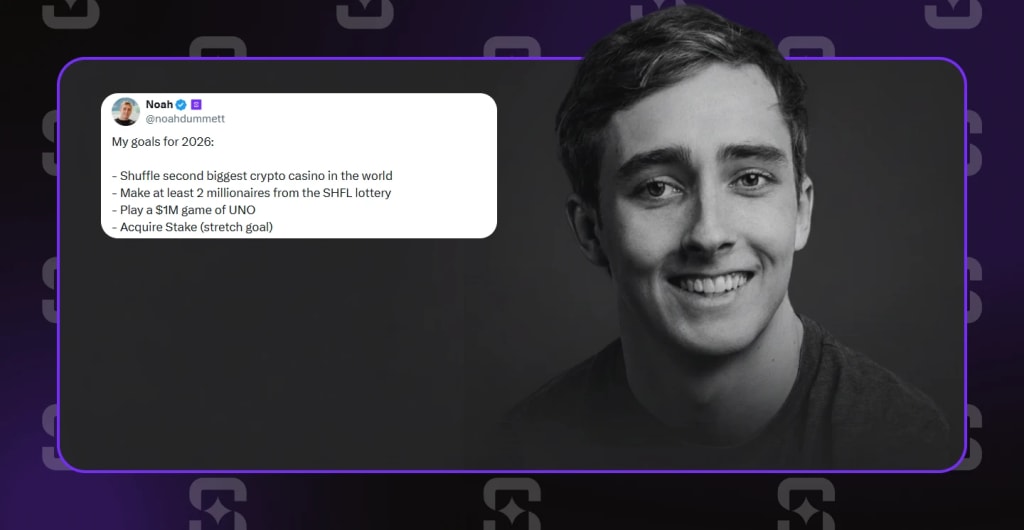
His goals for 2026, published publicly on X, include making at least two people millionaires through the SHFL lottery, as well as the broader aim of making Shuffle the second-largest crypto casino in the world.
How Dummett Thinks About Competition
Dummett has been unusually open about how he studies competitors, particularly Stake.com. His analysis is worth paying attention to.
He concluded that Stake Casino‘s success breaks down roughly as 20% product, 80% marketing and distribution. He acknowledged Stake’s product quality directly, describing it as “nearly flawless,” with a smooth user experience, the ability to handle large bets, strong trust, and a transparent, public-facing team led by co-founder Ed Craven .
Rather than dismissing the competition, he used that analysis to shape Shuffle’s own approach: lead with community, lead with transparency, and compete hard on distribution. “We’re not gamblers, so we have a new approach to things,” he told Pierre Lindh.
He has also noted that Stake is at an interesting inflection point – transitioning from a medium-sized operator into a large corporation. His view, informed by his time at BitMEX and FTX, is that this transition is harder than it looks and creates genuine opportunity for challengers.
October 2025 – The Data Breach and How Shuffle Handled It
In October 2025, Shuffle faced its most significant public challenge. On 10 October 2025, Shuffle confirmed a data breach affecting the majority of its users. The incident did not originate from Shuffle’s own systems – it came through Fast Track, a third-party iGaming CRM provider that Shuffle used for automated email communications and customer data management.
What got exposed was substantial: customer names, contact details (email, phone, home address), and full transaction and betting histories. Worse, the attackers also reached KYC verification files – the passport and driver’s license scans users had uploaded to confirm their identity. Dummett disclosed the incident publicly on X and through direct messages to affected users. Crucially, account passwords, login credentials, and player funds were not compromised because they were never stored with Fast Track.
Fast Track confirmed that the breach had been contained and posed no ongoing risk. Shuffle advised users to enable two-factor authentication and stay alert to phishing attempts.
How a platform handles a crisis matters as much as whether the crisis happened. Dummett disclosed it promptly, communicated clearly, and provided users with the information they needed to protect themselves. That response won’t erase the incident from the record, but it compares well with the industry norm of delayed or minimized disclosures.
The Wider Corporate Footprint – Kingside and Munyon Canyon
Alongside Shuffle, Dummett co-founded Kingside – a separate Melbourne-based company. Kingside is a data and business intelligence operation. His LinkedIn activity for Kingside has included hiring data analysts with SQL and Python skills, and BI roles using tools like Metabase and Posthog. The two businesses appear to be complementary – Kingside providing the data infrastructure and analytical capability that sits behind operational decisions at scale.
The US expansion is a separate story. Shuffle’s American product, Shuffle.us, runs on the sweepstakes model rather than the crypto model – because real-money online crypto casinos can’t legally operate in most US states. To handle that market, a distinct legal entity was set up: Munyon Canyon Limited, registered in the British Virgin Islands at Trinity Chambers, Road Town, Tortola. Shuffle.us launched in September 2025 under that entity, operating with Gold Coins and Shuffle Cash rather than crypto.
That structure matters. Plenty of crypto operators try to push their offshore product into the US market and get shut down for it. Dummett’s team built a separate, properly registered company specifically for the sweepstakes framework – the kind of structural discipline that suggests this isn’t a founder cutting compliance corners. Our Shuffle US review covers that product in detail.
Noah Dummett Net Worth – What We Actually Know
There is no verified net worth figure for Noah Dummett in the public domain. He has never disclosed his personal wealth, and Shuffle is a private company. But the public numbers around the business let you build a defensible estimate – so here is the working.
Shuffle processes roughly $2 billion in wagers per month. Third-party industry estimates put annualized net gaming revenue – what the platform keeps once player rebates and cashback are paid out – at $100 million or more. Crypto gambling companies have historically traded at three to eight times annual revenue in private market transactions, putting Shuffle’s plausible enterprise value somewhere in the $300 million to $800 million range. Dummett is one of three co-founders and serves as CEO, so a meaningful equity stake is a reasonable assumption even after dilution from the $2.5 million seed round.
Based on those inputs, his stake’s paper value plausibly falls within the $100 million to $300 million range. That is an estimate, not a verified figure. Private company valuations swing on factors we can’t see, and paper value is not liquid wealth until equity is sold or the business is acquired.
Then there’s his pinned tweet from January 2026. His publicly stated goals for the year include making Shuffle the second biggest crypto casino in the world- and, as a stretch goal, acquiring Stake. Stake has been valued by industry observers at somewhere between $1 billion and $4 billion, though no official figure has ever been confirmed.
He labeled it a stretch goal, and he posted it alongside a plan to play a $1 million game of UNO – so the tone is partly serious, partly for the crowd. But you don’t pin a tweet about acquiring a billion-dollar competitor if the idea is completely detached from reality. It tells you how he sees his own position in this industry.
If a verified figure surfaces from a credible source – a regulatory filing, an acquisition, a public valuation – we’ll update this page.
Public Presence and Community Style
Dummett takes an active public role in a way that’s become standard among the leading generation of crypto casino founders. He uses X (formerly Twitter) to post Shuffle updates, run community giveaways, share industry opinions, and occasionally troll competitors in good humor. He has 17,000+ followers on the platform.
His approach mirrors what made Stake’s co-founders effective early on – being genuinely accessible, identifiable, and responsive rather than hiding behind a corporate front. He appears on podcasts, addresses community concerns directly, and communicates major platform updates himself rather than delegating to a PR team.
This visibility is a deliberate strategic choice, not just a personality trait. He has said as much – understanding that trust in a crypto casino is partly built on knowing exactly who is responsible for it.
Is Noah Dummett the Real Deal?
Dummett is one of the more credible founders in this space. His career arc – self-taught coder, Intercom, BitMEX, Alameda, FTX, then out the door before the collapse to build his own thing – reads as someone who has always been moving towards building, not just trading or supporting other people’s businesses.
The Sol Vegas story from 2021 is probably the most telling. Not because of the idea itself, but because he had the judgment to walk away from it once he saw it couldn’t work – and then used those exact lessons to build something that could. That is a different kind of founder from the one who just chases the trend.
Shuffle’s growth numbers are hard to dismiss. Going from zero to $2 billion in monthly wagers in two years, on $2.5 million in outside funding, is not a common story. Whether Shuffle goes on to challenge Stake’s dominance is an open question – but Dummett has earned the right to make that case.
His willingness to be publicly wrong, publicly accountable, and to name his ambitions clearly makes him a more interesting figure than most in this space. We’ll keep updating this profile as the story develops.
Try Shuffle Casino for Yourself – Code SMPBONUS
Responsible Gambling
Gambling should be entertainment, not a financial strategy. Set a budget before you play and stick to it. If gambling stops being fun, step away. Free support is available via BeGambleAware.org and GamblingTherapy.org. Must be 18+ to gamble.
Somuchpoker.com is an independent affiliate site. We earn a commission if you sign up via our links. This does not affect our editorial opinions or the accuracy of our content.
Since early 2025, I've covered iGaming promotions, online poker platforms, and player stories for SoMuchPoker. I discovered poker at 14 during the poker boom, and I've played cash games, online tournaments, and live events ever since.

Ed Craven Net Worth and Life 2026: Stake Casino Founder
Ed Craven net worth sits around $2.2B USD per Forbes. Here's how the founders of Stake Casino and Kick built Australia's biggest crypto gambling empire.

Shuffle.us 10,000,000 GC Daily Race
Play the Shuffle.us Daily Race and share 10,000,000 GC across the top 100 players. Free entry, code SMPBONUS unlocks 1 SC + 25,000 GC. Full breakdown inside.

New Slide Game on Shuffle.us – Win From 5,000 SC
Slide just launched on Shuffle.us with a 1,000,000x max multiplier. Top 50 players split 5,000 SC. Get in early before the leaderboard fills - play now.

Vegas Matt Net Worth 2026 – His Life & Real Income Breakdown
Vegas Matt net worth is widely reported at $40M, but he says that's inflated. See how the YouTube gambler really makes his money in 2026, in his own words.

Shuffle.us Feel the Rush: Win a Share of 10,000 SC
Shuffle.us's Feel the Rush promo has 10,000 SC up for grabs. Hit all 8 Endorphina multiplier targets and claim your share. Ends May 28, 2026.