

The Great Poker Debate – "Don't Touch My Chips!"

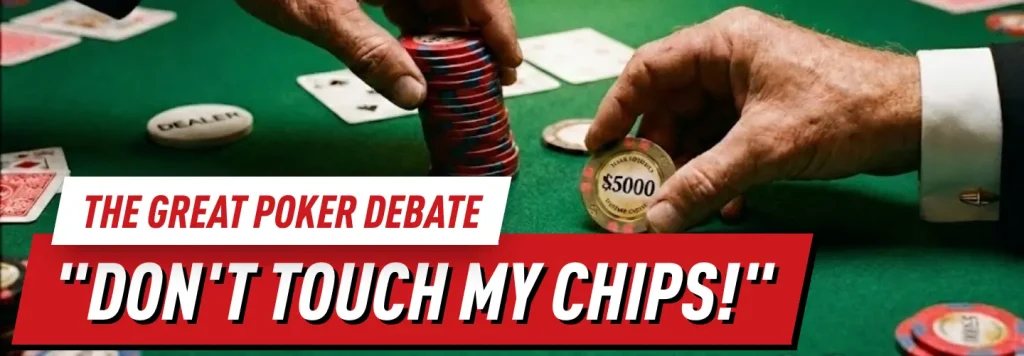
It is a phrase heard in poker rooms across the world: "Don't touch my chips!"
For many players, the physical stack in front of them feels like personal property. They paid the buy-in, they won the pots, and they want to build a castle. So, when a Poker Tournament Director walks over and starts removing lower-denomination chips outside of a scheduled break, it can feel like a violation.
However, veteran Tournament Director Justin Hammer recently weighed in on this controversial topic. His message? There is a method to the madness, and it is all about keeping the game running smoothly.
What Are Discretionary Color Ups?
Most tournament players are familiar with the standard chip race-off. This happens at scheduled intervals when small denomination chips are no longer needed due to blind increases. Everyone expects it.
Discretionary color ups are different. These occur when a tournament director notices a specific table or player has way too many small chips, making the stack hard to count or manage. According to the TDA (Tournament Directors Association), if a TD cannot quickly estimate a stack size, neither can the opponents. This slows down the game.
Hammer points out a fundamental misunderstanding among players:
Cash Games: You purchase the physical chips. They are yours.
Tournaments: You purchase the right to a specific value of chips. The physical tokens are just tools for the house to manage the event.
The Need for Speed and Accuracy
Why do TDs insist on these unscheduled interventions? It usually boils down to three main factors:
Pace of Play: If players have to count out twenty small chips for every bet, the game crawls to a halt.
Inventory Management: The house needs to keep track of the total chips in play.
Countability: Opponents need to be able to look across the table and estimate how much a player has. Giant mountains of low-value chips make this impossible.
Hammer argues that while these color-ups do not happen at set times, they are "very necessary" and well within standard poker rules.
Finding the Right Balance
While defending the practice, Hammer admits that some tournament staff can go too far. The goal is not to leave a player with just five chips, making them feel "short-stacked" even if they have plenty of big blinds.
He compares it to the start of a tournament. Usually, players begin with 20 to 30 physical chips. Rarely does anyone complain about not having enough chips to maneuver at the start. The problems arise later when players accumulate massive piles (300, 400, or 500 chips) and feel attached to the visual bulk of their stack.
Hammer suggests a middle ground. TDs should aim to keep stacks in that "sweet spot" - enough chips to riffle and stack, but not so many that they slow down the action.
Justin Hammer’s Promise to Players
At the end of the day, poker is about the player experience. Hammer emphasizes that he wants players to have fun and enjoy their time at the tables. He promises to listen to player feedback and ensure that discretionary color ups are done fairly.
"I’m willing to take fewer chips so that players can have more to play with"
- Hammer says, provided it stays within reason.
Key Takeaways for Tournament Players
Next time a TD comes to color up your stack, remember these points:
It’s Not Personal: They aren't trying to shrink your stack; they are trying to speed up the game.
Check the Rules: TDA rules explicitly allow TDs to manage chip quantities for countability.
Ownership: In a tournament, you own the value, not the physical plastic.
Efficiency: Fewer chips mean faster betting and more hands per hour.
Feedback Matters: Good TDs like Hammer are open to finding a balance that keeps the game fun.
So, while "don't touch my chips" is a natural reaction, understanding the logic behind the color-up might just make the situation a little less painful!
via poker.org
About the Editor

Beus Zsoldos is Somuchpoker's Senior Copywriter and Player Stories Editor, covering WSOP color moments, player profiles and poker personalities for the site's Stories section. She has spent more than 20 years around the game, first as a player, then as a live tournament director and localization manager for a major online poker room, before moving into full time poker writing.
Related News
 NewsLive Poker
Scheduled Maintenance: Live and Player Profiles Temporarily Offline
Somuchpoker is moving to a new server. Live and Player Profiles will be offline for a few days. Here is what to expect and when we are back.
 NewsOnline PokeriGaming
Road to Triton Cyprus: Win a $25,000 Seat at Titi Poker
Join the Road to Triton Cyprus at Titi Poker. Start free on Oct 6, climb the satellite ladder and win one of 3 guaranteed $25,000 tickets.
 NewsOnline PokeriGamingPromotion
GGPoker and Natural8 $18M October Giveaway
Win your share of $18M in the GGPoker and Natural8 giveaway this October. Cash drops, Halloween Party, leaderboards - plus a welcome bonus.
 NewsOnline PokeriGaming
Andrii Novak Wins the GGPoker WSOP Online Main Event for $3.93M
Andrii Novak beats Simon Beckmann to win the 2026 GGPoker WSOP Online Main Event for $3.93M. Full final table results, payouts and stats.
 iGamingNews
PokerStars B2B Network Opens Its Doors: A Game-Changer for Online Poker
The PokerStars B2B network is officially open. Discover how this new white-label platform and shared liquidity will change the online poker industry.
 NewsOnline PokerLive PokeriGaming
QQPK Freeroll: Win a Poker Dream Malaysia Seat + $800
Win a MYR 3,200 Poker Dream Malaysia Main Event seat + $800 in the free Somuchpoker freeroll on QQPK. Sept 27 - sign up with code SMPBONUS.